
Quick answer
The best temples to visit on Sri Lanka's south coast are Seenigama's island temple and Devol Devale near Hikkaduwa, Yatagala rock temple near Unawatuna, Kataluwa's colonial-era murals near Koggala, Weherahena's painted tunnel at Matara, the Devinuwara shrines at Dondra Head, Wewurukannala's giant seated Buddha at Dikwella, Mulkirigala's cave temples north of Tangalle, and Kirinda's temple on the rocks. Most take 30 minutes to two hours, are free or by donation, and require covered shoulders and knees.
Key takeaways
- Mulkirigala, north of Tangalle, is the finest temple climb on the south coast, with cave shrines on five terraces.
- Wewurukannala at Dikwella has a seated Buddha of around 50 metres, completed in the late 1960s.
- Weherahena at Matara has an underground gallery of hundreds of painted Jataka panels.
- Devinuwara at Dondra Head is one of the oldest Vishnu shrines in Sri Lanka, with its own Esala festival.
- Most south coast temples are free or by donation, with modest dress and shoes off at the shrine.
Why visit temples on the south coast
The temples of Sri Lanka's south coast show a side of the region that the beaches never reveal. They are working places of worship, visited daily by local families, monks and pilgrims, and many have histories reaching back more than a thousand years.
South coast temples are also varied. In a single day you can see a monastery among granite boulders, a cave shrine with eighteenth-century murals, a modern giant Buddha and a shrine where people grind chilli to seek justice. Few other parts of the island pack so much variety into such a short distance.
Temples from Hikkaduwa to Weligama
At the western end of the coast, Seenigama near Hikkaduwa has a temple on an islet just offshore and the Devol Devale, a shrine to the god Devol, where people grind chilli and pepper on a stone while naming a wrongdoer. Kumarakanda temple at Dodanduwa sits on a hill above the coast road.
Near Galle, Yatagala Raja Maha Viharaya is a monastery among boulders with a reclining Buddha and murals, a few kilometres inland from Unawatuna. Kataluwa, near Koggala, has nineteenth-century murals mixing Jataka stories with figures in European dress, and Kushtaraja Gala at Weligama is an ancient rock-cut figure.
- →Seenigama: island temple and the cursing shrine.
- →Yatagala: boulders, reclining Buddha and murals.
- →Kataluwa: colonial-era murals.
- →Kushtaraja Gala: a rock-cut Bodhisattva figure.
Temples around Matara and Dondra
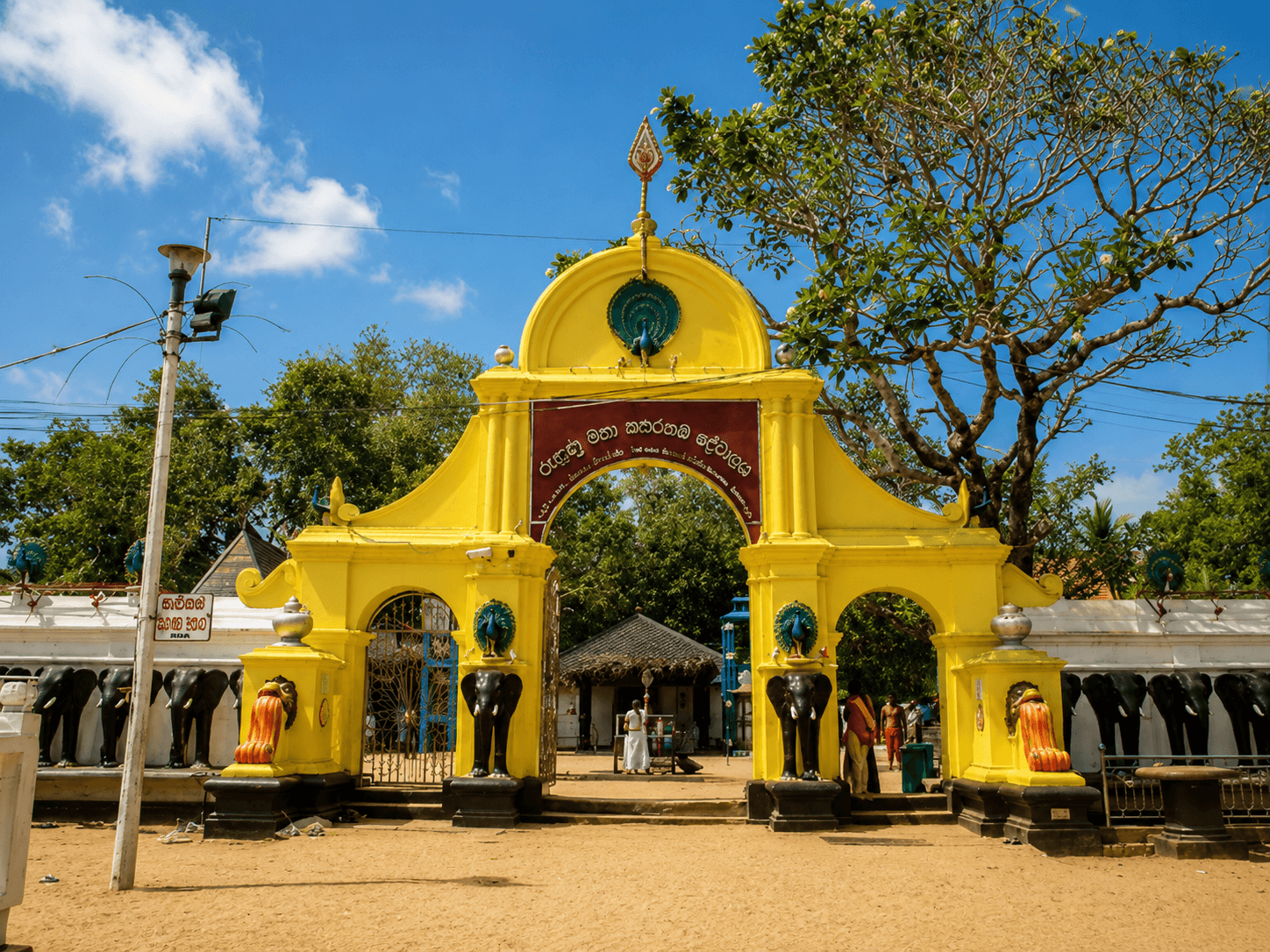
Matara has two of the coast's most interesting temples. Weherahena, a few kilometres east of town, has an underground gallery lined with hundreds of painted panels of Jataka stories and a giant seated Buddha above. Paravi Duwa is a small temple on an island off Matara's beach, reached by a footbridge.
At Dondra Head, the Devinuwara shrines include one of the oldest Vishnu temples in Sri Lanka, with a large annual Esala festival. The area was once home to a great temple destroyed by the Portuguese in the late sixteenth century, and fragments of its stonework survive.
- →Weherahena: the painted tunnel and the giant Buddha.
- →Paravi Duwa: an island temple by footbridge.
- →Devinuwara: an ancient Vishnu shrine at the southern tip.
Temples from Dikwella to Kirinda
At Dikwella, Wewurukannala Vihara has a seated Buddha of around 50 metres, stairs to its head and a hall of vivid hell scenes. North of Tangalle, Mulkirigala is a monastery on a rock rising about 200 metres from the plain, with cave shrines, reclining Buddhas and murals on five terraces.
At the eastern end of the coast, Tissamaharama's great stupa dates back more than 2,000 years, and Kirinda's temple sits on boulders above the sea. Kataragama, inland, is a sacred city shared by Buddhists, Hindus and Muslims, best visited at the evening puja.
- →Wewurukannala: the giant Buddha and hell hall.
- →Mulkirigala: cave temples on a great rock.
- →Tissamaharama and Kirinda: ancient stupas and sea views.
Temple etiquette on the coast
The same rules apply at every temple on Sri Lanka's south coast. Cover shoulders and knees, remove shoes and hats before entering the shrine area, and keep voices low. Never pose for photographs with your back to a Buddha image, and do not touch statues or murals.
Most temples are free or by donation, and a small donation is appreciated when a monk or caretaker opens a shrine for you. Poya days, the monthly full moon holidays, are busier with worshippers dressed in white.
- →Carry a sarong or scarf in the car for temple stops.
- →Wear slip-on shoes, as shoes come off often.
- →Visit early or late, when stone floors are cooler.
Planning a temple day
A temple day on the south coast works best focused on one area. From Galle, Yatagala and Kataluwa fit into a morning. From Mirissa, Weherahena, Devinuwara and Wewurukannala make a full day. From Tangalle, Mulkirigala at dawn and Wewurukannala in the afternoon is a classic pairing.
Lankan Stays & Trails arranges temple days with guides who can explain the murals and rituals, which adds a great deal to the experience. Without a guide, ask monks or caretakers, who are often happy to share the stories.
Frequently asked questions
What are the best temples on Sri Lanka's south coast?
Highlights include Mulkirigala rock temple, Wewurukannala's giant Buddha, Weherahena's painted tunnel, Yatagala near Unawatuna, Kataluwa's murals, Seenigama's island temple and the Devinuwara shrines at Dondra Head. Tissamaharama and Kirinda add ancient stupas at the eastern end.
What should I wear to temples in southern Sri Lanka?
Cover shoulders and knees, and remove shoes and hats before entering the shrine area. Light, loose clothing in pale colours is comfortable and respectful. Carry a sarong or scarf if you are coming from the beach.
Do you have to pay to enter temples on the south coast?
Most are free or by donation. A few larger sites, such as Mulkirigala, Wewurukannala and Weherahena, charge foreign visitors a small fee of a few US dollars. Fees change, so confirm locally.
Which south coast temple is best for murals?
Mulkirigala and Kataluwa have the finest traditional murals, with eighteenth and nineteenth-century paintings of Jataka stories. Weherahena has a modern, colourful gallery in a popular style. Yatagala and Wewurukannala's older shrine also have murals worth seeing.
Can you visit temples on poya days?
Yes. Temples are busiest on poya days, the monthly full moon holidays, with worshippers dressed in white bringing flowers and lighting lamps. Visitors are welcome, but should be especially respectful and quiet. Alcohol is not sold on poya days.
Is there a temple near Mirissa?
Yes. Weherahena at Matara is about 15 minutes from Mirissa, and Kushtaraja Gala at Weligama about 10 minutes. Wewurukannala at Dikwella is around 35 minutes away. Each makes an easy half-day outing from a Mirissa base.
Which south coast temple is best for children?
Weherahena and Wewurukannala usually impress children with their giant Buddhas and colourful paintings, though both have graphic hell scenes. Yatagala's monkeys and boulders are fun, and Seenigama's boat ride to the island temple is a hit in calm seas.