
Quick answer
The best things to do in Kandy on a second visit lie beyond the standard circuit. See the eighteenth-century murals at Degaldoruwa Cave Temple, walk the courtyards of Malwatta and Asgiriya monasteries, attend the dawn puja in place of the evening one, and visit the weaving and brass villages of the Dumbara valley and Pilimathalawa. Further out are Loolecondera, the first tea estate, the Victoria reservoir and the Knuckles Range. Stay in the countryside this time, not the city, and allow two or three nights.
Key takeaways
- Degaldoruwa Cave Temple, about seven kilometres from Kandy, holds the best-preserved Kandyan murals in the country.
- The Dumbara valley, east of Kandy, has been known for patterned weaving since the time of the Kandyan kings.
- Loolecondera estate, where Ceylon tea began in 1867, lies about an hour and a half south-east of Kandy.
- The Knuckles Range, about an hour and a half from Kandy, is part of the Central Highlands World Heritage Site listed in 2010.
- The dawn puja at the Temple of the Sacred Tooth Relic sees a fraction of the evening's visitors.
A different approach the second time
A second visit to Kandy works best with a different base and a different rhythm. Stay out of the city, in the hills towards Hantana, Digana or Hunnasgiriya, and treat the centre as one outing among several.
The second visit to Kandy is also the time to hire a specialist. A guide who knows Kandyan art, a naturalist for the forest or a trekking guide for the Knuckles opens places that a general driver would pass.
Painted temples and craftsmen
Degaldoruwa Cave Temple is the first stop for returning visitors to Kandy. Its walls carry Jataka stories painted in the 1770s and 1780s, with courtiers, elephants and a musket-bearing demon drawn from the life of the kingdom. The monk who unlocks the shrine will often explain the panels.
Other painted temples near Kandy repay the effort. Suriyagoda and Hindagala, both within half an hour, have murals of different periods. The three temples of Embekke, Lankatilaka and Gadaladeniya are worth revisiting on foot, taking the paths across the rice fields.
- →Degaldoruwa: Kandyan murals, seven kilometres north-east.
- →Hindagala: a rock temple near Peradeniya with fragments of much older painting.
- →Embekke to Lankatilaka on foot: three kilometres through paddy.
- →Pilimathalawa: brass founders' workshops beside the road.
Living traditions
Living traditions around Kandy are easier to see on a second visit, when there is time to sit and watch. In the Dumbara valley, a few families still weave hana-fibre mats with geometric patterns on simple looms. Visits are informal and best arranged through someone who knows the weavers.
The monasteries of Malwatta and Asgiriya show the institutional side of Kandyan Buddhism. Walk their courtyards, see the chapter houses, and at Asgiriya ask for the royal cremation ground. A drumming or dance school, where boys train for the Perahera, makes a memorable hour if a visit can be arranged.
Landscapes beyond the city
Landscapes beyond Kandy are the real discovery of a second visit. Loolecondera estate, reached by winding roads through Galaha and Deltota, preserves James Taylor's original tea field and the stone seat from which he surveyed it. Few visitors come.
The Victoria reservoir and the Knuckles Range lie to the east and north-east of Kandy. The first offers lake views, the tallest dam in the country and quiet roads. The second offers cloud forest, village trails and some of the best hill walking in Sri Lanka.
- →Loolecondera: tea history and views, half a day.
- →Victoria reservoir: scenery and engineering, half a day.
- →Knuckles Range: guided trekking, full day or overnight.
- →Hunnas Falls and Sembuwatta Lake: cool hills an hour north.
The temple again, differently
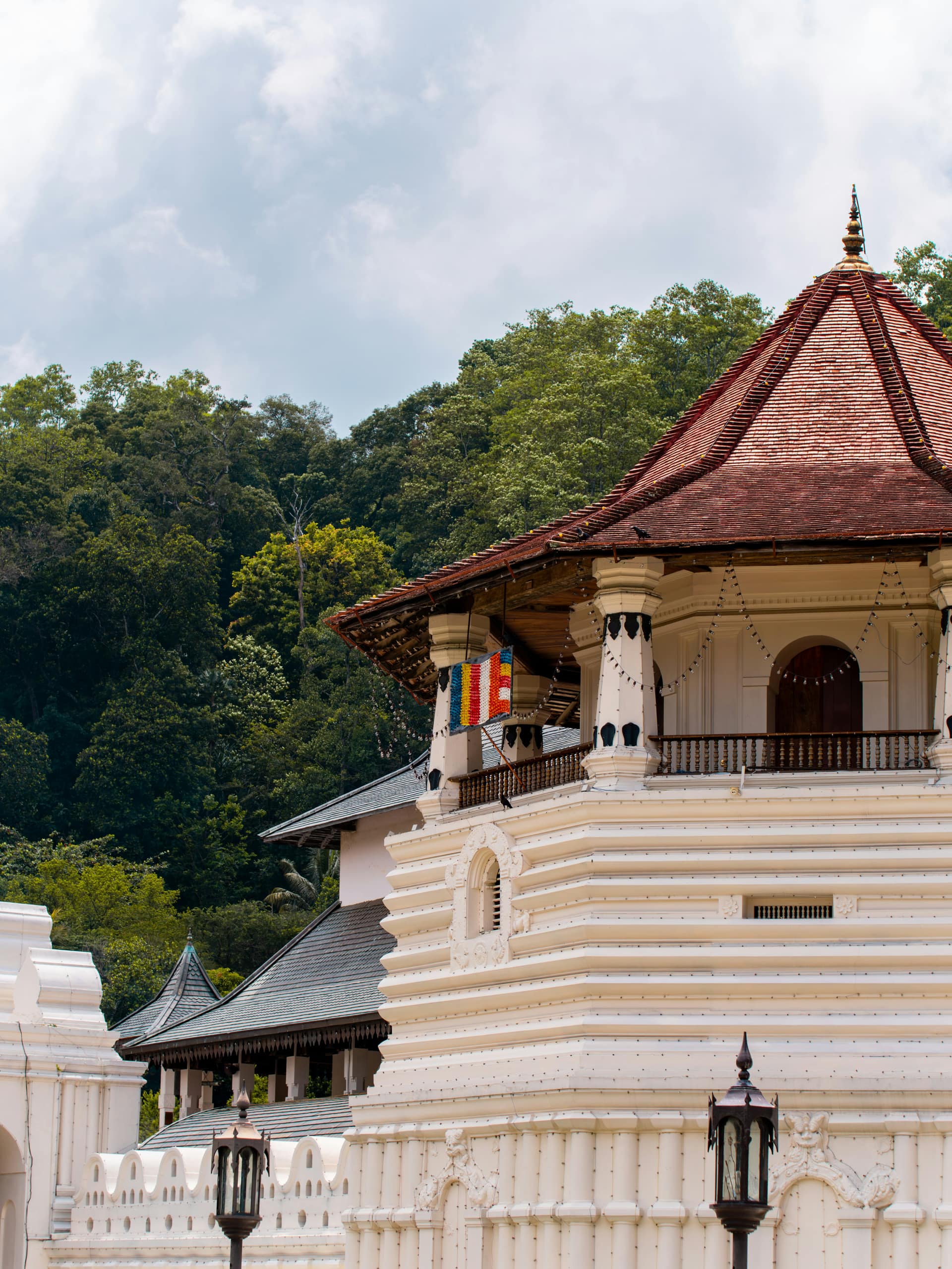
The Temple of the Sacred Tooth Relic deserves a return, done differently. Go to the dawn puja at 5.30, when the halls are half empty and the worshippers are local. Spend time in the Audience Hall and the International Buddhist Museum that you hurried past before.
Timing a second visit to Kandy around the calendar adds another dimension. A poya day shows the temple as a pilgrimage site. The Esala Perahera in July or August is the obvious prize, and the smaller peraheras held at the devales in other months are almost unknown to visitors.
A three-night plan for returning visitors
A three-night plan for a second visit to Kandy keeps the city to one morning. Lankan Stays & Trails builds these stays around a countryside hotel, with a different direction each day and no two days alike.
The plan below assumes arrival by mid-afternoon on the first day. Swap the Knuckles day for Loolecondera and Victoria if you prefer driving to walking.
- →Arrival afternoon: settle in; sunset from the hotel terrace.
- →Day one: dawn puja, monasteries, Degaldoruwa and the Dumbara valley.
- →Day two: full day in the Knuckles Range with a guide.
- →Day three: Embekke to Lankatilaka on foot, then onward.
Frequently asked questions
What is there to do in Kandy besides the Temple of the Tooth?
Besides the Temple of the Sacred Tooth Relic, Kandy offers the botanic gardens, the lake, Udawattakele forest, the four devales, two historic cemeteries, the monasteries of Malwatta and Asgiriya, painted cave temples such as Degaldoruwa, and day trips to medieval temples, tea estates and the Knuckles Range.
Is Kandy worth visiting twice?
Kandy is worth visiting twice if the second visit goes beyond the centre. The painted temples, craft villages, tea history and mountain scenery around the city are missed by most first-time visitors and give a much fuller picture of the Kandyan region.
What are the lesser-known temples near Kandy?
Lesser-known temples near Kandy include Degaldoruwa, with its Kandyan murals, the rock temple at Hindagala near Peradeniya, Suriyagoda, and the three fourteenth-century temples of Embekke, Lankatilaka and Gadaladeniya, which remain quiet despite being better known.
Where should I stay on a second visit to Kandy?
On a second visit, stay in the countryside around Kandy: on the Hantana ridge, near Digana and the Victoria reservoir, or in the hills towards Hunnasgiriya. These areas are quieter, cooler and closer to the walks and villages you will be exploring.
Can I see traditional crafts being made near Kandy?
Traditional crafts can be seen at brass workshops in Pilimathalawa, among wood carvers near Embekke, with Dumbara mat weavers east of the city and at the Kandyan Art Association beside the lake. Village visits are best arranged through a guide who knows the families.
Are there other peraheras in Kandy besides Esala?
Kandy's devales and monasteries hold smaller processions at other times of year, linked to particular full moons and temple anniversaries. They are local events with little publicity. The Esala Perahera in July or August remains by far the largest.