
Quick answer
Vesak, on the May full moon poya, is Sri Lanka's most important Buddhist festival, marking the Buddha's birth, enlightenment and passing. It is celebrated with kudu, paper lanterns hung from homes and streets, thoranas or pandals, which are large illuminated panels depicting Jataka stories, and dansal, free food stalls run by volunteers. Colombo, Kandy and Kelaniya have the largest displays. The lights are best after dark on the poya day and the day after, and no alcohol is sold.
Key takeaways
- Vesak falls on the May full moon poya, with a second public holiday the following day.
- Kudu are paper lanterns hung from homes, shops and trees across the whole island.
- Thoranas, or pandals, are large illuminated panels telling Jataka stories from the Buddha's past lives.
- Dansal are free food stalls run by volunteers, offered to anyone passing.
- No alcohol is sold, meat is less widely served, and many businesses close for both days.
What Vesak marks
Vesak commemorates three events said to have occurred on the same full moon day: the Buddha's birth, his enlightenment and his passing into parinirvana. It is the most important date in the Theravada Buddhist calendar and, in Sri Lanka, the most visually extraordinary two days of the year.
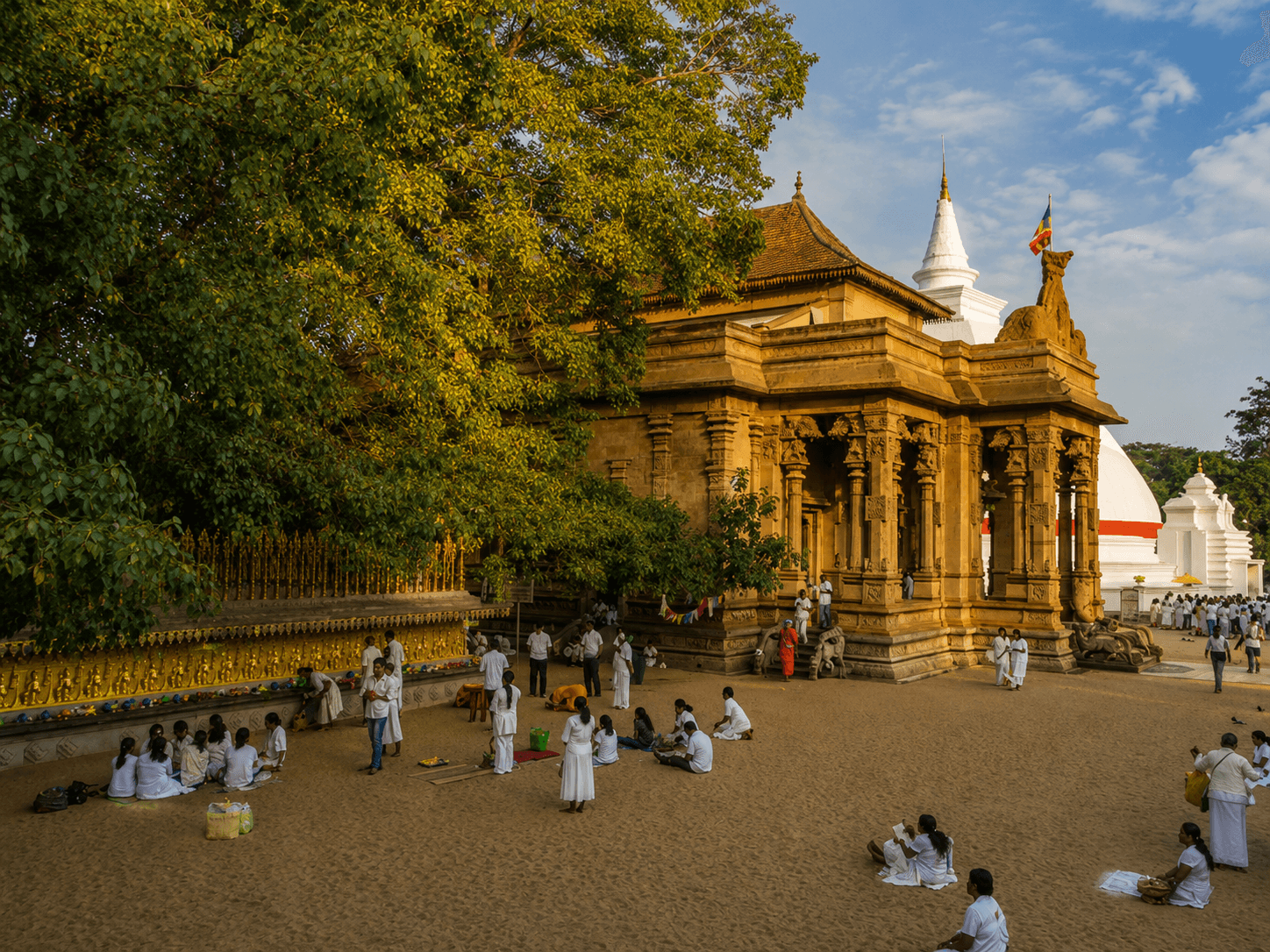
It is a religious observance first. Devotees visit temples in white, observe precepts, and many take sil, spending the day at a temple in meditation and abstinence. The lanterns and lights, which are what visitors notice, sit alongside that rather than replacing it.
- →Marks the Buddha's birth, enlightenment and passing on one full moon day.
- →The most important date in the Theravada Buddhist calendar.
- →Devotees visit temples in white; many take sil and spend the day there.
- →Two public holidays: the poya day and the day after.
Kudu: the lanterns
The Vesak kudu is a lantern of coloured tissue paper stretched over a bamboo frame, traditionally made at home in the days before the festival and hung outside houses, shops and offices. The classic form is a hexagonal or star shape with paper tails, lit from within, and children make them at school in the weeks beforehand.
The effect at scale is what makes it: whole streets, whole villages, lined with soft-glowing paper in every colour, moving in the breeze. Rural lanterns are often more affecting than city ones precisely because they are homemade. Larger and more elaborate lantern structures appear at temples and public spaces, some several metres across.
- →Handmade from coloured tissue paper on a bamboo frame.
- →Hung outside homes, shops and offices; children make them at school.
- →Rural streets are often more affecting than city displays.
- →Large elaborate lantern structures appear at temples and public spaces.
Thoranas: the pandals
Pandals, called thorana in Sinhala, are the spectacle. They are enormous temporary structures, sometimes four or five storeys high, carrying painted panels that tell a Jataka story, one of the accounts of the Buddha's previous lives. Thousands of coloured bulbs are wired to flash in sequence, drawing the eye from panel to panel so the story unfolds in order.
Each is built by a neighbourhood committee or a business, funded by local donations, and assembled over weeks. Loudspeakers narrate the story in Sinhala. Crowds gather in front and move slowly along, and the streets around a major pandal are closed to traffic. They are switched on after dark and run late into the night.
- →Large illuminated structures telling a Jataka story in painted panels.
- →Thousands of bulbs flash in sequence so the story unfolds in order.
- →Built by neighbourhood committees over weeks, funded by donations.
- →Best after dark; surrounding streets are closed to traffic.
Dansal: free food for everyone
Dansal are the part that most surprises visitors. Groups of volunteers set up roadside stalls and give away food and drink to anyone passing, free, for hours: rice and curry, kiribath, tea, ice cream, soft drinks, fruit. There is no catch and no collection tin. Giving is the point.
Accepting is the correct response. Refusing politely is fine but accepting graciously is better, and it is one of the few moments where a visitor can participate in a Sri Lankan religious festival directly rather than watching it. Queues can be long and the atmosphere is cheerful and chaotic.
- →Volunteer-run roadside stalls giving away food and drink, entirely free.
- →Rice and curry, kiribath, tea, ice cream and soft drinks are typical.
- →There is no collection; giving is the religious act.
- →Accepting graciously is the right response and lets you participate.
Where to see the best displays
Colombo has the largest concentration of major pandals, particularly around Pettah, Borella and the Beira Lake area, and the city organises Vesak zones, kalapaya, where streets are closed and displays cluster. Gangaramaya Temple and the Seema Malaka on Beira Lake are focal points.
Kelaniya Raja Maha Vihara, just outside Colombo, is one of the most significant temples in the country and its Vesak is substantial. Kandy's displays around the lake and the Temple of the Tooth are beautiful, and Anuradhapura's around the sacred city are quieter and more atmospheric. Small towns and villages, where the lanterns are homemade and the dansal are run by neighbours, are often the most memorable.
- →Colombo: Pettah, Borella and Beira Lake, with designated Vesak zones.
- →Kelaniya Raja Maha Vihara: major temple, substantial celebrations.
- →Kandy: displays around the lake and the Temple of the Tooth.
- →Villages and small towns: homemade lanterns, often the most affecting.
Practicalities and etiquette
Everything happens after dark, so plan a late evening and expect heavy foot traffic and road closures around major pandals. Move with the crowd rather than against it, keep valuables secure, and be patient: the whole point is that everyone is out.
It is a poya day, so no alcohol is sold anywhere, meat is less widely served, and many shops and businesses close for both days. Dress modestly if visiting temples, remove shoes, and remember that behind the lights people are observing a serious religious occasion. Ask before photographing worshippers.
- →Displays run after dark; expect crowds and road closures.
- →No alcohol sold; many businesses closed across both days.
- →Dress modestly and remove shoes at temples.
- →Ask before photographing worshippers; the lights are fair game, people are not.
When it happens
Vesak falls on the May full moon poya, and the date shifts each year with the lunar calendar. The main displays run on the poya day and the day after, both public holidays, though many lanterns go up several days earlier and stay up for a week.
For a first-time visitor this is worth planning around deliberately. It is the single most visually remarkable event in the Sri Lankan year and it costs nothing to attend. Confirm the year's date before booking, as it moves by several weeks between years.
Planning a Vesak visit
Base yourself in or near Colombo or Kandy for the main pandals, but build in at least one evening in a smaller town, where the homemade lanterns and neighbourhood dansal give a truer sense of what the festival is. Late May also sits at the start of the east coast season, so pairing Vesak with Trincomalee works well.
Lankan Stays & Trails plans Vesak evenings around the pandal zones and the road closures, which are the two things that catch independent visitors out.
Frequently asked questions
What are Vesak pandals?
Thoranas, or pandals, are large temporary illuminated structures, sometimes four or five storeys high, carrying painted panels that tell a Jataka story from the Buddha's previous lives. Thousands of bulbs flash in sequence so the narrative unfolds panel by panel after dark.
What are Vesak lanterns called?
Kudu. They are made from coloured tissue paper stretched over a bamboo frame, traditionally hexagonal or star-shaped with paper tails, lit from within and hung outside homes, shops and offices across the island. Children typically make them at school beforehand.
Where can you see Vesak in Sri Lanka?
Colombo has the largest pandals, around Pettah, Borella and Beira Lake, with designated Vesak zones where streets are closed. Kelaniya Raja Maha Vihara, Kandy around the lake, and Anuradhapura all have substantial displays. Villages with homemade lanterns are often most affecting.
What is a dansal?
A free food stall run by volunteers during Vesak and other poya festivals, giving away rice and curry, kiribath, tea, ice cream and soft drinks to anyone passing. There is no collection and no catch; the giving is itself the religious act. Accepting graciously is the correct response.
When is Vesak in Sri Lanka?
On the May full moon poya, with a second public holiday the following day. The exact date shifts each year with the lunar calendar, sometimes by several weeks between years, so confirm the current date before booking travel around it.
Can you buy alcohol during Vesak?
No. Vesak is a poya day, so alcohol sales are prohibited nationwide across the holiday: liquor shops close, supermarket shelves are covered and bars do not serve. Meat is also less widely available, as many people observe vegetarianism. Buy in advance if it matters to you.
Is Vesak a good time to visit Sri Lanka?
It is the most visually remarkable event in the Sri Lankan year and costs nothing to attend. Late May also opens the east coast season, so Vesak pairs well with Trincomalee. Expect closures, no alcohol, crowds after dark, and road closures around the major pandals.