
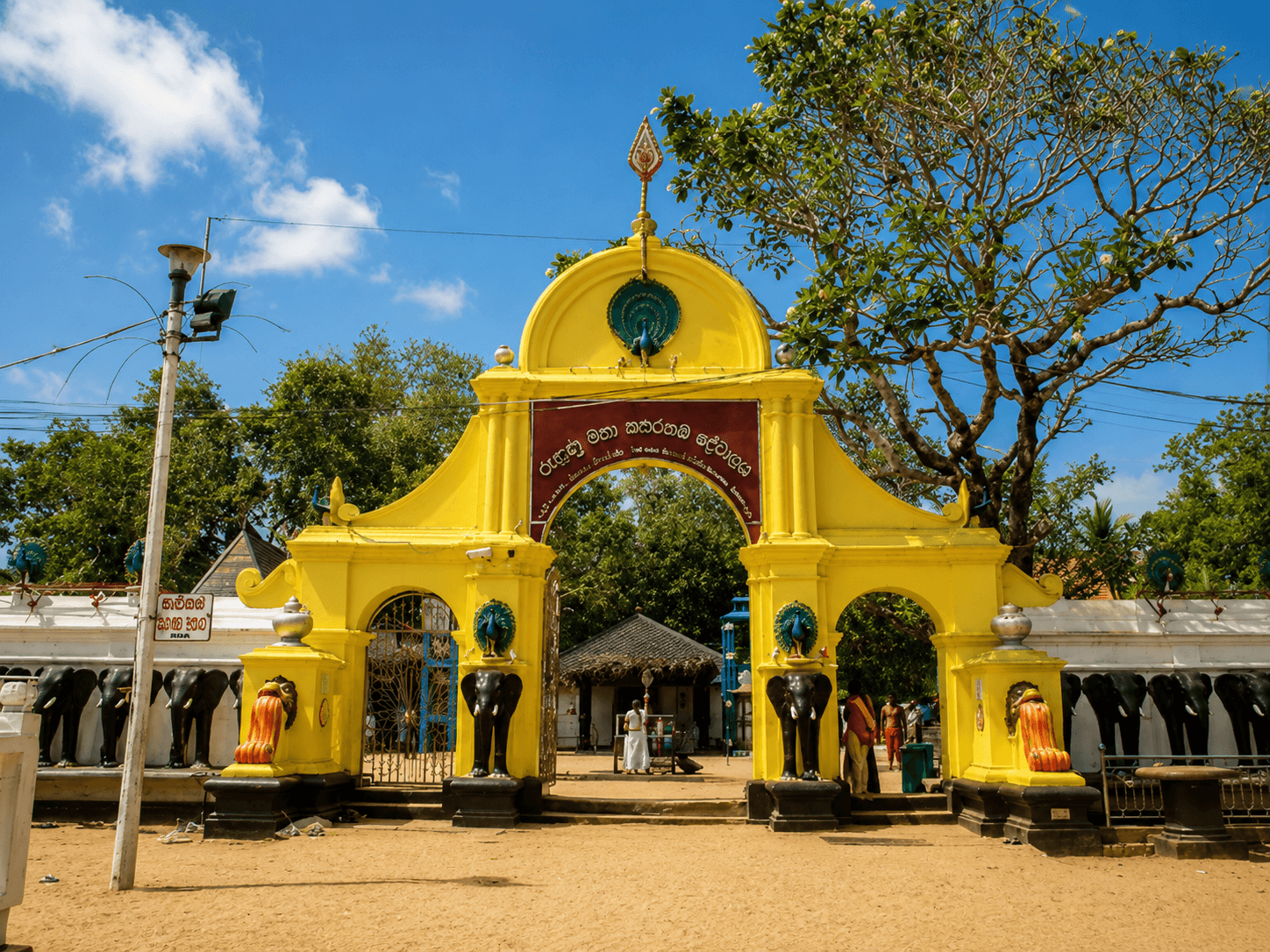
Quick answer
Weherahena Poorvarama Rajamaha Viharaya is a Buddhist temple about 3 to 4 kilometres east of Matara town, known for an underground gallery whose walls and ceilings are covered with hundreds of colourful paintings of Jataka stories and the life of the Buddha. Above it sits a giant seated Buddha of roughly 39 metres. A visit takes 45 minutes to an hour, entry is by donation or a small fee, and the temple hosts the Kap Ruka festival of decorated wish-fulfilling trees around the full moon in November or December.
Key takeaways
- Weherahena lies about 3 to 4 kilometres east of Matara town, roughly 15 minutes from Mirissa by road.
- The underground gallery holds hundreds of brightly painted panels of Jataka stories and the Buddha's life.
- The giant seated Buddha above the gallery is roughly 39 metres tall and visible across the surrounding countryside.
- The Kap Ruka festival, with decorated wish-fulfilling trees, is held around a full moon in November or December, on dates that shift each year.
- A visit takes 45 minutes to an hour, and shoulders and knees must be covered.
What Weherahena temple is
Weherahena Poorvarama Rajamaha Viharaya is a large Buddhist temple complex on the outskirts of Matara, a short drive inland from the coast road. Its two famous features are an underground gallery, lined with painted stories, and a giant seated Buddha that rises above the temple grounds.
Weherahena is a busy local temple rather than an ancient monument. Most of what visitors see was built and painted in the twentieth century, in a bright, popular style that many Sri Lankans love and some foreign visitors find surprising. It is cheerful, devotional and full of life.
The painted underground gallery
Weherahena's underground gallery is a long, cool tunnel beneath the giant Buddha, its walls and ceilings covered with hundreds of painted panels. They tell Jataka stories, the tales of the Buddha's previous lives, and scenes from his final life, in vivid colours and a style close to a comic strip.
Walking through takes 15 to 30 minutes, longer if a monk or guide explains the stories. Some panels show heavens and hells in graphic detail, which may need explaining to young children. The tunnel is well lit and cooler than the grounds outside.
- →Jataka stories: the past lives of the Buddha in sequence.
- →Life of the Buddha: birth, enlightenment, teaching and passing.
- →Heavens and hells: vivid moral scenes.
The giant seated Buddha
The giant seated Buddha at Weherahena is roughly 39 metres tall, one of the largest in Sri Lanka. It sits in meditation above the gallery and can be seen from far across the surrounding coconut groves and paddy fields.
Visitors can usually climb stairs within the structure to see the statue at close range and look out over the countryside. The statue is a focus of devotion, and local people bring flowers and light oil lamps at its base, especially on poya days.
- →Height: roughly 39 metres.
- →Pose: seated in meditation.
- →Best light: morning or late afternoon.
The Kap Ruka festival
Weherahena is known for its Kap Ruka festival, held around a full moon in November or December, on dates that shift each year with the lunar calendar. Kap Ruka are wish-fulfilling trees from Buddhist tradition, and the festival features decorated tree-like structures hung with gifts and offerings, carried in a procession with drummers and dancers.
The festival draws large crowds from across the south and is a rare chance to see a temple procession on the coast. If your dates match, check with the temple or a local guide for the exact night, and expect traffic around Matara.
Visiting Weherahena
Weherahena lies about 3 to 4 kilometres east of Matara town, around 15 minutes by car from Mirissa and 45 minutes from Tangalle. Entry is by donation or a small fee, usually only a few US dollars. Shoes come off at the entrance, and the floors can be hot in the middle of the day.
Cover shoulders and knees, and carry a sarong if you are coming from the beach. Photography is generally allowed in the grounds but may be restricted in parts of the gallery. Mornings and poya days are busiest with local worshippers.
- →Time needed: 45 minutes to an hour.
- →Cost: a donation or small fee.
- →Best combined with: Matara's Star Fort and Dondra Head.
Fitting Weherahena into a south coast day
Weherahena fits easily into a day around Matara, with the Star Fort, the Paravi Duwa island temple and Dondra Head lighthouse all within 20 minutes. From Mirissa, a half-day loop covers all of them comfortably.
Lankan Stays & Trails often adds Weherahena to a Matara and Dondra loop, or to a drive between Mirissa and Tangalle, for travellers who want to see a lively, devotional temple of the modern south as well as the ancient ones.
Frequently asked questions
Where is Weherahena temple?
Weherahena Poorvarama Rajamaha Viharaya is about 3 to 4 kilometres east of Matara town, a short distance inland from the coast road. It is around 15 minutes from Mirissa and 45 minutes from Tangalle by car or tuk-tuk.
What is special about Weherahena temple?
Weherahena has an underground gallery with hundreds of brightly painted panels of Jataka stories and scenes from the Buddha's life, and a giant seated Buddha of roughly 39 metres above it. It also hosts the Kap Ruka festival each November or December.
When is the Kap Ruka festival at Weherahena?
The Kap Ruka festival is held around a full moon in November or December, with dates that shift each year according to the lunar calendar. Confirm the exact night with the temple or a local guide, and expect crowds and traffic around Matara.
Is there an entrance fee at Weherahena?
Entry is by donation or a small fee, usually a few US dollars for foreign visitors. Arrangements change, so confirm locally. A donation supports the temple and the upkeep of the paintings.
How long do you need at Weherahena temple?
Allow 45 minutes to an hour to walk through the painted gallery, see the giant Buddha and explore the grounds. With a guide explaining the stories, an hour and a half is comfortable.
Is Weherahena suitable for children?
Mostly yes. Children usually enjoy the colourful, story-like paintings in the tunnel. Some panels show hell scenes in graphic detail, so parents of young children may want to explain or move past them quickly.
What should I wear to Weherahena temple?
Cover shoulders and knees, and remove shoes and hats before entering the temple grounds and gallery. A sarong or scarf in your bag is useful if you come straight from the beach. Light colours are cooler and respectful.