
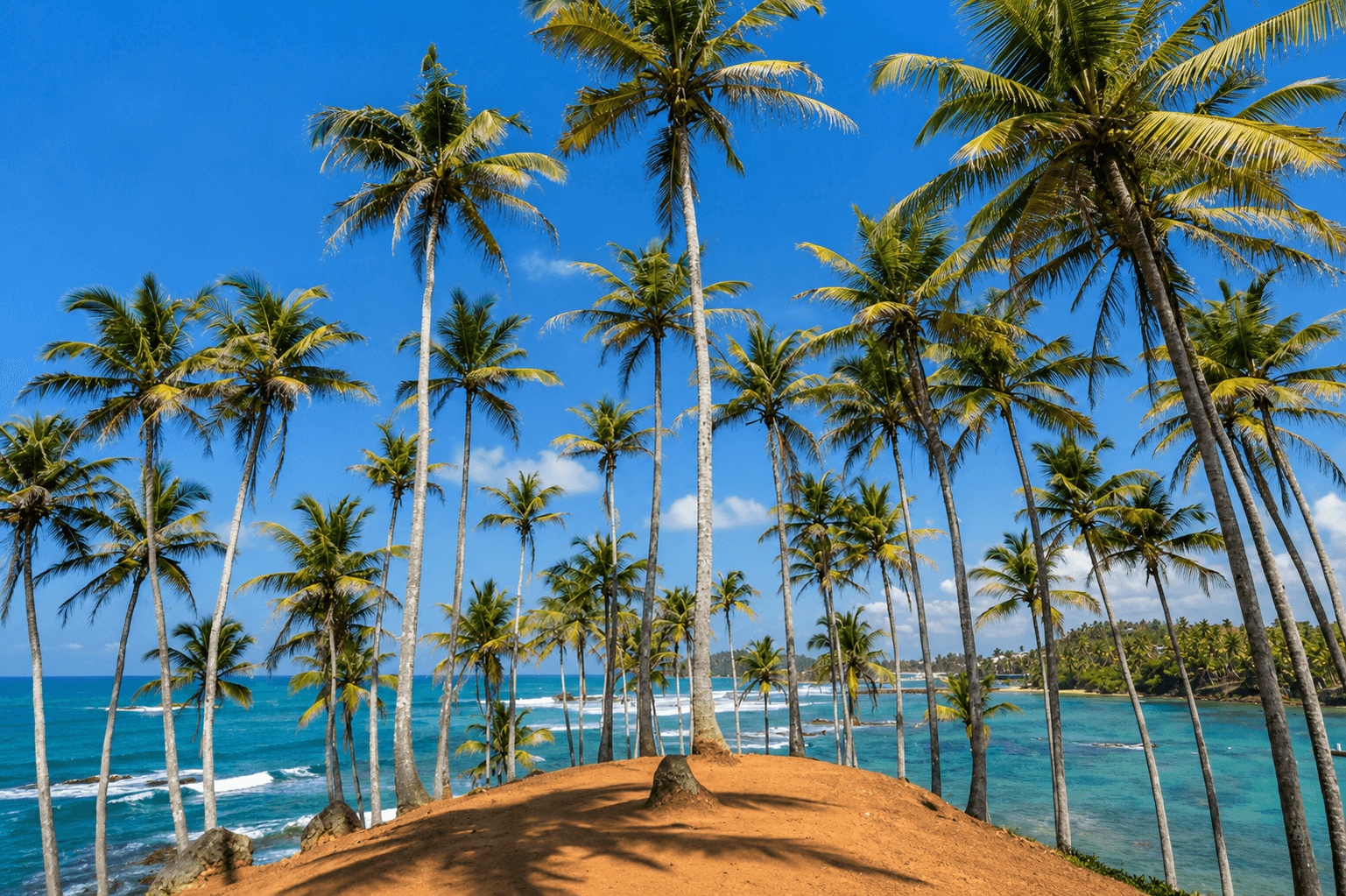
Quick answer
The south coast belongs at the end of a Sigiriya and Ella route. Ella to Mirissa or Weligama takes roughly four to five hours, and Galle to Bandaranaike International Airport on the Southern Expressway takes roughly two and a half to three. That gives an easy final transfer and two or three restful days after the inland section, which is the main reason the conventional order runs north to south.
Key takeaways
- Ella to Mirissa or Weligama takes roughly four to five hours by road.
- Galle to the airport on the Southern Expressway takes roughly two and a half to three hours.
- Whale watching from Mirissa runs roughly December to April, with trips typically four to six hours at sea.
- From May to September the south-west monsoon makes Trincomalee or Nilaveli the better coastal choice.
- Udawalawe sits roughly two to two and a half hours from Ella, directly on the route down to the coast.
Why the coast belongs at the end
The inland section of a Sri Lankan trip is the demanding part. Sigiriya is roughly 1,200 steps, the drives between bases run to several hours each, and the Kandy to Ella train takes most of a day. By the time Ella is behind you, the trip has earned a change of pace.
The south coast provides it and, crucially, sits in the right place. Ella is roughly four to five hours from Mirissa and Weligama, which is a single comfortable transfer rather than a full day, and the coast itself asks nothing beyond deciding where to eat.
The departure leg is the clincher. Galle to Bandaranaike International Airport on the Southern Expressway takes roughly two and a half to three hours on genuinely fast road, which is the shortest significant transfer in the whole itinerary and the best thing to have waiting on a departure day.
- →The inland section carries the climbing, the long drives and the train.
- →Ella to the south coast: roughly four to five hours, one transfer.
- →Galle to the airport: roughly two and a half to three hours by expressway.
- →The route shortens as it goes rather than lengthening.
Which stretch of the south coast
Mirissa and Weligama are the usual choices and sit close together. Mirissa is the base for whale watching and has a compact beach with a headland walk; Weligama is wider, shallower and the standard place to learn to surf, which makes it the better family option of the two.
Unawatuna sits further west, closer to Galle, and suits travellers who want a swimmable bay and easy access to the fort. It is busier than either Mirissa or Weligama and the beach has changed shape considerably over the years, so expectations should be set accordingly.
Galle Fort itself is usually a half-day rather than a base, walked in the late afternoon when the ramparts catch the light. Travellers with an evening flight often do the fort on their departure day, which works well given the short expressway run that follows.
- →Mirissa: whale watching base, compact beach, headland walk.
- →Weligama: wider and shallower, the standard place to learn to surf.
- →Unawatuna: swimmable bay, closest to Galle, and the busiest of the three.
- →Galle Fort: a half-day on the ramparts, often on the departure day.
Fitting whale watching into the end of the trip
Whale watching from Mirissa runs roughly December to April, when blue whales and sperm whales pass the continental shelf off the southern coast. Trips typically leave very early and last four to six hours at sea, so they need a full morning and a day either side that is not a transfer day.
That is the practical argument for two nights on the coast rather than one. A single night means arriving from Ella in the afternoon and leaving the next morning, which leaves no room for a boat trip at all.
Choose the operator on conduct rather than price. Responsible boats keep their distance, do not chase or encircle animals, and limit the number of vessels around a sighting. Lankan Stays and Trails works only with operators who follow those rules, and a trip that promises guaranteed sightings is telling you something about how it intends to get them.
- →Whale watching from Mirissa runs roughly December to April.
- →Trips leave very early and last roughly four to six hours at sea.
- →Two coastal nights are needed to fit a boat trip in at all.
- →Choose operators that keep distance and do not chase or encircle animals.
When the east coast replaces the south
From roughly May to September the south-west monsoon affects the south and west coasts, and the sea around Mirissa and Unawatuna can be rough with limited swimming. In that window the coastal section should move to the east, where the weather pattern is reversed.
Trincomalee and Nilaveli are the usual substitutes, along with Pasikuda further south and Arugam Bay for surfers. Whale watching also shifts, running off Trincomalee roughly May to September rather than off Mirissa.
The east coast changes the shape of the route rather than breaking it. From Ella, Arugam Bay is a reasonable run south-east, and Trincomalee pairs more naturally with a Cultural Triangle finish, which is one of the few cases where ending inland and north genuinely works.
- →From May to September the south-west monsoon affects the south and west coasts.
- →Trincomalee, Nilaveli, Pasikuda and Arugam Bay are the east coast alternatives.
- →Whale watching moves to Trincomalee, roughly May to September.
- →Trincomalee pairs naturally with a Cultural Triangle finish.
How many coastal nights to give it
Two nights is the minimum that produces an actual beach stay rather than a stopover, and three is where the coast starts doing its real work. On a seven-day trip two is usually all that can be spared; on ten days three is comfortable; on fourteen, four or five nights at the end is not excessive.
The structural point is that coastal nights are the cheapest to add and the first to be sacrificed. Travellers cutting a trip short almost always trim the beach, which is understandable and usually a mistake, because the beach is what makes the inland section sustainable.
A useful test: if the itinerary has more hotel changes than beach nights, it is a transfer schedule with a holiday attached rather than the other way round.
- →Two coastal nights is the minimum for a genuine stay.
- →Three nights on a ten-day trip; four or five on fourteen days.
- →Coastal nights are the first to be cut and usually the wrong thing to cut.
- →More hotel changes than beach nights signals an over-packed itinerary.
Frequently asked questions
How long is the drive from Ella to the south coast?
Roughly four to five hours to Mirissa or Weligama. It is a single comfortable transfer rather than a full day, and it descends steadily out of the hill country, which makes it one of the easier long legs in a Sri Lankan itinerary.
How long does it take to get from Galle to Colombo airport?
Roughly two and a half to three hours on the Southern Expressway, which is genuinely fast road. It is the shortest significant transfer in a standard itinerary, which is why a coastal finish makes departure days so much easier than an inland one.
Should the beach come at the start or end of a Sri Lanka trip?
The end, for most itineraries. The inland section carries the climbing, the long drives and the train, so the coast works as a landing rather than a launch, and the expressway run to the airport afterwards is short and easy.
When is whale watching season in Mirissa?
Roughly December to April, when blue whales and sperm whales pass the continental shelf off the southern coast. Trips leave very early and last roughly four to six hours at sea, so they need a full morning rather than a transfer day.
Where should I go to the beach in Sri Lanka in July?
The east coast. From roughly May to September the south-west monsoon affects the south and west, so Trincomalee, Nilaveli, Pasikuda or Arugam Bay are the better choices. Whale watching also shifts to Trincomalee in that window.
Which south coast beach is best for families?
Weligama, generally. It is wider and shallower than Mirissa, it is the standard place to learn to surf, and it sits close enough to Mirissa and Galle to use both. Unawatuna has a swimmable bay but is busier than either.
How many nights should I spend on the coast?
Two at minimum for a genuine stay, three on a ten-day trip, and four or five on a fortnight. Two nights is also the least that allows a whale watching trip, since a single night means arriving and leaving with no full morning in between.