
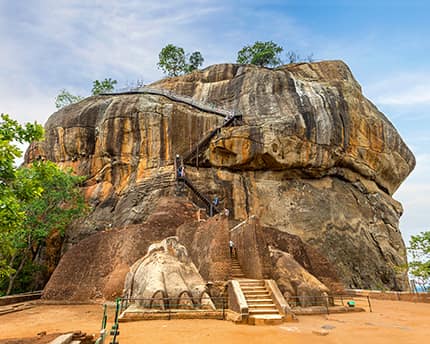
Quick answer
Sigiriya is a UNESCO World Heritage Site because it preserves a rare, near-complete fifth-century royal city built by King Kashyapa, combining urban planning, landscaped water gardens, a monumental lion gateway, frescoes and more than 1,800 medieval graffiti. UNESCO inscribed it in 1982 as the Ancient City of Sigiriya, recognising it as an outstanding example of ancient town planning and art in South Asia.
Key takeaways
- UNESCO inscribed the Ancient City of Sigiriya on the World Heritage List in 1982.
- Sigiriya was one of Sri Lanka's first World Heritage listings, alongside Anuradhapura and Polonnaruwa in the same year.
- The listing recognises Sigiriya's town planning, water gardens, frescoes and mirror-wall graffiti as a single ensemble.
- Sigiriya's water gardens are among the oldest surviving landscaped gardens in Asia.
- Sri Lanka has eight World Heritage Sites; Sigiriya, Dambulla, Anuradhapura and Polonnaruwa sit within the Cultural Triangle.
Sigiriya's UNESCO listing in 1982
UNESCO added Sigiriya to the World Heritage List in 1982 under the name Ancient City of Sigiriya. It was among Sri Lanka's first World Heritage listings, inscribed the same year as the sacred city of Anuradhapura and the ancient city of Polonnaruwa.
The listing covers the whole ancient city rather than the rock alone: the summit, the lion terrace, the fresco gallery and mirror wall, the gardens, the moats and ramparts. That distinction matters, because most of what makes Sigiriya exceptional is at the bottom of the rock, not the top.
What makes Sigiriya outstanding
Sigiriya's case rests on the combination of its elements. A fifth-century city plan survives on the ground, laid out along a clear axis around the rock. The water gardens use gravity-fed hydraulics that still work in heavy rain. The frescoes are among the finest surviving ancient paintings in South Asia, and the graffiti are some of the earliest Sinhala poetry.
Few sites anywhere preserve a royal city, its art and the recorded responses of its visitors together. That ensemble, built in a short, datable period, is what gives Sigiriya its universal value.
- →A near-complete fifth-century city plan around the rock.
- →Landscaped water gardens among the oldest in Asia.
- →Frescoes among the finest ancient paintings in South Asia.
- →More than 1,800 graffiti, including early Sinhala poetry.
- →A monumental lion gateway, of which the paws survive.
Sigiriya among Sri Lanka's World Heritage Sites
Sri Lanka has eight UNESCO World Heritage Sites: six cultural and two natural. Four sit in or near the Cultural Triangle: Sigiriya, the Golden Temple of Dambulla, the sacred city of Anuradhapura and the ancient city of Polonnaruwa. The others are the sacred city of Kandy, the old town of Galle and its fortifications, the Sinharaja Forest Reserve and the Central Highlands.
Sigiriya is the most visited of them, and the one most often called the eighth wonder of the world in local promotion. That phrase is informal, not a UNESCO designation.
- →Ancient City of Sigiriya, 1982.
- →Sacred City of Anuradhapura, 1982.
- →Ancient City of Polonnaruwa, 1982.
- →Golden Temple of Dambulla, 1991.
- →Sacred City of Kandy, and Old Town of Galle, both 1988.
- →Sinharaja Forest Reserve, 1988; Central Highlands, 2010.
What the UNESCO status means for visitors
World Heritage status brings obligations that visitors see directly at Sigiriya. Photography rules in the fresco gallery, the ban on touching or writing on the mirror wall, drone restrictions and the managed one-way route all come from the duty to protect the site.
It also shapes cost. Foreign visitors pay a separate, considerably higher ticket than Sri Lankan citizens, which funds conservation through the Central Cultural Fund. Confirm the current fee before you go, because it changes.
What threatens Sigiriya
Sigiriya's main pressures are visitor numbers, weather and time. The frescoes are vulnerable to light, humidity and touch; the mirror wall has been scratched by modern visitors; and the heavy footfall on the stairways and summit wears the fabric of the site.
The best contribution a visitor can make is simple: keep to the route, touch nothing painted or plastered, and never write or scratch anything. Lankan Stays & Trails briefs every group on this before the climb, and visitors who have scratched the wall in recent years have faced arrest.
- →Light, humidity and touch damage the frescoes.
- →Modern scratching damages the mirror wall.
- →Heavy footfall wears stairways and summit surfaces.
- →Drones and flash photography are restricted for a reason.
Frequently asked questions
Is Sigiriya a UNESCO World Heritage Site?
Yes. UNESCO inscribed Sigiriya on the World Heritage List in 1982 as the Ancient City of Sigiriya, recognising its fifth-century city planning, water gardens, frescoes and graffiti as a site of outstanding universal value.
When did Sigiriya become a World Heritage Site?
In 1982. It was one of Sri Lanka's first three World Heritage listings, inscribed in the same year as the sacred city of Anuradhapura and the ancient city of Polonnaruwa.
Is Sigiriya one of the wonders of the world?
Sigiriya is often called the eighth wonder of the world in Sri Lankan promotion, but that is an informal phrase, not an official title. Its formal international recognition is its UNESCO World Heritage listing from 1982.
Why is Sigiriya important?
Sigiriya is important because it preserves a near-complete fifth-century royal city with its gardens, hydraulic engineering, frescoes and medieval graffiti in one place. Few sites anywhere keep a city, its art and its visitors' responses together.
How many UNESCO sites are there in Sri Lanka?
Sri Lanka has eight UNESCO World Heritage Sites: six cultural, including Sigiriya, Anuradhapura, Polonnaruwa, Dambulla, Kandy and Galle, and two natural, the Sinharaja Forest Reserve and the Central Highlands. Four of the cultural sites lie in or near the Cultural Triangle.
Does the Sigiriya ticket fund conservation?
The site is managed by the Central Cultural Fund, and ticket revenue supports its conservation and management work. Foreign visitors pay a separate, higher fee than Sri Lankan citizens; confirm the current price before you travel.