
Quick answer
Day 3 of the 14-day Sri Lanka itinerary drives roughly one hour from Sigiriya to Polonnaruwa, the medieval royal capital, and cycles its ruins for three to four hours, finishing at the Gal Vihara rock-cut Buddhas. After lunch and a rest, an afternoon jeep safari of roughly three hours visits whichever park the wild elephants are using: Minneriya, Kaudulla or Hurulu Eco Park. The night is the third and last at Sigiriya.
Key takeaways
- Polonnaruwa is roughly one hour's drive from Sigiriya and is best explored by bicycle along a flat, shaded road.
- The Gal Vihara, four Buddha figures carved from one granite face, is the natural place to finish before the heat builds.
- Wild elephants move between Minneriya, Kaudulla and Hurulu Eco Park, so local drivers choose the park on the day.
- The Minneriya Gathering peaks roughly July to September; in the December to April season herds are more often at Kaudulla or Hurulu.
- Day 3 is the last Sigiriya night, so pack loosely in the evening for the day 4 move to Kandy.
Day 3 of the 14-day itinerary at a glance
Day 3 of the 14-day Sri Lanka itinerary pairs the Cultural Triangle's best-preserved ancient city with its most memorable wildlife experience. Both sit within roughly an hour of Sigiriya, and you return to the same hotel at night.
The rhythm repeats day 2: active early, still through the heat, active again once the sun softens. After a slow day 2, most travellers find they have the energy for both halves.
- →Around 6.30am: drive roughly one hour to Polonnaruwa.
- →Morning: cycle the ancient city, roughly three to four hours.
- →Midday: lunch near Polonnaruwa or Habarana and a rest.
- →Around 2.30pm to 3pm: meet the jeep for the elephant safari.
- →Around 6pm: back at the hotel for the last Sigiriya night.
Cycling Polonnaruwa on day 3
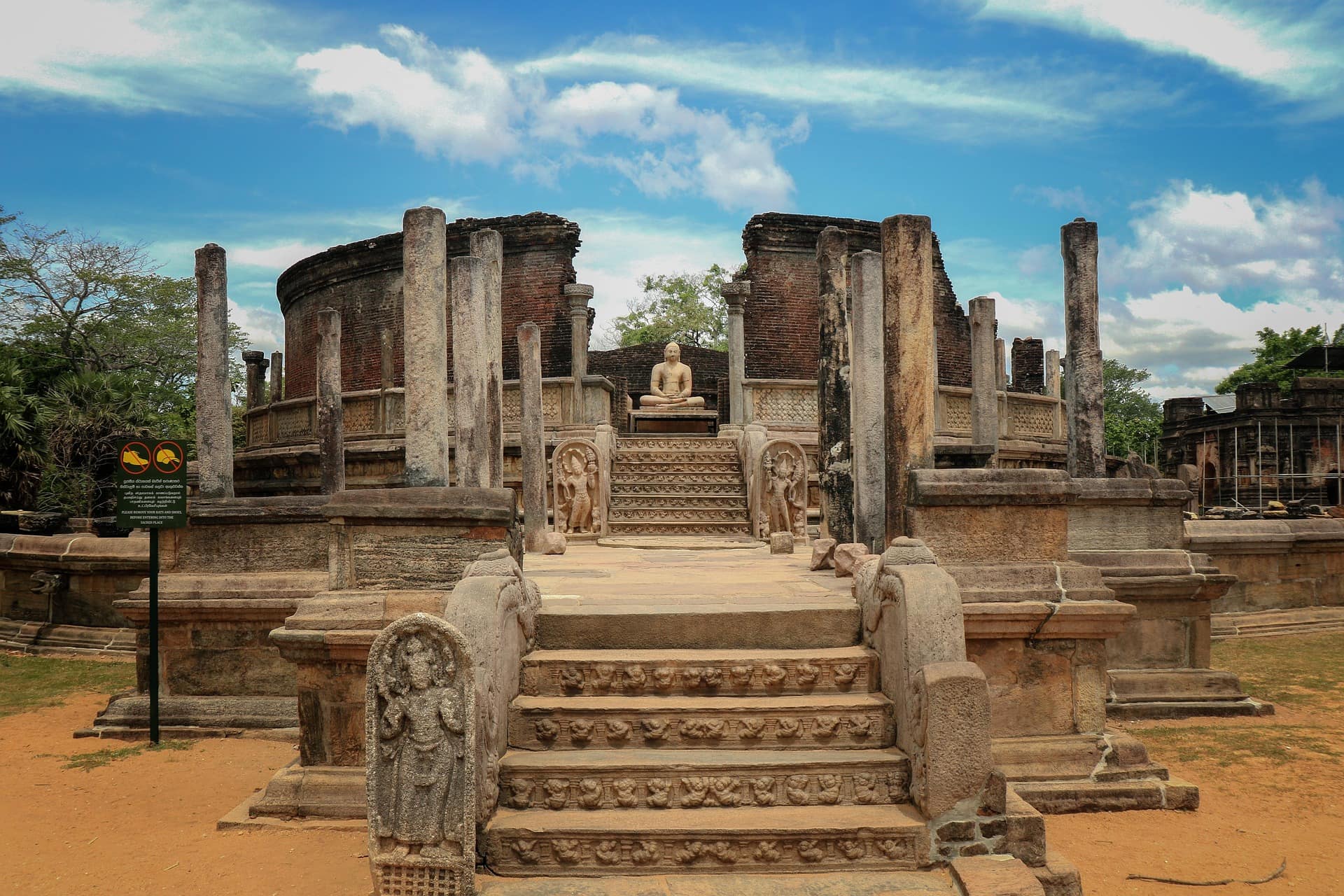
Polonnaruwa was Sri Lanka's royal capital from roughly the 11th to the 13th century, and its ruins are compact, well preserved and laid out along a flat road several kilometres long. Cycling between them, with shade from the trees at each stop, is the classic way to see the site.
Bicycles can be hired near the entrance, and your driver can follow in the car for anyone who prefers not to ride. Visit the museum near the entrance first if you like context, then work north through the palace and the Quadrangle to the Gal Vihara.
- →The Royal Palace of Parakramabahu: massive brick walls that once rose several storeys.
- →The Quadrangle: the circular Vatadage relic house and the Hatadage, the densest cluster of monuments.
- →Rankoth Vehera: a large stupa with a grassy crown.
- →The Gal Vihara: seated, standing and reclining Buddhas cut from a single granite face.
Minneriya, Kaudulla or Hurulu: the afternoon elephant safari
The Cultural Triangle's wild elephants follow water and fresh grass rather than park boundaries, moving between Minneriya National Park, Kaudulla National Park and Hurulu Eco Park through the year. Jeep drivers in Habarana track the herds daily, which is why the 14-day route never fixes the park in advance.
From roughly July to September the Minneriya reservoir shrinks and exposes new grass, drawing the famous Gathering of dozens or more elephants. In the December to April season this route is built for, family herds are more often at Kaudulla or Hurulu, and a good sighting is still very likely.
- →Minneriya: the Gathering, roughly July to September, and the most jeeps.
- →Kaudulla: often better from roughly August to December, and quieter.
- →Hurulu Eco Park: a reliable choice through the northern winter months.
Watching elephants the right way
An elephant safari in the Cultural Triangle is only as good as its driver's manners. A responsible driver keeps a respectful distance, switches off the engine near a herd, and never blocks an elephant's path or drives between a mother and calf.
Elephant rides are offered around Habarana and Sigiriya and have no place on this itinerary. Wild herds grazing on a reservoir bed at golden hour are the far better experience, and they need nothing from you except patience and quiet.
Adjusting day 3 for energy and interest
Day 3 sits in the middle of three nights at one base, so it bends easily. Tired travellers can skip Polonnaruwa, sleep late and do only the safari. History lovers can stay at Polonnaruwa all morning, add the Northern Group, and skip the jeep.
Families with young children often prefer a short Polonnaruwa loop by car, covering only the Quadrangle and the Gal Vihara. Keen photographers can ask for the latest possible safari start, so the herds are seen in the last golden light.
- →Low-energy version: a late breakfast and the afternoon safari only.
- →History version: a full morning at Polonnaruwa, no safari.
- →Family version: Polonnaruwa by car, a long lunch, a shorter jeep drive.
Planning day 3 of the 14-day route
Book the safari jeep the day before through your hotel or driver, so the park can be chosen on the freshest information. Carry a hat, sunscreen and plenty of water for Polonnaruwa, and a light layer and binoculars for the jeep, which gets breezy as the sun goes down.
Lankan Stays & Trails works with Habarana jeep drivers who follow distance rules. Day 4 of this series leaves Sigiriya for Dambulla Cave Temple and the road south to Kandy.
Frequently asked questions
Can you do Polonnaruwa and an elephant safari in one day?
Yes. Polonnaruwa takes a morning by bicycle and the elephant safari runs in the afternoon, and both lie within roughly an hour of Sigiriya or Habarana. A long lunch and rest between them keeps the day comfortable, which is why the 14-day route pairs them.
How long do you need at Polonnaruwa?
Three to four hours covers the main sites: the Royal Palace, the Quadrangle, Rankoth Vehera and the Gal Vihara. Enthusiasts can spend a full day adding the Northern Group and the museum. Start early, because the site has limited shade at midday.
Which is better, Minneriya or Kaudulla?
It depends on the month. Minneriya hosts the Gathering around July to September, while Kaudulla is often better from roughly August to December and sees fewer jeeps. Hurulu Eco Park is a good option in the northern winter. Let local drivers choose on the day.
Will I see elephants in December to April?
Very likely, though in smaller herds than during the Gathering. In the December to April window the elephants are usually at Kaudulla or Hurulu Eco Park rather than Minneriya, and experienced drivers track them daily. Sightings are never guaranteed but are among the most reliable in Asia.
Is it better to cycle or drive around Polonnaruwa?
Cycling suits most visitors, since the sites spread along a flat road several kilometres long with shade between stops. Driving with your driver suits young children, older travellers and very hot days. Many visitors cycle the central section and drive to the Gal Vihara.
How long is an elephant safari in the Cultural Triangle?
Most afternoon jeep safaris last roughly three hours, including the drive from Habarana to the park gate. They usually start around 2.30pm to 3pm and end near sunset, when the herds are most active on the open grass.