
Quick answer
A 2-week Sri Lanka plan for history lovers spends two nights in Anuradhapura, three at Sigiriya for Polonnaruwa and Dambulla, three in Kandy, one in Nuwara Eliya, one in Ella, two inside Galle Fort and one in Colombo. It follows the island's history in order, from the first capital of roughly the 4th century BCE to the colonial ports, and takes in all six of Sri Lanka's cultural UNESCO World Heritage Sites. It replaces the safari and most beach days.
Key takeaways
- Sri Lanka has six cultural UNESCO World Heritage Sites: Anuradhapura, Polonnaruwa, Sigiriya, Dambulla, Kandy and Galle Fort.
- Anuradhapura was the island's capital for well over a thousand years, from roughly the 4th century BCE.
- Polonnaruwa replaced Anuradhapura as capital in the 11th century and reached its height under Parakramabahu I in the 12th.
- The Kandyan kingdom was the last to fall, ceded to the British in 1815.
- Galle Fort was begun by the Portuguese in the 16th century and rebuilt by the Dutch from the 1660s.
The 2-week plan for history lovers at a glance
The 2-week Sri Lanka plan for history lovers runs north first, then south, so the sites appear in roughly the order they were built. Anuradhapura is roughly four to five hours from the airport, and the route ends in Colombo, close to the departure gate.
- →Anuradhapura, two nights: the first capital and Mihintale.
- →Sigiriya, three nights: Sigiriya Rock, Polonnaruwa and Dambulla Cave Temple.
- →Kandy, three nights: the last kingdom, its temples and its museum.
- →Nuwara Eliya, one night, and Ella, one night: the plantation era and the railway.
- →Galle Fort, two nights: Portuguese, Dutch and British layers inside one wall.
- →Colombo, one night: the National Museum and the colonial Fort district.
Anuradhapura and Mihintale: the first thousand years
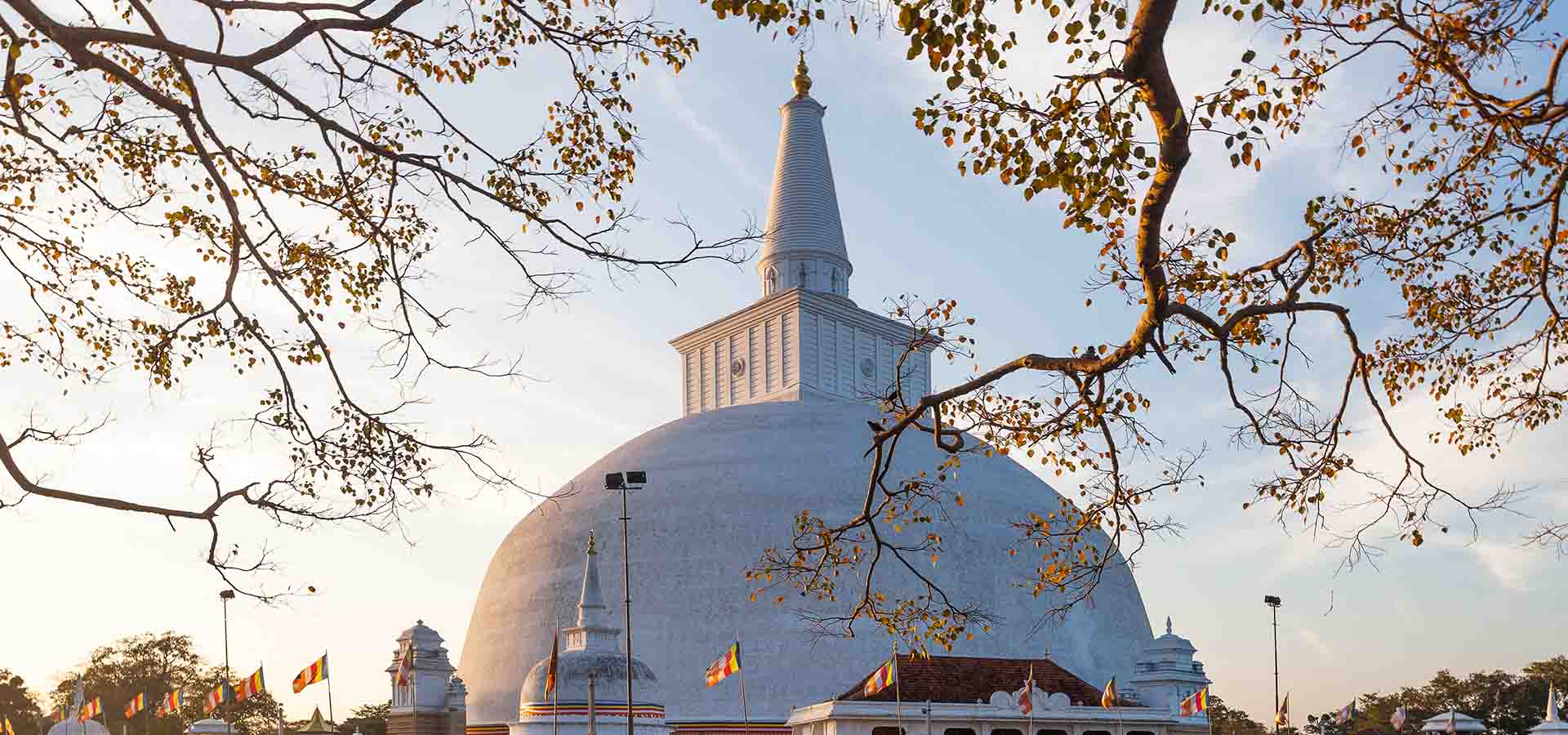
Anuradhapura was the capital of Sri Lanka from roughly the 4th century BCE until its sack in the late 10th century. Its great stupas, the Ruwanwelisaya, Jetavanaramaya and Abhayagiri, were among the largest brick structures of the ancient world, and the Sri Maha Bodhi, grown from a cutting of the tree under which the Buddha attained enlightenment, has been tended for more than two thousand years.
Two nights allow a full day in the sacred city by bicycle or tuk-tuk, and a morning at Mihintale, roughly 20 to 30 minutes away, where Buddhism is said to have been introduced to the island in the 3rd century BCE. Anuradhapura is still a place of worship, so white or pale clothing covering shoulders and knees is expected.
Sigiriya, Polonnaruwa and Dambulla: three days in the Triangle
Sigiriya, the rock citadel of King Kashyapa in the late 5th century, is roughly one and a half to two hours from Anuradhapura. Three nights here cover three distinct periods. The Dambulla Cave Temple has been a monastery since about the 1st century BCE; Sigiriya is a single reign's ambition; Polonnaruwa is the medieval capital at its most complete.
- →Sigiriya Rock: water gardens, the frescoes, the Mirror Wall and the palace summit; two to three hours.
- →Polonnaruwa: the Royal Palace, the Quadrangle and the rock-cut Buddhas of Gal Vihara; three to four hours by bicycle.
- →Dambulla: five painted cave shrines; roughly an hour, best at opening.
- →Optional: the forest monastery of Ritigala, for ruins with almost no visitors.
Kandy: the last kingdom
Kandy held out against the Portuguese and the Dutch for more than two centuries and fell to the British only in 1815. Three nights give history lovers what one night cannot: the Temple of the Sacred Tooth Relic at a puja, the museums beside it, and a half-day loop of three 14th-century temples in the countryside.
Embekke is known for its carved wooden pillars, Lankatilaka for its site on a rock outcrop and Gadaladeniya for its South Indian stonework. On the road in from Dambulla, the Aluvihare rock temple near Matale is where the Buddhist scriptures are traditionally said to have been first written down.
The colonial chapters: hill stations, Galle and Colombo
The colonial period is read in the hills and on the coast. Nuwara Eliya, laid out by the British in the 19th century, still has its post office, racecourse and bungalows, and the railway to Ella was built to carry tea. A tea factory visit explains how coffee blight in the 1860s turned the highlands over to tea.
Galle Fort is the best-preserved colonial sea fortress in South Asia. Two nights allow the ramparts at dawn and dusk, the Dutch Reformed Church, the old hospital and the maritime museum. Colombo closes the story with the National Museum, founded in 1877, and the arcades of the Fort district.
Who this plan suits, and what it leaves out
The history plan suits travellers who would rather read an inscription than lie on a beach. Choose it if the ancient cities are the reason for the trip. Choose the standard route if a leopard safari, whale watching or three days by the sea matter as much as the ruins.
The plan works best from December to April, when the whole route is dry, and adapts easily from May to September, since the Cultural Triangle is dry then too. Lankan Stays & Trails can arrange licensed site guides at the major sites, which makes a real difference at Polonnaruwa and Anuradhapura.
- →Left out: Yala, Mirissa and the beach days.
- →Added: Anuradhapura, Mihintale, a third Kandy night and Colombo.
- →Tickets: the ancient cities are among the island's more expensive entries; confirm current rates.
Frequently asked questions
What are the best historical sites in Sri Lanka?
The leading historical sites are Anuradhapura, Polonnaruwa, Sigiriya, the Dambulla Cave Temple, the Temple of the Sacred Tooth Relic in Kandy and Galle Fort. All six are UNESCO World Heritage Sites, and together they cover more than two thousand years of the island's history.
Can I see all of Sri Lanka's UNESCO cultural sites in two weeks?
Yes. Two weeks is enough to visit all six cultural World Heritage Sites at a comfortable pace: Anuradhapura, Sigiriya, Polonnaruwa and Dambulla in the first five nights, Kandy in the middle and Galle Fort near the end, with time left for the hill country.
Is Anuradhapura or Polonnaruwa better for history lovers?
Both, if time allows. Anuradhapura is older, larger and still an active pilgrimage city, with vast stupas and the sacred Bo tree. Polonnaruwa is more compact and better preserved, so the layout of a medieval capital is easier to read. They are different periods, not rivals.
How many days do I need in Anuradhapura?
Two nights is right for most history lovers. That gives one full day in the sacred city, which is spread over a wide area and best explored by bicycle or tuk-tuk, and a morning at Mihintale before driving on to Sigiriya, roughly one and a half to two hours away.
Do I need a guide for Sri Lanka's ancient cities?
A guide is not required, but a licensed site guide adds a great deal at Anuradhapura and Polonnaruwa, where signs are limited and the ruins are spread out. Agree the fee before starting. At Sigiriya, a guide helps most in the gardens and at the frescoes.
What should I wear to historical and religious sites in Sri Lanka?
Cover shoulders and knees at every religious site, and remove shoes and hats before entering. White or pale clothing is customary at Anuradhapura and the Temple of the Sacred Tooth Relic. Carry socks, because stone and sand become very hot by late morning.