
Quick answer
For first-time history lovers in Sri Lanka, the essential places are Anuradhapura, capital from roughly the fourth century BCE, Polonnaruwa, capital from the eleventh to thirteenth centuries, Sigiriya and its fifth-century citadel, Dambulla's cave temples, and Kandy, seat of the last independent Sinhalese kingdom until 1815. Galle Fort adds the colonial layer, with Portuguese fortification from 1588 and Dutch rebuilding from 1663.
Key takeaways
- Sri Lanka's ancient capitals run in sequence: Anuradhapura, then Polonnaruwa, then later Kandy, spanning over two thousand years.
- Anuradhapura was capital for over a thousand years from roughly the fourth century BCE.
- Sigiriya dates to the fifth century CE and was built during the Anuradhapura period, not between the capitals.
- Galle Fort carries the colonial layer, fortified by the Portuguese from 1588 and rebuilt by the Dutch from 1663.
- A history-led trip should give the Cultural Triangle four or five nights rather than the usual two.
The sequence, which makes everything else legible
Sri Lankan history has an unusually clear structure for a visitor, because the royal capitals moved in sequence and each left its own city. Visiting them in chronological order rather than geographical convenience turns a series of ruins into a narrative, and it is worth doing deliberately.
Anuradhapura came first, founded around the fourth century BCE and serving as capital for over a thousand years. Buddhism arrived during this period, and the Sri Maha Bodhi, grown from a cutting of the tree at Bodh Gaya, dates from it. Polonnaruwa followed, reaching its peak in the twelfth century under Parakramabahu I.
Kandy came much later, as the seat of the last independent Sinhalese kingdom, which held out against the Portuguese and Dutch before falling to the British in 1815. The colonial layer runs alongside from 1505 onwards, and Galle Fort is where it is most visible.
- →Anuradhapura: capital from roughly the fourth century BCE for over a thousand years.
- →Polonnaruwa: capital from roughly the eleventh to thirteenth centuries.
- →Kandy: the last independent Sinhalese kingdom, falling in 1815.
- →Galle: Portuguese fortification from 1588, Dutch rebuilding from 1663.
Anuradhapura, which rewards the time
Anuradhapura is the site most often cut from general itineraries and the one a history-focused traveller should protect. At its height it was among the largest and most sophisticated cities in the world, with monasteries housing thousands of monks and irrigation works that remain in use.
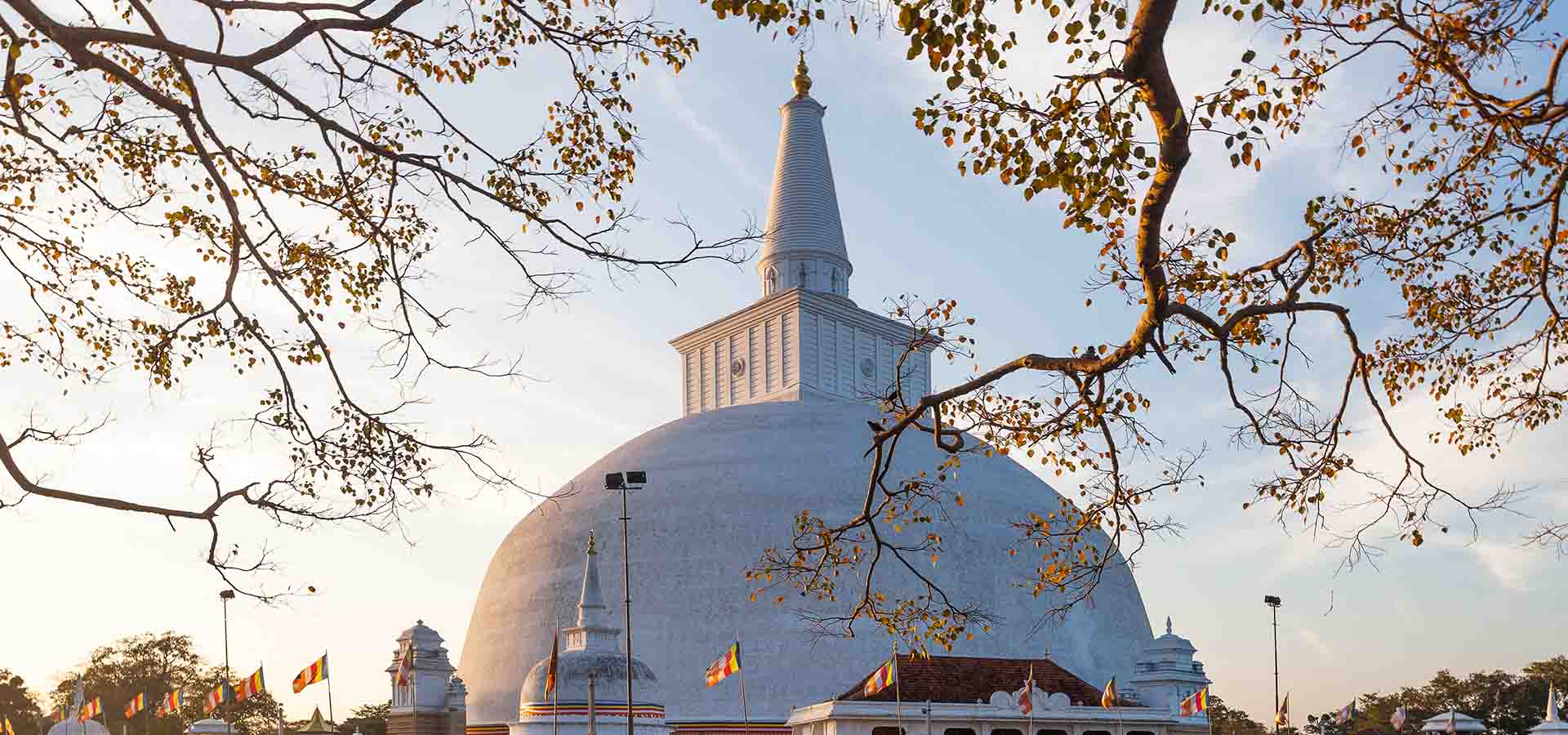
It needs a full day and a vehicle or bicycles, because the monuments sit kilometres apart across a sacred landscape rather than clustered in an archaeological park. Ruwanwelisaya and Jetavanaramaya are among the largest brick structures of the ancient world, and the scale of them is the point.
The Sri Maha Bodhi deserves its own mention. It has been tended continuously for more than two thousand years, which makes it one of the oldest documented planted trees anywhere, and it remains an active pilgrimage focus rather than a monument. Visiting on a poya day, when the full moon draws white-clad pilgrims, is remarkable, though lunar dates shift each year.
- →Needs a full day and a vehicle or bicycles; monuments sit kilometres apart.
- →Ruwanwelisaya and Jetavanaramaya are among the largest brick structures of the ancient world.
- →The Sri Maha Bodhi has been tended continuously for over two thousand years.
- →Poya days draw large numbers of pilgrims; lunar dates shift each year.
Polonnaruwa, Sigiriya and Dambulla
Polonnaruwa is the best preserved of the ancient cities, because it was occupied for a shorter period and abandoned more cleanly. It is compact enough to cycle in a morning, and the Gal Vihara, four Buddha figures carved from a single granite wall including a reclining figure of roughly fourteen metres, is the finest sculpture in the country.
Sigiriya is often mentally filed between the two capitals, and it belongs earlier: it dates to roughly 477 to 495 CE, during the Anuradhapura period, built by King Kashyapa after he seized the throne. The water gardens and hydraulic engineering at its base are arguably more historically significant than the summit palace.
Dambulla is the continuity site. Five caves under a rock overhang have been in religious use for over two thousand years, with roughly 150 Buddha statues and painted ceilings covering around 2,100 square metres, layered across many centuries. It shows the through-line that the abandoned capitals cannot.
- →Polonnaruwa: best preserved, cycleable, with the Gal Vihara as its highlight.
- →Sigiriya: roughly 477 to 495 CE, built during the Anuradhapura period.
- →Sigiriya's water gardens are arguably its most significant feature.
- →Dambulla: continuous religious use for over two thousand years.
The sites beyond the usual three
Mihintale is the one a history-led trip should add. It is where Buddhism is held to have been introduced to Sri Lanka in the third century BCE, when the monk Mahinda met King Devanampiya Tissa, and it sits roughly twenty minutes from Anuradhapura. For understanding why the ancient capitals look as they do, it is more important than its visitor numbers suggest.
The Avukana Buddha, a standing figure of roughly twelve metres carved from a granite face, and Yapahuwa, a rock fortress that briefly served as a capital in the thirteenth century, are both worthwhile additions for travellers with a genuine appetite for the period.
On the colonial side, Galle Fort is the essential stop, but the story extends further. Sri Lanka passed through Portuguese, Dutch and British control between 1505 and independence in 1948, and the layering is visible in the fort's architecture, the Dutch Reformed Church with its floor of gravestones, and the British-era lighthouse and clock tower.
- →Mihintale: where Buddhism arrived in the third century BCE, near Anuradhapura.
- →Avukana: a standing Buddha of roughly twelve metres carved from granite.
- →Yapahuwa: a thirteenth-century rock fortress and briefly a capital.
- →Galle: Portuguese, Dutch and British layers visible in one walled town.
How to get more from the sites
A specialist guide makes a larger difference at these sites than anywhere else in Sri Lanka, because so much of what matters is invisible without context. The difference between looking at a brick dome and understanding what a dagoba encloses, or between a carved slab and a moonstone depicting a sequence of symbolic levels, is entirely a matter of explanation.
The Mahavamsa, the chronicle of Sri Lankan history compiled from the fifth century CE onwards and continued for centuries after, is worth reading around before travelling. It is the reason Sri Lankan history is so precisely datable compared with much of South Asia, and knowing its outline transforms a visit to Anuradhapura.
Timing also matters practically. These sites are hot, exposed and involve a great deal of barefoot walking on stone. Starting at opening and finishing by late morning makes a full day of ruins sustainable in a way that a midday start does not.
- →A specialist guide matters more here than at any other Sri Lankan site type.
- →The Mahavamsa chronicle explains why Sri Lankan history is so precisely datable.
- →Sites are hot, exposed and involve barefoot walking on stone.
- →Start at opening and finish by late morning to sustain a full day of ruins.
Shaping a history-led first trip
A history-led trip should give the Cultural Triangle four or five nights rather than the usual two, ideally split between a Habarana or Sigiriya base and a night at Anuradhapura itself so the sacred city can be reached at dawn. Add two nights at Kandy and two or three at Galle, and the trip covers the full sequence properly.
That leaves less room for the hill country and the coast, which is the correct trade for this traveller. Lankan Stays and Trails builds these itineraries chronologically rather than geographically where the roads allow, and arranges guides with genuine archaeological background rather than general driver-guides, because at these sites that distinction is the whole difference.
Frequently asked questions
What are the best historical sites in Sri Lanka?
Anuradhapura, Polonnaruwa, Sigiriya, Dambulla and Kandy cover the ancient and medieval sequence, and Galle Fort covers the colonial layer. Mihintale, where Buddhism arrived in the third century BCE, is the most worthwhile addition for a history-focused trip.
In what order should I visit Sri Lanka's ancient cities?
Chronologically where the roads allow: Anuradhapura first, capital from roughly the fourth century BCE, then Polonnaruwa, capital from the eleventh to thirteenth centuries, then Kandy, the last independent kingdom until 1815. Sigiriya belongs within the Anuradhapura period.
How old is Sigiriya?
The citadel dates to roughly 477 to 495 CE, built by King Kashyapa during the Anuradhapura period rather than between the capitals. The water gardens and hydraulic engineering at its base are arguably more historically significant than the summit palace ruins.
How many days do you need for Sri Lanka's historical sites?
Four or five nights in the Cultural Triangle for the ancient capitals, ideally including a night at Anuradhapura itself, plus two at Kandy and two or three at Galle. That covers the full sequence from the fourth century BCE through to the colonial period.
Is Mihintale worth visiting?
For a history-focused trip, yes. It is where Buddhism is held to have been introduced to Sri Lanka in the third century BCE, when the monk Mahinda met King Devanampiya Tissa, and it sits roughly twenty minutes from Anuradhapura.
Do I need a guide for Sri Lanka's ancient sites?
A specialist guide makes more difference here than anywhere else in the country, because much of what matters is invisible without context. The symbolism of moonstones, the structure of a dagoba and the layout of a monastic complex all need explanation.
What is the Mahavamsa?
The chronicle of Sri Lankan history, compiled from around the fifth century CE and continued for centuries afterwards. It is the reason Sri Lankan history is unusually precisely datable compared with much of South Asia, and reading its outline beforehand transforms a visit to Anuradhapura.