
Quick answer
The best temples in Sri Lanka for a first trip are the Temple of the Sacred Tooth Relic at Kandy, which houses the country's most venerated Buddhist relic, Dambulla's five painted cave temples, the Sri Maha Bodhi at Anuradhapura, and Kataragama, a multi-faith shrine complex in the south. Shoulders and knees must be covered and shoes removed at all of them, and three or four sites across a trip is usually the limit before they blur.
Key takeaways
- The Temple of the Sacred Tooth Relic is best visited during one of the daily puja ceremonies, typically three each day.
- Shoulders and knees must be covered and shoes removed at all Buddhist and Hindu sites.
- Never pose with your back to a Buddha image; it is a genuine offence rather than a minor discourtesy.
- Kataragama is venerated by Buddhists, Hindus, Muslims and indigenous Vedda people at the same complex.
- Three or four temple visits across a trip is usually the point at which they begin to blur.
The three Buddhist sites that matter most
The Temple of the Sacred Tooth Relic at Kandy, Sri Dalada Maligawa, is the most important Buddhist site in the country. It houses a tooth relic of the Buddha that has functioned as a symbol of sovereignty for centuries, and it remains an active pilgrimage destination rather than a monument.
Visit during one of the daily puja ceremonies, of which there are typically three, when drummers play in the corridors and the chamber holding the relic casket is opened for viewing. Confirm current times locally and arrive well before, as queues build. The relic itself is not visible: what is displayed is the outermost of a series of nested caskets.
Dambulla and the Sri Maha Bodhi complete the trio. Dambulla's five caves hold roughly 150 Buddha statues and painted ceilings covering around 2,100 square metres, in continuous use for over two thousand years. The Sri Maha Bodhi at Anuradhapura is a sacred fig grown from a cutting of the tree at Bodh Gaya, tended continuously for more than two millennia.
- →Temple of the Sacred Tooth Relic: visit during puja, typically three times daily.
- →The relic is not visible; the outermost of several nested caskets is displayed.
- →Dambulla: five caves, roughly 150 Buddha statues, over two thousand years of use.
- →Sri Maha Bodhi: grown from a cutting of the Bodh Gaya tree.
The sites beyond Buddhism
Sri Lanka's Hindu kovils are visually and sonically quite different from its Buddhist temples: brightly painted gopuram towers, bells, camphor flame and a far more sensory style of worship. The Nallur Kandaswamy Kovil in Jaffna is the most significant, and the Koneswaram temple at Trincomalee, perched on Swami Rock above the sea, is the most dramatically sited.
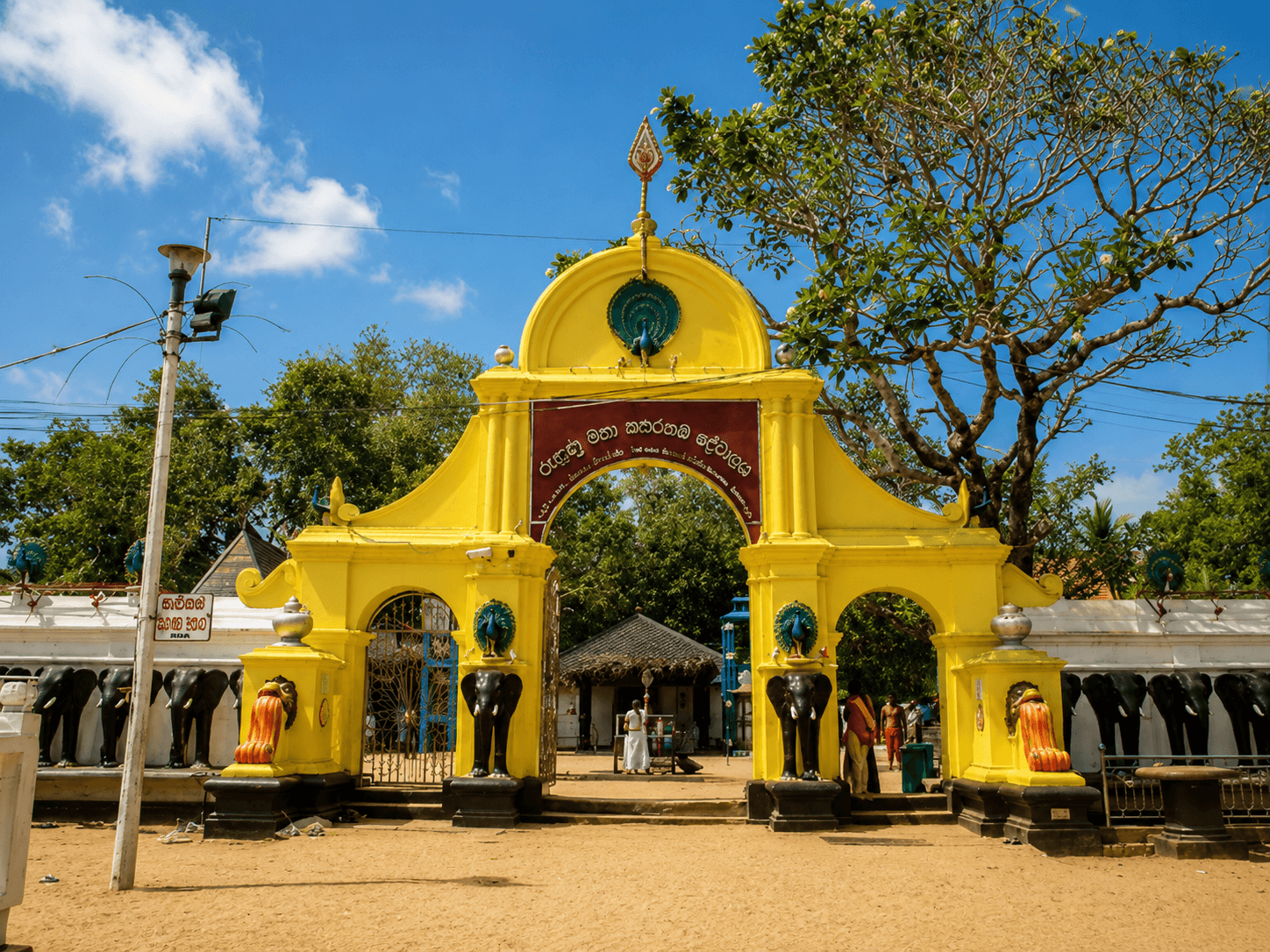
Kataragama in the deep south is the most interesting single religious site in the country, because it is venerated simultaneously by Buddhists, Hindus, Muslims and the indigenous Vedda people. Evening puja there, with pilgrims of several faiths making offerings at adjacent shrines, is unlike anything else on the island.
The Christian and Muslim layers are most visible around Negombo and in Colombo respectively. Negombo has a strong Catholic heritage from Portuguese influence, with churches rather than temples as its landmarks, and the Red Mosque in Colombo's Pettah district is among the most distinctive buildings in the city.
- →Nallur Kandaswamy Kovil in Jaffna is the most significant Hindu site.
- →Koneswaram at Trincomalee sits on Swami Rock above the sea.
- →Kataragama is venerated by Buddhists, Hindus, Muslims and Vedda people together.
- →Negombo carries a strong Catholic heritage; Colombo's Red Mosque is distinctive.
Behaving correctly, which matters here
The rules are consistent across Buddhist and Hindu sites and are enforced rather than suggested. Shoulders and knees must be covered by everyone. Shoes are removed before entering, and hats too at Buddhist sites. A light sarong or scarf carried in a day bag covers most situations.
The most important rule concerns Buddha images. Never pose with your back to one, never touch one, and never climb on one for a photograph. This is treated as a genuine offence in Sri Lanka rather than a minor discourtesy, and visitors have faced serious consequences for it. Tattoos of the Buddha are also a real legal risk and are best kept covered.
Practically, shoes off means walking barefoot on stone that has often been in full sun. Socks solve this and are not considered disrespectful. Photography is generally permitted but not always, and a quiet look for signs or a question to an attendant is worth the moment it takes.
- →Shoulders and knees covered; shoes removed, and hats at Buddhist sites.
- →Never pose with your back to a Buddha image, touch one, or climb on one.
- →Buddha tattoos carry genuine legal risk and are best kept covered.
- →Carry socks; the stone underfoot gets very hot by the middle of the day.
Poya days and festivals
Every full moon is a poya day and a public holiday in Sri Lanka, and temples are at their busiest and most atmospheric then. Pilgrims wear white, offerings increase, and the sites take on a character quite different from an ordinary weekday. Alcohol sales are restricted and many businesses close.
For a temple-focused trip, deliberately scheduling a poya day at Anuradhapura or Kataragama is worth doing. Lunar dates shift each year, so confirm them well ahead rather than assuming a fixed calendar.
The major festivals follow the same principle at greater scale. The Kandy Esala Perahera, around July or August, is the most spectacular, with caparisoned elephants, dancers and drummers over several nights. Vesak, around May, fills towns with paper lanterns and illuminated pandals. Both shift with the lunar calendar.
- →Every full moon is a poya day and a public holiday; temples are busiest then.
- →Alcohol sales are restricted and many businesses close on poya days.
- →Kandy Esala Perahera falls around July or August; dates shift each year.
- →Vesak, around May, brings paper lanterns and illuminated pandals.
Avoiding temple fatigue
Three or four religious sites across a first trip is usually the point at which they begin to blur, and a well-planned temple-focused itinerary works harder at variety than at volume. Four Buddhist temples in a week produces diminishing returns; a Buddhist temple, a Hindu kovil, a multi-faith shrine and a colonial church does not.
Timing helps as much as variety. An evening puja, a dawn visit and a poya day are three quite different experiences of the same kind of site, whereas three mid-morning visits are three versions of one experience.
Spacing matters too. Putting Dambulla, Kandy and Anuradhapura on consecutive days is the commonest cause of fatigue. Interleaving them with a safari, a walk and a beach day keeps each one distinct, which is a good argument against the instinct to group similar things together.
- →Three or four religious sites is usually the practical limit on a first trip.
- →Vary tradition rather than adding more sites of the same kind.
- →An evening puja, a dawn visit and a poya day are genuinely different experiences.
- →Interleave temples with safaris, walks and beach days rather than grouping them.
Shaping a temple-focused first trip
A workable shape is Dambulla and the Sri Maha Bodhi from a Cultural Triangle base, the Temple of the Sacred Tooth Relic at evening puja from Kandy, and Kataragama in the deep south on the way to the coast. That covers four genuinely different religious experiences across three regions without stacking them.
Lankan Stays and Trails arranges temple visits around puja times rather than around driving convenience, which occasionally means reversing a day, and it is the adjustment that most changes how these sites are experienced. A temple visited at a ceremony and the same temple visited at eleven in the morning are not the same place.
Frequently asked questions
What are the most important temples in Sri Lanka?
The Temple of the Sacred Tooth Relic at Kandy, which houses the country's most venerated Buddhist relic, Dambulla's five painted cave temples, the Sri Maha Bodhi at Anuradhapura, and Kataragama in the south, venerated by Buddhists, Hindus, Muslims and Vedda people.
What should I wear to temples in Sri Lanka?
Shoulders and knees covered, for all visitors. Shoes are removed before entering, and hats too at Buddhist sites. A light sarong or scarf in a day bag covers most situations, and socks are worth carrying since the stone underfoot gets very hot.
What should you not do at a Sri Lankan temple?
Never pose with your back to a Buddha image, touch one, or climb on one for a photograph. This is treated as a genuine offence rather than a minor discourtesy. Buddha tattoos also carry real legal risk in Sri Lanka and are best kept covered.
When is the best time to visit the Temple of the Tooth?
During one of the daily puja ceremonies, of which there are typically three, when drummers play and the relic chamber is opened. Confirm current times locally and arrive well before them, as queues build quickly. The evening puja is the most atmospheric for most visitors.
What is a poya day in Sri Lanka?
Every full moon is a poya day and a public holiday. Temples are at their busiest and most atmospheric, with pilgrims in white and increased offerings. Alcohol sales are restricted and many businesses close. Lunar dates shift each year, so confirm them ahead.
Why is Kataragama significant?
It is venerated simultaneously by Buddhists, Hindus, Muslims and the indigenous Vedda people, which makes it the most genuinely multi-faith site in Sri Lanka. Evening puja there, with pilgrims of several traditions making offerings at adjacent shrines, is unlike anywhere else.
How many temples should I visit in Sri Lanka?
Three or four across a first trip, chosen for variety rather than volume. Four Buddhist temples produce diminishing returns; a Buddhist temple, a Hindu kovil, a multi-faith shrine and a church do not. Interleave them with other kinds of days rather than grouping them.