
Quick answer
A first visit to Sri Lanka's Cultural Triangle works best as three nights at one central base, Sigiriya, Habarana or Dambulla, with a fourth night if you want Anuradhapura. Climb Sigiriya at opening time around 7am, visit Dambulla's cave temple in the late afternoon, and cycle Polonnaruwa early the next day before an afternoon elephant safari. Cover shoulders and knees, remove shoes and hats at temples, and budget roughly US$25 to US$35 per major site ticket.
Key takeaways
- The Cultural Triangle's corners are Anuradhapura in the north-west, Polonnaruwa in the east and Kandy in the south, with Sigiriya and Dambulla near the middle.
- Sigiriya, Habarana and Dambulla are all within about 30 minutes of one another, so any of the three works as a single base for three or four nights.
- The major sites open roughly 7am, and the dry-zone heat climbs past 30°C by late morning for much of the year.
- Sigiriya, Anuradhapura and Polonnaruwa each cost foreign adults roughly US$25 to US$35, so tickets alone often reach US$90 to US$110 per person.
- Five Cultural Triangle sites are UNESCO World Heritage Sites: Anuradhapura, Polonnaruwa and Sigiriya (1982), Kandy (1988) and Dambulla (1991).
What a first-time visitor should know about the Cultural Triangle
Sri Lanka's Cultural Triangle is the dry-zone region between Anuradhapura, Polonnaruwa and Kandy, where most of the island's ancient capitals, monasteries and rock temples stand. For a first-time visitor it is usually the second stop after the airport, roughly four to four and a half hours' drive north-east of Bandaranaike International.
The Cultural Triangle looks very different from the beaches and tea hills most people picture. The land is flat and hot, broken by granite outcrops such as Sigiriya and Pidurangala, and dotted with huge ancient reservoirs called tanks. Much of the heritage is living religion, not dead ruins: white-clad pilgrims, monks and oil lamps are part of almost every site.
The Cultural Triangle is also where first-timers make most of their planning mistakes, mainly by trying to see too much in the midday heat. A slower plan that starts early and rests at noon shows you more.
- →Anuradhapura: the first great capital, giant stupas and the sacred Bo tree.
- →Polonnaruwa: the compact medieval capital, best seen by bicycle.
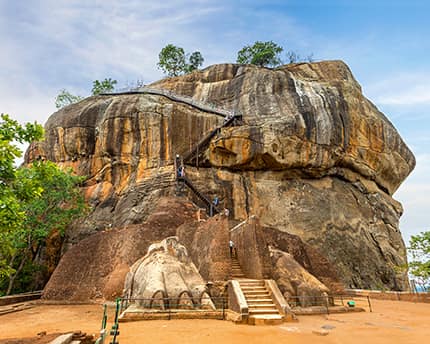
- →Sigiriya: the 5th-century rock fortress with frescoes and a summit palace.
- →Dambulla: five painted cave shrines under one overhanging rock.
- →Kandy: the last royal capital and the Temple of the Sacred Tooth Relic.
Where to base yourself on a first visit
A single central base is the most important decision for a first visit to the Cultural Triangle. Sigiriya, Habarana and Dambulla sit within about 30 minutes of each other, and from any of them Polonnaruwa is roughly an hour to an hour and a half away and Anuradhapura roughly one and a half to two hours.
Sigiriya village suits travellers who want to be at the rock at opening time and like a quiet, rural setting. Habarana is the crossroads for elephant safaris at Minneriya, Kaudulla and Hurulu. Dambulla has more shops, banks and the cave temple on the doorstep, and puts you closer to Kandy for the onward drive.
Changing hotels every night is the most common way first-timers lose time in the Cultural Triangle. Three nights in one place, with day trips, means you unpack once and can move a site by a day if the weather or your energy changes.
- →Sigiriya: best for an early climb and village quiet.
- →Habarana: best for elephant safaris and the Polonnaruwa road.
- →Dambulla: best for services, the cave temple and the drive on to Kandy.
A first-time plan for three or four days
The classic first-time plan for the Cultural Triangle covers the three headline sites in three days with rest in between. Day one is the arrival drive from the airport, which takes most of the day once immigration and lunch are counted. Keep the evening free.
Day two is Sigiriya at around 7am, back to the hotel by late morning, then Dambulla's cave temple from about 3.30pm when the steps are in shade. Day three is Polonnaruwa from early morning, starting at the museum, followed by an afternoon elephant safari at whichever park the trackers currently favour.
- →Day 1: airport to the central base, roughly four to four and a half hours.
- →Day 2: Sigiriya at opening, midday rest, Dambulla cave temple in the late afternoon.
- →Day 3: Polonnaruwa by bicycle or tuk-tuk, then an elephant safari after lunch.
- →Day 4 (optional): Anuradhapura from about 6am, with Mihintale at sunset.
- →Day 5: on to Kandy, roughly two and a half to three hours, via Nalanda Gedige or Aluvihare.
Temple rules and dress for first-timers
Every active temple in the Cultural Triangle asks visitors to cover their shoulders and knees and to remove shoes and hats before stepping onto sacred ground. That includes the stupas and image houses inside Anuradhapura and Polonnaruwa, not only the working temples, so carry a light scarf or sarong and wear shoes that slip off easily.
A few rules surprise first-time visitors. Posing for a photo with your back to a Buddha image is considered disrespectful, and visible Buddha tattoos have led to visitors being refused entry. Drones are banned at the archaeological sites without a permit, and you walk clockwise around a stupa.
- →Cover shoulders and knees: a sarong or long skirt works for everyone.
- →Remove shoes and hats at temple entrances; socks are usually fine.
- →Never touch or turn your back on a Buddha image for a photo.
- →Keep voices low and do not point your feet towards monks or images.
Tickets and costs on a first visit
Entry tickets are the largest fixed cost of a first visit to the Cultural Triangle. Foreign adults pay roughly US$30 to US$35 at Sigiriya and roughly US$25 to US$30 each at Anuradhapura and Polonnaruwa, while Dambulla's cave temple costs much less. Prices change, so confirm them shortly before you go.
A car and driver for the region typically costs roughly US$50 to US$90 a day, a licensed site guide roughly US$20 to US$40 for a half day, and an elephant safari roughly US$50 to US$80 per person in a shared private jeep including park fees. Children usually pay reduced rates at the ticketed sites.
- →Sigiriya: roughly US$30 to US$35 for foreign adults.
- →Anuradhapura and Polonnaruwa: roughly US$25 to US$30 each.
- →Dambulla cave temple: a few dollars to around US$10.
- →Elephant safari: roughly US$50 to US$80 per person including fees.
Fitting the Cultural Triangle into a first trip
The Cultural Triangle usually comes first on a first trip to Sri Lanka, followed by Kandy, the hill country and the south coast. That order puts the hottest sightseeing at the start, while you are fresh, and ends the trip on the beach. Between roughly January and September the dry zone is mostly rain-free; October to December brings the heaviest rain.
Lankan Stays & Trails plans first visits to the Cultural Triangle around one base and early starts, with a driver who knows which park the elephants are in that week. For deeper background on each site, read the Cultural Triangle hub guide, then the site guides for Sigiriya, Anuradhapura and Polonnaruwa.
Choose three nights if you want Sigiriya, Dambulla, Polonnaruwa and a safari at a gentle pace. Choose four if Anuradhapura's stupas and the Sri Maha Bodhi matter to you, or if you are travelling with children or older relatives and want a spare day.
Frequently asked questions
How many days do first-time visitors need in the Cultural Triangle?
Three nights covers Sigiriya, Dambulla, Polonnaruwa and an elephant safari at a comfortable pace, with rest during the hottest hours. A fourth night adds Anuradhapura and Mihintale. Two nights is possible but means skipping either Polonnaruwa or the safari.
Which is better for a first visit, Sigiriya or Dambulla as a base?
Sigiriya suits travellers who want to reach the rock at opening time and prefer a rural setting with village walks. Dambulla has more services, the cave temple nearby and a shorter onward drive to Kandy. Habarana is the third option, best for elephant safaris.
What should I wear to the Cultural Triangle temples?
Wear loose, light clothing that covers your shoulders and knees, such as linen trousers or a long skirt with a T-shirt. Slip-on shoes save time because you remove them at every temple, and a pair of socks protects your feet from hot stone at midday.
Is the Cultural Triangle safe for first-time visitors?
Yes, the Cultural Triangle is generally safe and used to visitors. The main hazards are heat, slippery rock after rain, monkeys that snatch food and wild elephants on rural roads after dark. Use licensed guides and agree tuk-tuk fares before setting off.
Can you visit the Cultural Triangle without a guide?
You can. The sites have signboards and many visitors explore Polonnaruwa by bicycle alone. A licensed guide adds a lot at Anuradhapura, where the sites are spread out and the history is layered, and at Dambulla, where the cave paintings are easy to walk past without context.
What is the best month to visit the Cultural Triangle?
January to April is the driest period, with February and early March the best balance of dry weather and bearable heat. May to September is also mostly dry and adds the elephant gathering. October to December brings the main rains to the dry zone.
Does Lankan Stays & Trails arrange first visits to the Cultural Triangle?
Yes. We plan Cultural Triangle stays around one well-placed base, early starts at each site and an experienced driver-guide, then link them to Kandy, the hill country and the coast. Share your dates and pace and we will suggest a plan.