
Quick answer
Choose Polonnaruwa if you have one day: it is compact, easily covered by bicycle in half a day, exceptionally well preserved, and contains the Gal Vihara Buddha carvings, the finest sculpture in Sri Lanka. Choose Anuradhapura if you want scale and living religion: it was capital from around the fourth century BCE to the eleventh century CE, holds the Sri Maha Bodhi and the great stupas, and remains an active pilgrimage centre. Anuradhapura is far larger and needs a full day plus transport.
Key takeaways
- Anuradhapura was capital for roughly 1,300 years; Polonnaruwa for about two centuries from the eleventh century.
- Polonnaruwa is compact and cyclable in half a day; Anuradhapura sprawls over a very large area.
- The Gal Vihara rock carvings at Polonnaruwa are widely regarded as Sri Lanka's finest sculpture.
- Anuradhapura's Sri Maha Bodhi and great stupas remain active pilgrimage sites.
- Both are UNESCO World Heritage sites and both charge separate archaeological zone entry fees.
The short answer
With one day, go to Polonnaruwa. It is more compact, better preserved, easier to understand without a guide, and it contains the single greatest thing in either city: the Gal Vihara. You can cycle it comfortably in half a day and come away feeling you saw it properly.
With two days, do both, and put Anuradhapura first so that Polonnaruwa's concentration comes as relief rather than anticlimax. If you have a specific interest in Buddhism as a living religion rather than as archaeology, reverse that and give Anuradhapura the priority.
- →One day, first visit: Polonnaruwa.
- →Two days: Anuradhapura then Polonnaruwa.
- →Interested in living pilgrimage rather than ruins: Anuradhapura.
- →Travelling with children or short on energy: Polonnaruwa, by bicycle.
Two very different histories
Anuradhapura was the capital of Sri Lanka from roughly the fourth century BCE until the eleventh century CE, which is an almost unimaginable span. Over that time it became one of the great cities of the ancient world, with vast monastic complexes, enormous stupas that were among the tallest structures on earth when built, and an irrigation system of reservoirs and canals that supported hundreds of thousands of people.
Polonnaruwa became the capital after Anuradhapura fell to Chola invasion in the eleventh century, and its golden age was brief and brilliant, particularly under Parakramabahu I in the twelfth century. Because it was built quickly, occupied briefly and then abandoned, it survives as a coherent city rather than as layers of successive rebuilding, which is precisely why it is easier to read.
- →Anuradhapura: capital from roughly the 4th century BCE to the 11th century CE.
- →Polonnaruwa: capital from the 11th century, peaking under Parakramabahu I.
- →Anuradhapura is layered over 1,300 years; Polonnaruwa is essentially one period.
- →Polonnaruwa's short life is why its plan survives so legibly.
What Polonnaruwa gives you
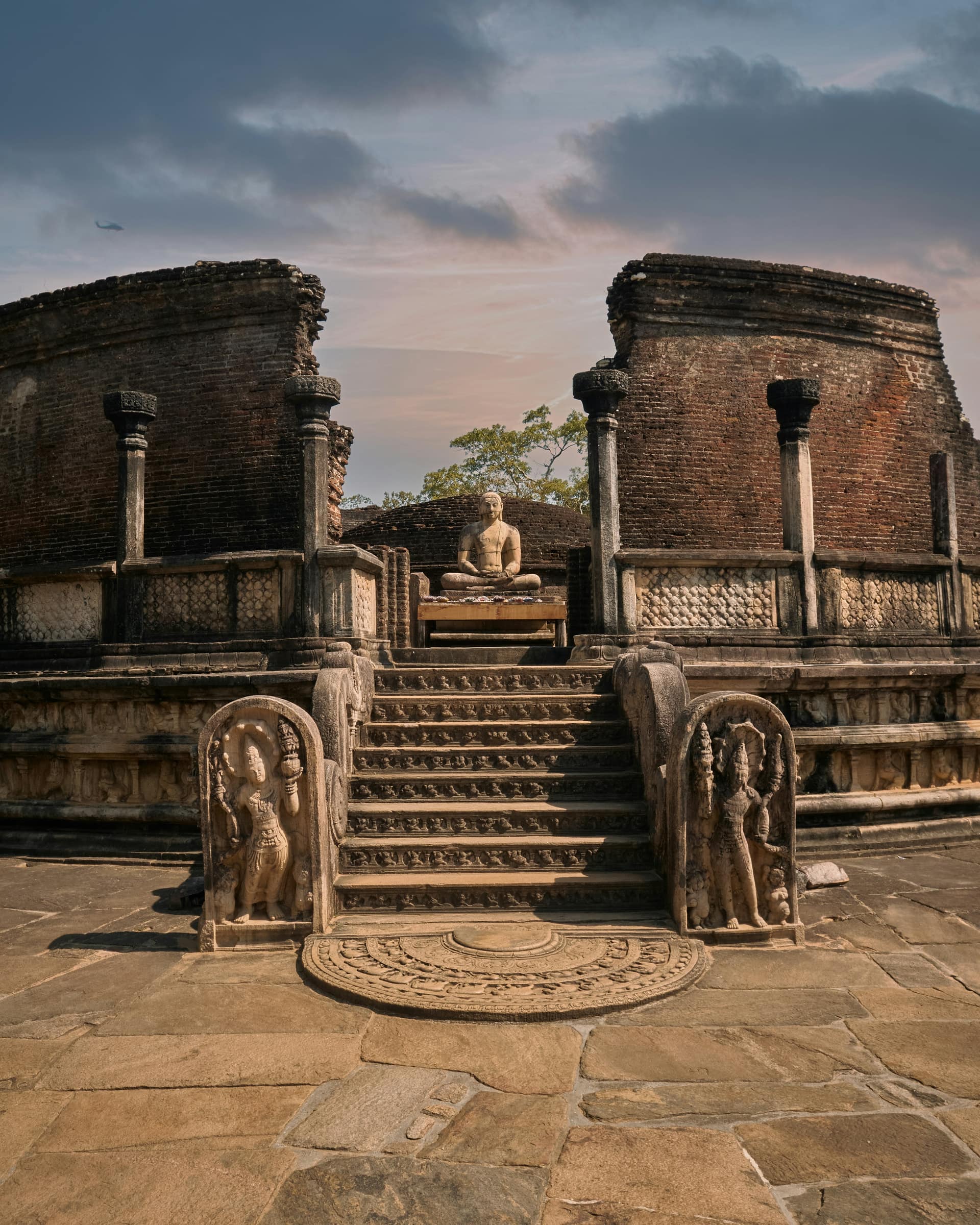
Polonnaruwa's quadrangle, the Dalada Maluwa, is the densest concentration of significant buildings in Sri Lanka: the Vatadage with its guardstones and moonstones, the Hatadage, the Thuparama image house, and the Gal Pota, a stone book nine metres long carved with a royal inscription. You can walk between all of them in twenty minutes.
The Gal Vihara is the reason to come. Four Buddha images carved from a single granite face, including a 14-metre reclining Buddha and a standing figure with its arms crossed in an unusual posture, they are the finest sculpture in the country and among the finest in Asia. Beyond them lie the Lankatilaka image house, the Rankot Vihara stupa, and the vast Parakrama Samudra reservoir.
- →Gal Vihara: four Buddha images in a single granite face, the finest sculpture in Sri Lanka.
- →The quadrangle: Vatadage, Hatadage, Thuparama and the Gal Pota stone book.
- →Lankatilaka, Rankot Vihara and the Royal Palace complex.
- →Parakrama Samudra: a twelfth-century reservoir still in use.
- →The whole site is cyclable; toque macaques are abundant around the ruins.
What Anuradhapura gives you
Anuradhapura's centrepiece is the Jaya Sri Maha Bodhi, a sacred fig grown from a cutting of the tree the Buddha sat under, planted in 236 BCE and continuously tended since, making it the oldest human-planted tree with a recorded planting date. Around it are Ruwanwelisaya, the great white stupa of the second century BCE, and Thuparamaya, the island's earliest stupa.
Further out are the enormous brick masses of Jetavanaramaya and Abhayagiri, the exquisite moonstone and guardstones at the Ratnaprasada, the Isurumuniya rock temple with its famous lovers' carving, and the Twin Ponds. The distances are considerable and the site is properly a landscape rather than a park.
The difference in feel is the crucial thing. Anuradhapura is full of pilgrims in white at all hours, and the sacred areas are places of worship, not exhibits. Polonnaruwa, with a few exceptions, is a site you look at.
- →Jaya Sri Maha Bodhi: planted 236 BCE, an active and deeply revered shrine.
- →Ruwanwelisaya and Thuparamaya: the great early stupas.
- →Jetavanaramaya and Abhayagiri: vast brick stupas of the monastic quarters.
- →Isurumuniya, the Twin Ponds and the Ratnaprasada moonstone.
- →An active pilgrimage centre, not only an archaeological site.
Size, time and how you get around
Polonnaruwa's archaeological zone is compact enough that a bicycle covers it comfortably. Half a day is enough to see everything without rushing; a full day is generous. The main sites are strung along one axis with short distances between them, and shade is reasonable.
Anuradhapura is much larger and the major sites are kilometres apart. A bicycle works if you are fit and start early, but many visitors use a vehicle between clusters and walk within them. A full day is the minimum and it will be a long one. Shoes come off repeatedly at the sacred sites, and the granite gets very hot from mid-morning.
- →Polonnaruwa: compact, cyclable, half a day is sufficient.
- →Anuradhapura: sprawling, sites kilometres apart, a full day minimum.
- →Both are in the dry zone and both are hot; start at opening.
- →Anuradhapura involves repeated shoe removal on hot stone. Bring socks.
Where they are and how they fit a route
Polonnaruwa is roughly an hour and a half east of Sigiriya and Habarana, which puts it squarely in the standard Cultural Triangle loop. Most itineraries base at Sigiriya or Habarana and day-trip to it.
Anuradhapura is roughly two hours north-west of Sigiriya and about four hours from Colombo, and it is more of a commitment. It pairs naturally with Mihintale, which sits 12 kilometres away and is best done at dawn on the same day, and with Wilpattu National Park to the west.
- →Polonnaruwa: about 1.5 hours from Sigiriya or Habarana.
- →Anuradhapura: about 2 hours from Sigiriya, 4 hours from Colombo.
- →Anuradhapura pairs with Mihintale at dawn and with Wilpattu.
- →Polonnaruwa pairs with Minneriya or Kaudulla for an afternoon safari.
Tickets and value
Both charge separate archaeological zone entry fees for foreign visitors, and neither is cheap. Prices change, so confirm locally and carry cash, as card acceptance at ticket offices is unreliable.
In value terms, Polonnaruwa delivers more per hour: the density of significant things per kilometre walked is far higher. Anuradhapura rewards those who give it a full day and a guide, and disappoints those who try to see it in three hours between other commitments.
How we would plan it
Three nights at Sigiriya or Habarana. Day one: Sigiriya at opening, Dambulla in the afternoon. Day two: Polonnaruwa by bicycle in the morning, Minneriya or Kaudulla safari in the late afternoon. Day three: an early start for Mihintale, then Anuradhapura, returning in the evening.
Lankan Stays & Trails runs both cities with a guide, which matters far more at Anuradhapura than at Polonnaruwa, and provides bicycles at Polonnaruwa, which is simply the best way to see it.
Frequently asked questions
Anuradhapura or Polonnaruwa, which should I visit?
With one day, choose Polonnaruwa: it is compact, cyclable in half a day, exceptionally well preserved, and contains the Gal Vihara, the finest sculpture in Sri Lanka. Choose Anuradhapura if you want scale, the Sri Maha Bodhi and a living pilgrimage centre.
Which is bigger, Anuradhapura or Polonnaruwa?
Anuradhapura, by a very large margin. It was capital for roughly 1,300 years and its major sites are kilometres apart, requiring a full day and often a vehicle between clusters. Polonnaruwa's archaeological zone is compact enough to cover comfortably by bicycle.
What is the Gal Vihara?
A group of four Buddha images carved from a single granite face at Polonnaruwa, including a 14 metre reclining Buddha and a standing figure with crossed arms. They are widely regarded as the finest sculpture in Sri Lanka and among the finest in Asia.
How long do you need at Polonnaruwa?
Half a day is enough to see everything without rushing, and a full day is generous. The main sites are strung along one axis with short distances between them, which makes a bicycle the ideal way to get around. Start at opening to avoid the midday heat.
How long do you need at Anuradhapura?
A full day at minimum, and two if you want to include Mihintale properly. The sites are kilometres apart across a large landscape, and the sacred areas require repeated shoe removal on granite that becomes very hot from mid-morning. Start early and carry water.
Can you visit both Anuradhapura and Polonnaruwa in one day?
Not sensibly. They are roughly three hours apart by road and each needs at least half a day, so you would spend more time driving than looking. Base at Sigiriya or Habarana and give them separate days, with Polonnaruwa as the shorter of the two.
Are Anuradhapura and Polonnaruwa UNESCO sites?
Yes, both are UNESCO World Heritage Sites, as is Sigiriya, Dambulla and the Sacred City of Kandy. Anuradhapura and Polonnaruwa each charge a separate archaeological zone entry fee for foreign visitors, payable in cash at the site ticket offices.