
Quick answer
The Jaya Sri Maha Bodhi in Anuradhapura is a sacred fig tree grown from a cutting of the Bodhi tree at Bodh Gaya under which the Buddha attained enlightenment. It was brought to Sri Lanka by the nun Sanghamitta and planted in 236 BCE, making it the oldest living human-planted tree with a recorded planting date. It stands within Anuradhapura's sacred city and remains one of Buddhism's most important pilgrimage sites. Visitors must dress in modest clothing, ideally white, and remove shoes and hats.
Key takeaways
- The tree was planted in 236 BCE and is the oldest living human-planted tree with a recorded planting date.
- It grew from a cutting of the Bodhi tree at Bodh Gaya in India, brought by the nun Sanghamitta.
- It sits at the heart of Anuradhapura's sacred city, alongside Ruwanwelisaya and Thuparamaya.
- White clothing is traditional; shoulders and knees must be covered and shoes and hats removed.
- Poya days, especially Poson in June, bring enormous crowds of pilgrims.
How the tree got here
After King Devanampiya Tissa's conversion at Mihintale in the third century BCE, the monk Mahinda's sister Sanghamitta, a Buddhist nun, is recorded as having travelled from India bringing a cutting from the southern branch of the Bodhi tree at Bodh Gaya, under which the Buddha attained enlightenment. The cutting was planted at Anuradhapura in 236 BCE with the king in attendance.
The Mahavamsa records the planting and the arrangements made for the tree's protection, and the chronicles continue to record its care through the centuries. That continuous documentation is what makes the claim about its age meaningful: there are older living trees, but none with a written record of when they were planted and by whom.
- →Planted in 236 BCE, during the reign of King Devanampiya Tissa.
- →Grown from a cutting of the Bodh Gaya Bodhi tree, brought by the nun Sanghamitta.
- →The planting and its care are recorded in the Mahavamsa chronicle.
- →The original tree at Bodh Gaya was later destroyed; saplings from Anuradhapura were used to replant it.
What you see
The tree stands on a series of raised terraces enclosed by a gold-railed wall, with the main trunk supported by gilded props. Around it are lesser bodhi trees, shrine buildings and offering platforms, and the whole enclosure is approached through a series of gates where shoes are left.
The atmosphere is the point. Pilgrims in white bring lotus flowers and oil lamps, monks chant, and there is a continuous quiet movement of people around the terraces at almost any hour. Unlike much of the archaeological zone around it, this is not a ruin being visited; it is a living shrine that happens to be twenty-three centuries old.
- →Raised terraces enclosed by a gold-railed wall, with gilded trunk supports.
- →Approached through gates where shoes and hats must be left.
- →Active around the clock, with a steady flow of pilgrims in white.
- →Lotus flowers and oil lamps are the traditional offerings.
Etiquette, and why it matters here
This is among the most sacred places in the Buddhist world and it is treated as such. Wear white if you can, which is the traditional colour for temple visits, and at a minimum cover shoulders and knees in plain, modest clothing. Shoes and hats are removed at the entrance to the enclosure.
Do not turn your back on the tree or on a Buddha image for a photograph. Do not wear or display Buddha images on clothing or as tattoos, which causes genuine offence in Sri Lanka and has resulted in legal action against visitors. Keep your voice low, walk clockwise, and step aside for pilgrims. If a ceremony is in progress, watch quietly from the edge rather than moving through it.
- →Wear white if possible; otherwise cover shoulders and knees in plain clothing.
- →Remove shoes and hats at the enclosure entrance.
- →Never turn your back to the tree or a Buddha image for a photograph.
- →Do not display Buddha images on clothing or as tattoos.
- →Walk clockwise, keep quiet, and give way to pilgrims.
When to visit
Early morning is best. The sacred city opens early, the light is good, the stone is cool underfoot, and the crowds are lighter. By mid-morning the granite paving is genuinely hot and shoes are not permitted, which is a real consideration in the dry zone.
Poya days bring very large crowds, and Poson Poya in June, which commemorates the arrival of Buddhism, turns Anuradhapura and Mihintale into one of the largest pilgrimages in the country. That is either the best possible time to visit or the worst, depending entirely on what you want from the day.
- →Best: early morning, for cool stone, good light and lighter crowds.
- →Barefoot on hot granite by mid-morning is genuinely uncomfortable.
- →Poya days are very busy; Poson in June is the largest pilgrimage of the year.
- →A ticket for the Anuradhapura archaeological zone is required for the wider site.
The rest of the sacred city
The Sri Maha Bodhi sits within a vast archaeological zone that was one of the great cities of the ancient world. Ruwanwelisaya, the enormous white stupa built by King Dutugemunu in the second century BCE, is a few minutes' walk away and is at its most beautiful at dusk. Thuparamaya, the island's earliest stupa, stands nearby.
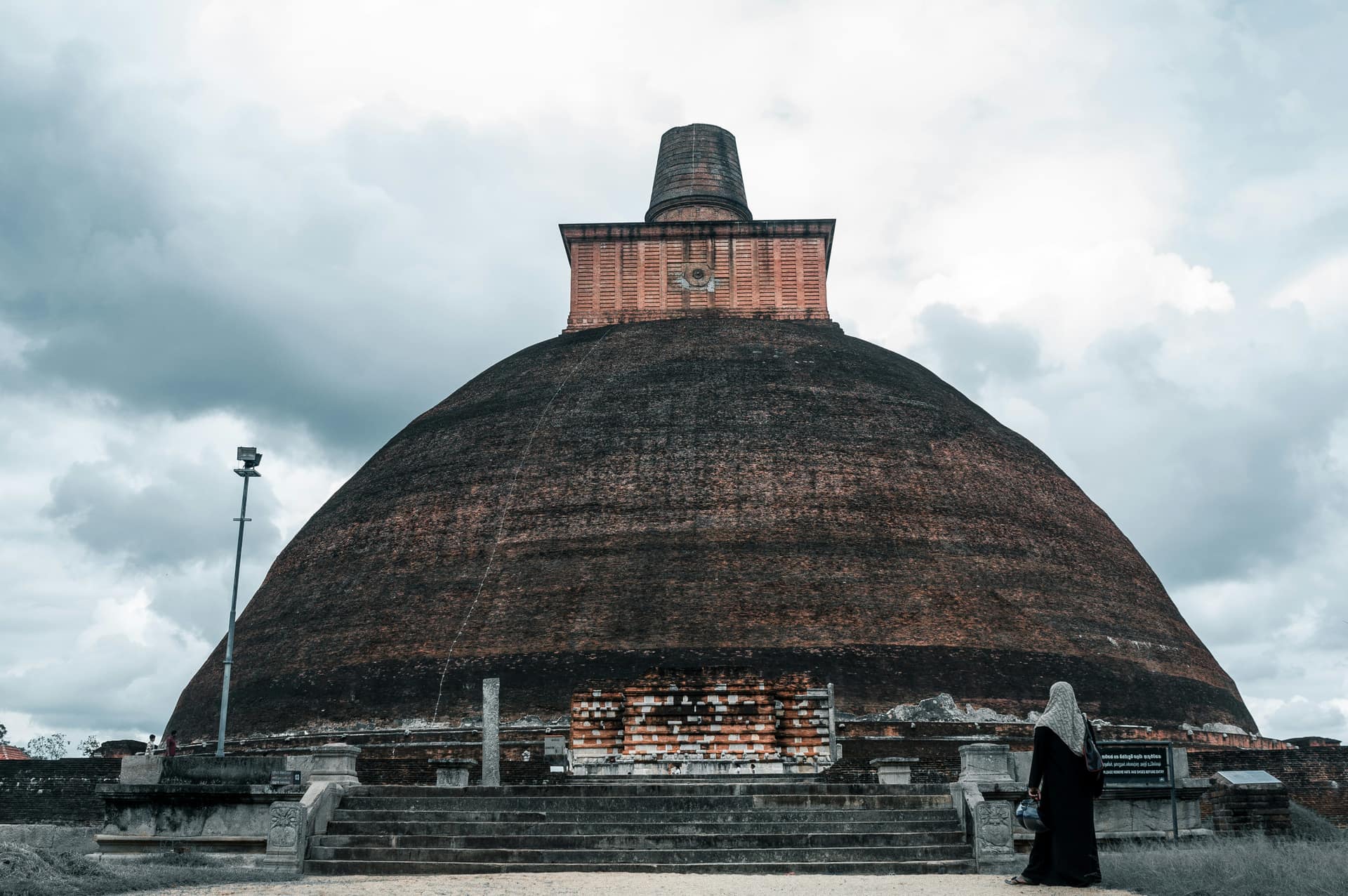
Further out are the giant brick masses of Jetavanaramaya and Abhayagiri, the moonstone and guardstones of the Ratnaprasada, the Isurumuniya rock temple with its famous lovers' carving, and the Twin Ponds. The site is far too large to walk in a day, which is why a bicycle is the right way to see it.
- →Ruwanwelisaya: enormous white stupa, second century BCE, superb at dusk.
- →Thuparamaya: the earliest stupa in Sri Lanka.
- →Jetavanaramaya and Abhayagiri: vast brick stupas of the monastic quarters.
- →Isurumuniya: rock temple with the celebrated lovers' carving.
- →Hire a bicycle; the archaeological zone is far too large to walk.
Practicalities
Anuradhapura is roughly four hours from Colombo and about two hours from Sigiriya or Dambulla, which makes it an easy addition to a Cultural Triangle itinerary. It deserves at least a full day, and two if you want to combine it properly with Mihintale.
Bring socks if hot stone concerns you, carry water, and expect to leave shoes at multiple points. There is a separate entry ticket for the archaeological zone, and the Sri Maha Bodhi enclosure itself may have its own arrangements, so carry cash.
- →Roughly four hours from Colombo; about two hours from Sigiriya.
- →Allow a full day, or two if combining with Mihintale.
- →Bring socks, water and cash for entry tickets.
- →Shoes come off at multiple points across the sacred city.
Fitting it into a trip
The strongest Cultural Triangle day pairs Mihintale at dawn with Anuradhapura by bicycle from mid-morning, finishing at Ruwanwelisaya as the light goes. That takes in the arrival of Buddhism, its oldest living symbol and its greatest ancient monuments in a single day.
Lankan Stays & Trails runs Anuradhapura with a guide who can explain what you are standing in front of, which matters more here than at almost any other site in Sri Lanka, because so much of the meaning is invisible without it.
Frequently asked questions
What is the Jaya Sri Maha Bodhi?
A sacred fig tree in Anuradhapura grown from a cutting of the Bodhi tree at Bodh Gaya, under which the Buddha attained enlightenment. Brought to Sri Lanka by the nun Sanghamitta and planted in 236 BCE, it is one of Buddhism's most important pilgrimage sites.
Is the Sri Maha Bodhi the oldest tree in the world?
It is the oldest living human-planted tree with a recorded planting date, documented in the Mahavamsa chronicle as planted in 236 BCE. Older living trees exist, but none has a continuous written record of when it was planted, by whom, and how it has been tended since.
What should I wear to visit the Sri Maha Bodhi?
White is traditional for temple visits in Sri Lanka and is the ideal choice here. At minimum, wear plain modest clothing covering shoulders and knees. Shoes and hats are removed at the enclosure entrance, and clothing displaying Buddha images must not be worn.
When is the best time to visit Anuradhapura's sacred city?
Early morning, when the granite paving is still cool underfoot, the light is good and crowds are lighter. Shoes are not permitted in the sacred areas, and by mid-morning the stone becomes uncomfortably hot. Poya days, especially Poson in June, are extremely busy.
How long do you need in Anuradhapura?
At least a full day for the sacred city, and two if you want to include Mihintale properly. The archaeological zone is very large, so hire a bicycle rather than trying to walk it. Anuradhapura is roughly four hours from Colombo and two from Sigiriya.
What else should I see in Anuradhapura?
Ruwanwelisaya, the great white stupa built in the second century BCE and best at dusk; Thuparamaya, the island's earliest stupa; the vast brick stupas of Jetavanaramaya and Abhayagiri; the Isurumuniya rock temple with its lovers' carving; and the Twin Ponds.
Do you need a ticket for the Sri Maha Bodhi?
A ticket is required for the Anuradhapura archaeological zone, which covers most of the sacred city, and the Sri Maha Bodhi enclosure may have its own arrangements. Carry cash, as card acceptance at ticket points across the Cultural Triangle is unreliable.