
Quick answer
Mihintale is a sacred hill roughly 12 kilometres east of Anuradhapura, regarded as the birthplace of Buddhism in Sri Lanka. Tradition holds that the monk Mahinda, son of the Indian emperor Ashoka, met King Devanampiya Tissa here in the third century BCE and converted him. Visitors climb a granite stairway of around 1,840 steps past monastic ruins, the Ambasthala Dagoba and Aradhana Gala to the Maha Seya stupa. Go at dawn to avoid the heat, and expect enormous crowds at Poson Poya in June.
Key takeaways
- Mihintale is about 12 kilometres east of Anuradhapura, roughly 20 minutes by road.
- The main stairway has around 1,840 granite steps, climbed in sections with terraces between.
- Tradition places Mahinda's meeting with King Devanampiya Tissa here in the third century BCE.
- Poson Poya in June draws hundreds of thousands of white-clad pilgrims to the hill.
- It is an active sacred site: cover shoulders and knees, and remove shoes and hats in the temple areas.
What happened at Mihintale
The Mahavamsa, Sri Lanka's great chronicle, records that in the third century BCE King Devanampiya Tissa was hunting deer on this hill when he was hailed by a stranger. The stranger was Mahinda, a monk and son of the Indian emperor Ashoka, and he tested the king with a question about mango trees to establish whether he could reason well enough to receive the teaching.
The king could, and the encounter is treated as the moment Buddhism entered Sri Lanka. Within a generation the religion had transformed the island's kingship, art, agriculture and architecture, and Anuradhapura became one of the ancient world's great monastic cities. That is why Mihintale matters far beyond its size: it is a founding site, not merely an old one.
- →Traditionally dated to the third century BCE, in the reign of Devanampiya Tissa.
- →Mahinda was a monk and, by tradition, son of the emperor Ashoka of India.
- →The meeting is recorded in the Mahavamsa chronicle.
- →Mihintale became one of the earliest monastic complexes in Sri Lanka.
The stairway and the climb
The ascent is by a broad granite stairway of around 1,840 steps, built in flights with level terraces between them, which makes it far less punishing than the number suggests. Most reasonably mobile visitors manage it in 30 to 45 minutes at an unhurried pace, stopping at the ruins on the way.
The first major terrace holds the remains of the monastic hospital and the refectory, with a large stone rice trough and an alms bowl carved from rock. Higher up you reach the Ambasthala Dagoba, marking the traditional spot of the meeting, with a statue of Devanampiya Tissa nearby and Mahinda's cave and stone bed a short walk away.
- →Around 1,840 steps, built in flights with level terraces between.
- →Typically 30 to 45 minutes to the main terrace at an unhurried pace.
- →Shoes must be removed above the Ambasthala terrace; the granite gets hot.
- →Handrails exist in places but not everywhere; the stone is worn smooth.
What to see on the hill
The Ambasthala Dagoba is the heart of the site, a small stupa surrounded by pillars where the mango-tree conversation is said to have taken place. From here, a bare granite dome called Aradhana Gala, the Rock of Invitation, is reached by an exposed climb with an iron handrail. It is the finest viewpoint on the hill and not for anyone uneasy with heights.
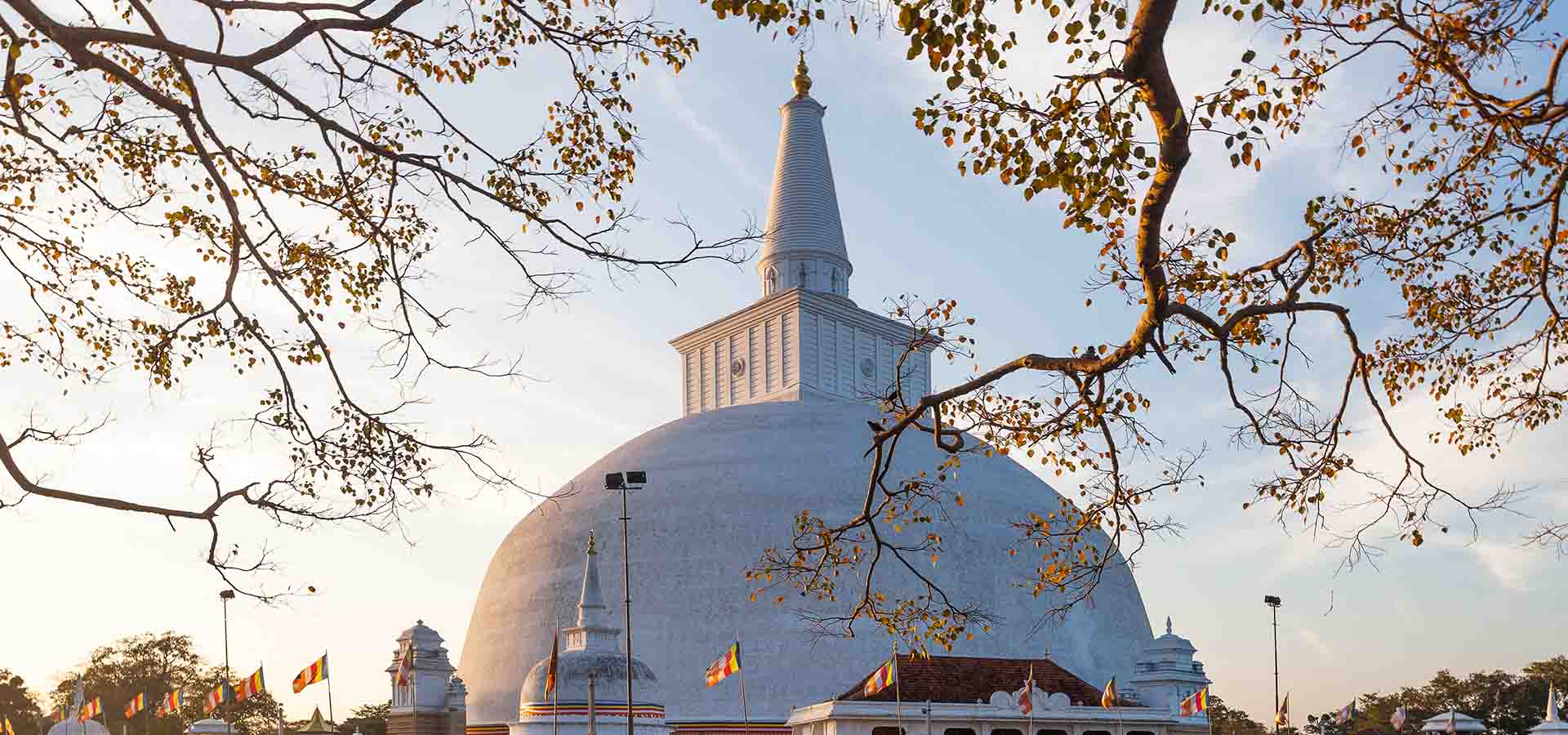
The Maha Seya, a large white stupa on the summit, is said to enshrine a relic of the Buddha and gives a 360-degree view across the dry-zone plain to Anuradhapura's stupas on the horizon. Below and to the side sit Kaludiya Pokuna, a beautifully constructed monastic bathing pond, and Sinha Pokuna, the lion pond with a carved spout, both worth the detour.
- →Ambasthala Dagoba: the traditional site of the meeting.
- →Aradhana Gala: bare granite climb with a handrail, best view on the hill.
- →Maha Seya: summit stupa with panoramic views towards Anuradhapura.
- →Kaludiya Pokuna and Sinha Pokuna: ancient monastic ponds below the main climb.
Poson Poya at Mihintale
Poson Poya, on the June full moon, commemorates Mahinda's arrival and is the single most important day at Mihintale. Hundreds of thousands of pilgrims dressed in white climb the steps, many through the night, and the roads for miles around fill with dansal, free food stalls run by volunteers.
It is extraordinary and it is extremely crowded. If you want to witness it, book Anuradhapura accommodation months in advance, expect heavy traffic, and be prepared for very slow progress on the steps. If you want a quiet Mihintale, come at any other time and avoid the week around the June poya entirely.
- →Poson falls on the June full moon; the date shifts each year with the lunar calendar.
- →Hundreds of thousands of pilgrims climb, many overnight.
- →Book Anuradhapura accommodation many months ahead for Poson.
- →Avoid the Poson week entirely if you want a quiet visit.
When to go
Come at dawn. Mihintale sits in the dry zone, the granite absorbs heat ferociously, and shoes must come off above the main terrace. By nine in the morning the stone is genuinely uncomfortable to walk on barefoot, and by midday it can be painful.
Sunrise from the upper terraces, looking west across the plain towards Anuradhapura, is one of the finest in the Cultural Triangle. Late afternoon is the alternative, with sunset from the Maha Seya, though you should be down before dark. The site is at its best in the dry months of roughly May to September on this side of the island.
- →Best: at or shortly after opening, for cool granite and morning light.
- →Second best: late afternoon for sunset from the summit.
- →Avoid the middle of the day; barefoot on hot granite is genuinely painful.
- →Carry water. There is little shade above the first terrace.
Etiquette at an active sacred site
Mihintale is not a ruin, it is a working temple and one of the most sacred places in the country. Cover shoulders and knees, remove shoes and hats above the Ambasthala terrace, and do not wear anything with a Buddha image on it, which causes genuine offence and can cause legal trouble.
Never pose with your back to a Buddha statue for a photograph, a practice that is deeply disrespectful and regularly reported. Keep your voice low near shrines, walk clockwise around stupas, and step aside for pilgrims, particularly the elderly making the climb slowly.
- →Cover shoulders and knees; remove shoes and hats above the main terrace.
- →Never turn your back to a Buddha image for a photograph.
- →Do not wear clothing or tattoos displaying Buddha images.
- →Walk clockwise around stupas and give way to pilgrims on the steps.
Fitting Mihintale into a Cultural Triangle trip
Mihintale is 12 kilometres from Anuradhapura and is best done as a dawn outing before breakfast, leaving the rest of the day for Anuradhapura's sacred city: the Sri Maha Bodhi, Ruwanwelisaya, Jetavanaramaya and Abhayagiri. That combination is one of the strongest days in the Cultural Triangle.
Lankan Stays & Trails sets Mihintale at first light and pairs it with Anuradhapura by bicycle later in the morning, which is the coolest and most enjoyable way to cover a very large ancient city.
Frequently asked questions
How many steps are there at Mihintale?
Around 1,840 granite steps, built in flights with level terraces between them, which makes the climb far more manageable than the number suggests. Most reasonably mobile visitors reach the main terrace in 30 to 45 minutes at an unhurried pace.
Why is Mihintale important?
It is regarded as the birthplace of Buddhism in Sri Lanka. The Mahavamsa chronicle records that the monk Mahinda, son of the Indian emperor Ashoka, met King Devanampiya Tissa here in the third century BCE and converted him, an encounter that transformed the island.
How far is Mihintale from Anuradhapura?
About 12 kilometres east, roughly 20 minutes by road. The two are almost always visited on the same day, with Mihintale done at dawn before the granite heats up and Anuradhapura's sacred city covered later in the morning, often by bicycle.
What is the best time to visit Mihintale?
At or shortly after opening, at dawn. Shoes must be removed above the main terrace and the granite becomes uncomfortably hot by mid-morning. Sunrise views west towards Anuradhapura are excellent. Late afternoon is a good alternative if you are down before dark.
What should I wear to Mihintale?
Cover shoulders and knees, as at any Sri Lankan Buddhist site. Shoes and hats must be removed above the Ambasthala terrace, so bring socks if hot stone concerns you. Avoid any clothing showing a Buddha image, which causes genuine offence and can cause legal difficulties.
When is Poson at Mihintale?
Poson Poya falls on the June full moon and commemorates Mahinda's arrival. Hundreds of thousands of white-clad pilgrims climb the steps, many overnight, and free dansal food stalls line the roads. Book accommodation many months ahead, or avoid that week entirely for a quiet visit.
Is Mihintale difficult to climb?
Moderate. The 1,840 steps are broad and divided into flights with flat terraces between, so it is a series of short climbs rather than one long one. The exposed granite scramble up Aradhana Gala, with only an iron handrail, is the part to skip if heights concern you.