
Quick answer
Polonnaruwa is worth it on a first trip to Sri Lanka, and it is the ancient capital most first-time visitors should choose. Capital from roughly the eleventh to thirteenth centuries, it is compact enough to cover by bicycle in a morning, well preserved, and anchored by the Gal Vihara, four Buddha figures carved from a single granite face. It sits roughly an hour and a half from Sigiriya and needs about half a day rather than a full one.
Key takeaways
- Polonnaruwa was Sri Lanka's capital from roughly the eleventh to the thirteenth century, and is the best preserved of the ancient cities.
- The whole site can be covered by bicycle in roughly three to four hours, unlike Anuradhapura, which needs a full day and a vehicle.
- The Gal Vihara, four Buddha figures cut from one granite wall, is the clearest single highlight of any ancient site in Sri Lanka.
- It sits roughly an hour and a half from a Sigiriya or Habarana base, making it a comfortable half-day trip.
- Hiring bicycles turns the site into an activity, which is why it works far better than Anuradhapura for families.
The verdict on Polonnaruwa for a first-time visitor
Polonnaruwa is worth it, and for most first-time visitors it is the single easiest ancient site to recommend. It served as Sri Lanka's capital from roughly the eleventh to the thirteenth century, reaching its peak under King Parakramabahu I, and because it was occupied for a shorter period and abandoned more cleanly than Anuradhapura, a great deal of it still stands.
The practical advantage is compactness. The main archaeological zone runs a few kilometres from end to end along a single route, with the monuments close enough together that a bicycle covers them comfortably. Visitors get a coherent sense of a city rather than a series of separate stops.
The Gal Vihara is what most people remember. Four Buddha images, including a seated figure and a reclining figure of roughly fourteen metres, are cut from one continuous wall of granite, and the quality of the carving is on a different level from anything else in the Cultural Triangle.
- →Capital from roughly the eleventh to thirteenth centuries, under Parakramabahu I and his successors.
- →The best preserved of Sri Lanka's ancient cities, with standing structures rather than foundations.
- →The Gal Vihara holds four Buddha figures carved from a single granite face.
- →The Parakrama Samudra reservoir alongside the site is still in agricultural use today.
What Polonnaruwa costs in trip time
Polonnaruwa costs a first-time visitor about half a day, which is roughly half what Anuradhapura asks for. The site itself takes three to four hours at a relaxed pace, and it sits roughly an hour and a half from a Sigiriya or Habarana base, so the round trip fits into a single day with time left over.
Most first trips attach it to the Cultural Triangle block without adding a night. A typical pattern is Sigiriya at opening on one morning, Dambulla that afternoon, and Polonnaruwa the following morning, returning in time for a late lunch.
The heat is the real limit rather than the distance. Polonnaruwa sits in the dry zone with very little shade between monuments, so an early start matters more here than the hour saved might suggest. Being back at the vehicle by midday is a reasonable target.
- →The site itself: roughly three to four hours at a relaxed pace.
- →Roughly an hour and a half from Sigiriya or Habarana, each way.
- →Fits as a half-day trip without adding a night to the itinerary.
- →Start early: there is very little shade between the monuments.
Why Polonnaruwa works best by bicycle
Polonnaruwa is the one ancient site in Sri Lanka that is genuinely better on a bicycle than in a vehicle, and hiring one changes the character of the visit. The route between monuments runs through shaded woodland on flat ground, and the distances are short enough that no real fitness is required.
The practical benefit is that cycling removes the stop-start rhythm of driving between car parks, which is what makes a long day of ruins tiring. The site starts to feel like a place rather than a checklist.
For families, the bicycles are frequently the highlight of the whole Cultural Triangle. Children who have been patient through two temple visits tend to find a morning of cycling among ruins and macaques a genuine pleasure, and bicycles for various sizes are usually available near the entrance. Confirm availability on the day rather than assuming.
- →Flat, mostly shaded routes between monuments, requiring no particular fitness.
- →Removes the stop-start driving rhythm that makes ruin days tiring.
- →Usually the most popular part of the Cultural Triangle for children.
- →Bicycle hire is generally available near the entrance; confirm on the day.
What to prioritise if time is short
Polonnaruwa rewards a focused visit more than a complete one. Travellers with only two hours should head directly for the Gal Vihara first, then work back through the Quadrangle, rather than following the site in geographical order and running out of energy before the best part.
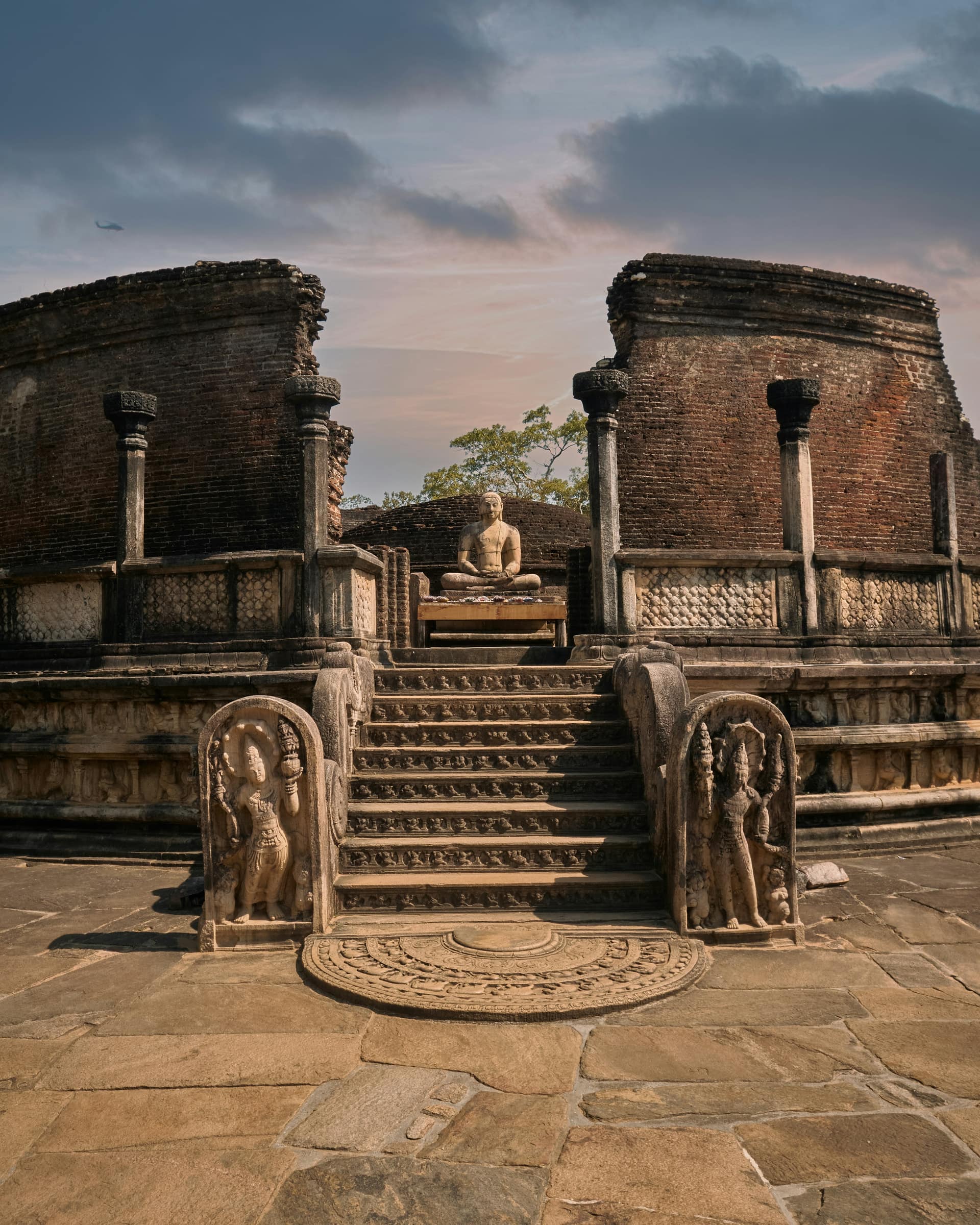
The Quadrangle is the densest cluster, holding the Vatadage with its carved moonstones and guardstones, along with several smaller shrines in a small walled compound. It gives the clearest impression of what a royal religious precinct looked like.
The Royal Palace complex and the Lankatilaka image house are the next tier, and the enormous Parakrama Samudra reservoir alongside the site is worth a few minutes for context: it is a twelfth-century engineering work that is still irrigating farmland today.
- →Gal Vihara first if time is short: four Buddha figures cut from one granite wall.
- →The Quadrangle second: the Vatadage, moonstones and guardstones in one compound.
- →Lankatilaka and the Royal Palace complex next, if time allows.
- →The Parakrama Samudra reservoir still irrigates farmland after eight centuries.
Who should skip Polonnaruwa
Polonnaruwa is genuinely optional for travellers on trips of seven days or fewer, where the Cultural Triangle is already competing with the hill country and the coast for a very small number of days. On those trips, Sigiriya and Dambulla together cover ancient Sri Lanka adequately.
It is also a reasonable cut for travellers who have chosen Anuradhapura instead. The two capitals cover overlapping ground, and doing both on a first trip only makes sense on itineraries of around fourteen days.
Visitors who find archaeology genuinely uninteresting should feel free to skip it without guilt. Polonnaruwa is a very good example of its kind, but it is still a field of ruins, and no amount of historical significance changes that for a traveller whose interest lies in wildlife or landscape.
- →Trips of seven days or fewer: Sigiriya and Dambulla are usually enough.
- →Skip it if Anuradhapura is already in the plan and the trip is under fourteen days.
- →Skip it without guilt if ruins are not your interest; the trip loses little.
Fitting Polonnaruwa into a first trip
Polonnaruwa slots naturally into the second morning of a Cultural Triangle stay based at Sigiriya or Habarana, and it pairs well with an afternoon at Minneriya or Kaudulla, where elephants gather at the reservoir edges in the drier months. That combination makes a strong single day of ruins and wildlife.
Our dedicated Polonnaruwa cycling article covers the route and the individual monuments in detail. This piece is only about whether it earns a slot on a first trip, and for most travellers it does, more comfortably than any other ancient capital. Lankan Stays and Trails uses it as the default ruins stop on first-visit itineraries for precisely that reason.
Frequently asked questions
Is Polonnaruwa worth visiting?
Yes, and it is usually the right ancient capital for a first trip. It is compact enough to cover by bicycle in three to four hours, better preserved than Anuradhapura, and anchored by the Gal Vihara, four Buddha figures carved from a single wall of granite.
How long do you need in Polonnaruwa?
Roughly three to four hours at a relaxed pace covers the main archaeological zone. Adding the drive from a Sigiriya or Habarana base, which takes around an hour and a half each way, makes it a comfortable half-day trip that does not require an extra night.
Can you cycle around Polonnaruwa?
Yes, and it is the best way to see it. The routes between monuments are flat and largely shaded, distances are short, and bicycle hire is generally available near the entrance. Cycling removes the stop-start driving rhythm that makes long days among ruins tiring.
What is the Gal Vihara at Polonnaruwa?
A group of four Buddha images cut from one continuous wall of granite, including a seated figure and a reclining figure of roughly fourteen metres. The carving quality is the highest of any ancient site in Sri Lanka, and it is the clear highlight of a Polonnaruwa visit.
Is Polonnaruwa good for children?
Better than any other ancient site in Sri Lanka, largely because of the bicycles. Children who have been patient through temple visits tend to enjoy a flat, shaded morning of cycling between ruins, with macaques and open woodland along the route keeping interest up.
How far is Polonnaruwa from Sigiriya?
Roughly an hour and a half by road, which makes it a straightforward half-day trip from a Sigiriya or Habarana base. Many first trips pair a Polonnaruwa morning with an afternoon safari at nearby Minneriya or Kaudulla, where elephants gather in the drier months.
Should I visit Polonnaruwa or Anuradhapura?
Polonnaruwa for most first-time visitors, because it is compact, cycleable and better preserved, with a clear highlight in the Gal Vihara. Choose Anuradhapura instead if active Buddhist pilgrimage and sheer scale interest you more than standing ruins. Trips of fourteen days can include both.