
Quick answer
Anuradhapura is worth it on a first trip to Sri Lanka only if you want a living sacred city rather than a compact set of ruins. Founded in the fourth century BCE and capital for over a thousand years, it centres on the Sri Maha Bodhi, grown from a cutting of the tree under which the Buddha attained enlightenment, and on enormous brick dagobas. It is spread over many kilometres and needs a full day, which is why many first trips choose Polonnaruwa instead.
Key takeaways
- Anuradhapura was Sri Lanka's capital for over a thousand years from the fourth century BCE, making it the oldest of the ancient cities.
- The Sri Maha Bodhi is grown from a cutting of the tree under which the Buddha attained enlightenment, and is among the oldest documented planted trees in the world.
- The site is spread across many kilometres and needs a vehicle or bicycle, unlike compact Polonnaruwa.
- It is an active pilgrimage site, so white clothing is common among worshippers and the dress code is strictly observed.
- Most first trips with limited days choose Polonnaruwa over Anuradhapura, and that is usually the right call.
The verdict on Anuradhapura for a first-time visitor
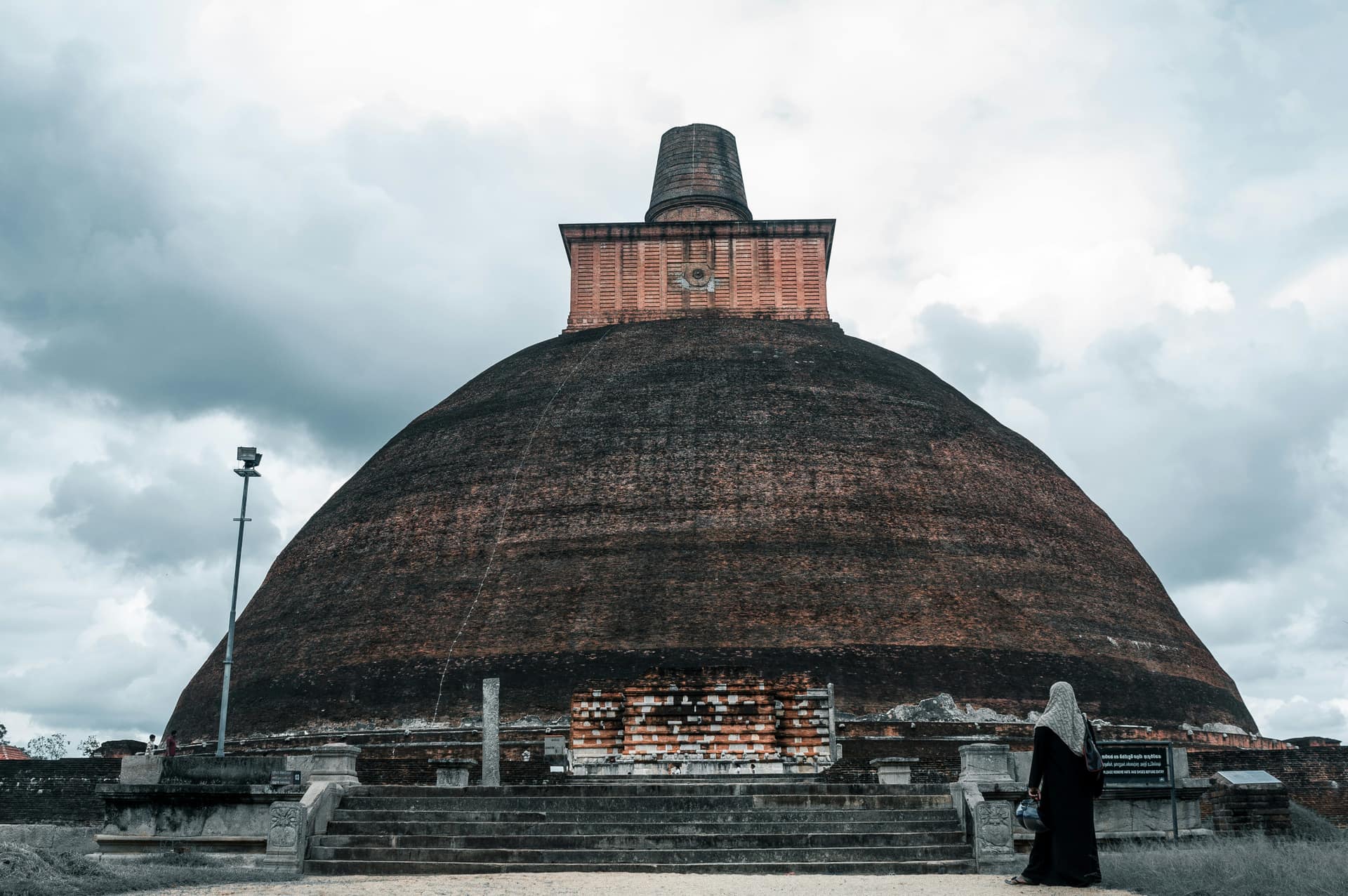
Anuradhapura is worth it for a specific kind of traveller and genuinely optional for everyone else. It was the island's capital for over a thousand years from around the fourth century BCE, and at its height it was one of the largest and most sophisticated cities in the world, with monasteries housing thousands of monks and irrigation works still in use today.
The difficulty for a first-time visitor is that this greatness is diffuse. Anuradhapura is not a walled site you walk around in a morning. It is a sacred landscape spread across many kilometres, with long gaps between the major monuments, and much of what made it extraordinary is now foundation stones and grass.
What is unambiguously worth seeing is the Sri Maha Bodhi, a sacred fig grown from a cutting of the tree at Bodh Gaya under which the Buddha attained enlightenment. It has been tended continuously for more than two thousand years, which makes it one of the oldest documented planted trees anywhere, and the atmosphere around it is unlike anything else on the island.
- →Capital for over a thousand years from roughly the fourth century BCE.
- →The Sri Maha Bodhi has been tended continuously for more than two thousand years.
- →Ruwanwelisaya and Jetavanaramaya are among the largest brick structures of the ancient world.
- →The site is a sacred landscape rather than a compact archaeological park.
What Anuradhapura costs in trip days
Anuradhapura costs a first-time visitor a full day, and often a night. It sits roughly an hour and a half from Sigiriya by road, which is manageable as a day trip, but the site itself is large enough that a rushed half-day leaves visitors with a sequence of car parks rather than an impression of a city.
That full day is the crux of the decision. On a ten-day trip covering the Cultural Triangle, the hill country, a safari and a coast, a full day is roughly ten per cent of the holiday. Polonnaruwa delivers a comparable sense of ancient Sri Lanka in a morning.
Travellers who do commit to Anuradhapura should hire bicycles or keep the vehicle with them. Walking between the main clusters is not realistic in the heat of the dry zone, and the distances surprise people who have only seen it on a map.
- →Roughly an hour and a half from Sigiriya by road, each way.
- →A full day to do properly; a rushed half-day is rarely satisfying.
- →Bicycles or a vehicle are essential; the monuments are kilometres apart.
- →Dry-zone heat makes midday walking between clusters genuinely difficult.
Anuradhapura or Polonnaruwa on a first trip
Most first-time visitors who have time for only one ancient capital should choose Polonnaruwa, and this is the single most useful piece of advice in this article. Polonnaruwa is compact, cycleable in a morning, better preserved, and it has an unambiguous highlight in the rock-cut Buddhas of the Gal Vihara.
Anuradhapura is the better choice for travellers with a genuine interest in Buddhist practice rather than archaeology, because it is an active pilgrimage centre in a way Polonnaruwa is not. Visiting on a poya day, when the full moon draws white-clad pilgrims in large numbers, is a remarkable experience that has nothing to do with ruins.
Doing both is worthwhile on a trip of fourteen days or more, ideally with Anuradhapura given its own night rather than squeezed in as a return day trip from Sigiriya.
- →Choose Polonnaruwa if you want ruins, compactness and a clear highlight.
- →Choose Anuradhapura if you want living Buddhist practice and enormous scale.
- →Poya days at Anuradhapura are extraordinary; note that lunar dates shift each year.
- →Trips of fourteen days or more can comfortably include both.
What to know before visiting Anuradhapura
Anuradhapura is an active sacred site, and the dress code around the Sri Maha Bodhi and the main dagobas is observed strictly. Shoulders and knees covered, shoes and hats removed in the sacred precincts, and no posing with your back to a Buddha image. Many Sri Lankan pilgrims wear white, and visitors in white are quietly appreciated though not required.
The ground around the dagobas is sand and stone, walked barefoot, and it becomes extremely hot by the middle of the day. Early morning and late afternoon are both cooler and better for photography, with the white domes taking the low light well.
Tickets for the main archaeological zone are usually bought at the site, and some individual temples sit outside that ticket. Confirm current arrangements locally, as the ticketing has changed more than once in recent years.
- →Shoulders and knees covered; shoes and hats off in sacred precincts.
- →Barefoot on sand and stone that gets very hot from mid-morning onward.
- →Early morning and late afternoon are cooler and better lit.
- →Ticketing arrangements change periodically; confirm locally rather than assuming.
Who should skip Anuradhapura
First-time visitors on trips of ten days or fewer should generally skip Anuradhapura, and put the day into the hill country or the coast instead. The trip loses very little, because Polonnaruwa and Dambulla between them already cover ancient Sri Lanka comfortably.
Families with young children should also think carefully. Anuradhapura asks for a lot of driving between sites, a lot of barefoot walking on hot ground, and a level of quiet reverence that is hard on small children and on the pilgrims around them. Polonnaruwa, where the bicycles themselves become the entertainment, tends to work far better.
Travellers who have already visited major Buddhist sites elsewhere in Asia, and who are coming to Sri Lanka primarily for landscape and wildlife, can skip the whole ancient-capital question without regret and keep only Sigiriya and Dambulla.
- →Trips of ten days or fewer: put the day elsewhere.
- →Families with young children: Polonnaruwa is the more workable choice.
- →Landscape and wildlife travellers: Sigiriya and Dambulla are enough ancient history.
Fitting Anuradhapura into a first trip
If Anuradhapura is in the plan, give it a proper morning starting early, and treat the Sri Maha Bodhi as the anchor rather than trying to see every monument. A guided visit makes a substantial difference here, more than at any other site in the Cultural Triangle, because so much of what matters is invisible without context.
Lankan Stays and Trails generally recommends Anuradhapura only on itineraries of twelve days or more, or for travellers whose interest in Buddhist history is the reason for the trip. On shorter first visits we route through Polonnaruwa instead, which is the honest recommendation rather than the one that fills more days.
Frequently asked questions
Is Anuradhapura worth visiting?
It is worth visiting if you want a living sacred city rather than a compact set of ruins. The Sri Maha Bodhi and the enormous brick dagobas are remarkable, but the site is spread over many kilometres and needs a full day, so it suits longer trips better than short ones.
Is Anuradhapura or Polonnaruwa better for a first trip?
Polonnaruwa for most first-time visitors. It is compact enough to cycle in a morning, better preserved, and has a clear highlight in the Gal Vihara rock-cut Buddhas. Anuradhapura is the better choice for travellers specifically drawn to active Buddhist pilgrimage and vast scale.
How long do you need in Anuradhapura?
A full day to do it justice, ideally starting early. The major monuments sit kilometres apart, so a vehicle or hired bicycles are essential. A rushed half-day tends to leave visitors with a series of car parks rather than a coherent sense of the ancient city.
What is the most important thing to see in Anuradhapura?
The Sri Maha Bodhi, a sacred fig grown from a cutting of the tree at Bodh Gaya under which the Buddha attained enlightenment. It has been tended continuously for more than two thousand years, and the atmosphere of devotion around it is the site's defining experience.
How far is Anuradhapura from Sigiriya?
Roughly an hour and a half by road, which makes a day trip from a Sigiriya or Habarana base practical. Travellers who want an early start at the Sri Maha Bodhi sometimes give Anuradhapura its own night instead, which suits longer itineraries of twelve days or more.
What should I wear in Anuradhapura?
Shoulders and knees covered, with shoes and hats removed in the sacred precincts. Much of the walking around the dagobas is barefoot on sand and stone that becomes very hot by mid-morning. Many pilgrims wear white, and visitors doing the same is quietly appreciated.
Is Anuradhapura boring?
It can feel that way to visitors expecting dramatic standing ruins, because much of the ancient city is now foundations and open ground. Travellers who come for the living pilgrimage atmosphere, particularly around the Sri Maha Bodhi, generally find it the most moving site in Sri Lanka.