
Quick answer
An ancient cities 7-day Sri Lanka itinerary spends two nights near Anuradhapura for the sacred city and Mihintale, three nights at Sigiriya or Habarana for Polonnaruwa, Sigiriya Rock and the Dambulla Cave Temple, and one night in Kandy for the Temple of the Sacred Tooth Relic, ending with a drive of roughly three to four hours to the airport. It covers five of Sri Lanka's UNESCO World Heritage Sites and has no day with more than about four hours' driving.
Key takeaways
- The ancient cities week covers Anuradhapura, Polonnaruwa, Sigiriya, Dambulla and Kandy, all UNESCO World Heritage Sites.
- The airport to Anuradhapura takes roughly four to five hours by road.
- Anuradhapura to Sigiriya or Habarana takes roughly one and a half to two hours.
- Anuradhapura's sites are spread over a large area and need a full day; Polonnaruwa's are compact enough to cycle.
- The week works year-round, though the dry zone is hottest from roughly March to September.
Who the ancient cities version is for
This version of the 7-day Sri Lanka itinerary is for travellers who find ruins, archaeology and religious history more compelling than beaches or tea estates. It trades the coast and the hill-country train for time at the two ancient capitals the classic route leaves out.
It also suits pilgrims and those interested in Buddhism, since Anuradhapura's Sri Maha Bodhi tree, Mihintale and the Temple of the Sacred Tooth Relic are among the holiest sites in the Buddhist world. Visiting them on a poya (full moon) day shows them at their most active, though crowds are larger.
It is not for anyone who will feel restless without a beach. The dry zone is hot, the days are shaped around early starts and midday rests, and the sights, though extraordinary, are mostly of the same broad kind.
- →Choose it if ruins and religious history are the reason for the trip.
- →Choose it for a Buddhist pilgrimage focus, especially around a poya day.
- →Choose the classic route if you want variety across landscapes.
The ancient cities week, day by day
The route runs north first to Anuradhapura, the oldest of the capitals, then east to the Sigiriya area as a base for Polonnaruwa, Sigiriya and Dambulla, and finally south to Kandy. It follows the chronology of Sri Lanka's royal history loosely, from the earliest capital to the last.
Three nights at Sigiriya or Habarana is the heart of the week. It means unpacking once for Polonnaruwa, Sigiriya Rock and Dambulla, with each getting the unhurried morning it deserves.
- →Day 1: Airport to Anuradhapura, roughly four to five hours.
- →Day 2: Anuradhapura's sacred city by bicycle or car; Mihintale at sunset.
- →Day 3: Drive to Sigiriya or Habarana, roughly one and a half to two hours; Dambulla Cave Temple in the late afternoon.
- →Day 4: Polonnaruwa by bicycle, roughly an hour away; Minneriya or Kaudulla safari optional.
- →Day 5: Sigiriya Rock at opening; afternoon rest or a village experience.
- →Day 6: Drive to Kandy, roughly two and a half to three hours; the evening puja.
- →Day 7: Kandy morning, then roughly three to four hours to the airport.
Anuradhapura and Mihintale
Anuradhapura was Sri Lanka's capital for roughly 1,300 years and its sacred city spreads over many square kilometres, with vast brick stupas such as Ruwanwelisaya and Jetavanaramaya, ancient reservoirs and the Sri Maha Bodhi, a fig tree grown from a cutting of the tree under which the Buddha is believed to have attained enlightenment.
The site needs a full day, ideally split into a morning and a late afternoon with a rest in between. Bicycles are a popular way to get around the flat terrain; a car and driver suits those less keen on cycling in heat. Mihintale, roughly 12 kilometres east, is where Buddhism is said to have been introduced to Sri Lanka and has a staircase of roughly 1,800 steps to a hilltop stupa that is magical at sunset.
- →Allow a full day for Anuradhapura, with a midday rest.
- →Bicycles suit the flat site; a car suits those who prefer shade.
- →Mihintale's steps are best climbed in the late afternoon for sunset.
- →White clothing is traditional at the Sri Maha Bodhi, and shoes come off at every sacred area.
Polonnaruwa by bicycle
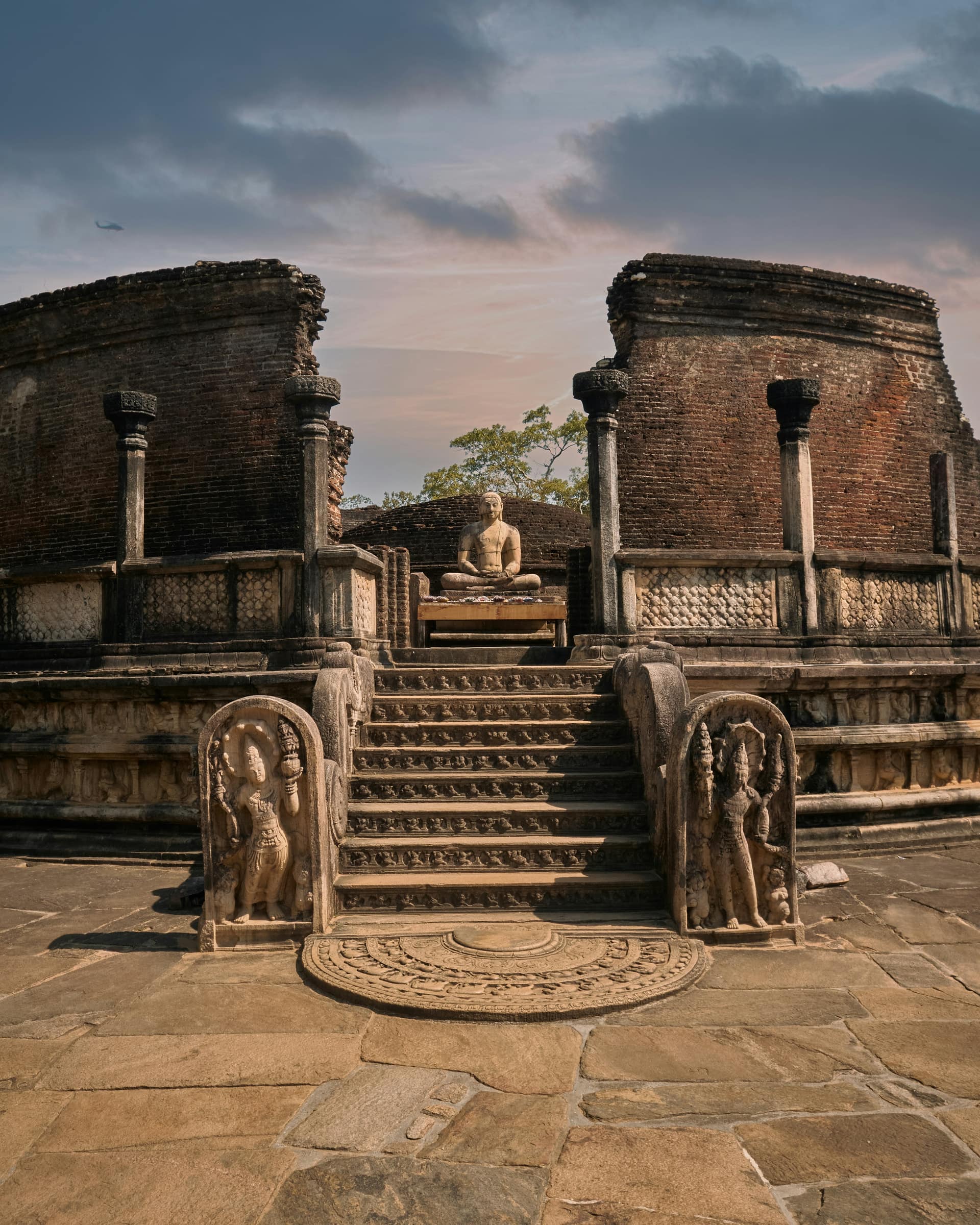
Polonnaruwa, capital in the 11th and 12th centuries, is far more compact than Anuradhapura, and its archaeological park can be covered comfortably by bicycle in a morning. The highlights are the royal palace, the Quadrangle with its circular Vatadage, and the Gal Vihara, four great Buddha figures carved from a single granite face.
Starting at opening avoids the worst heat. Polonnaruwa lies roughly an hour from Sigiriya or Habarana, and pairing it with a late-afternoon jeep safari at Minneriya or Kaudulla, both close by, makes a full and varied day. The elephant gathering at Minneriya is strongest roughly July to October.
- →Cycle the archaeological park in roughly three to four hours.
- →The Gal Vihara is the single most memorable site; save time for it.
- →Pair it with a Minneriya or Kaudulla safari in the afternoon.
Pacing a week of ruins in the dry zone
The Cultural Triangle sits in Sri Lanka's dry zone, where midday temperatures frequently reach the low to mid thirties Celsius. The ancient cities week only works if each day follows the same shape: sites from opening until around 11am, a long rest, then a late-afternoon visit.
The other risk is fatigue from similarity. Five heritage sites in a week can blur together, which is why this route mixes the types: a sacred city, a hilltop monastery, a rock fortress, a cave temple, a medieval capital and a living temple in Kandy, with an elephant safari to break the pattern.
Tickets, guides and dress
Each of the major sites charges its own entry fee for foreign visitors, typically quoted in US dollars and considerably higher than local rates. Prices change periodically, so confirm current fees locally rather than relying on older figures, and budget for them as a meaningful part of this week's cost.
A good licensed guide makes a large difference at Anuradhapura and Polonnaruwa, where the stories behind the ruins are not obvious from the stones. Cover shoulders and knees at every religious site, remove shoes and hats where required, and never pose with your back to a Buddha statue.
Planning the ancient cities week
The ancient cities version works year-round, since the Cultural Triangle is not affected by either monsoon in the way the coasts are. It is at its most comfortable from roughly December to February; from March to September, the heat is intense and the midday rest becomes essential.
Lankan Stays & Trails runs this route with guides who specialise in the ancient capitals, and our Kandy Esala Perahera and Cultural Treasures tour covers similar ground in eight days, with the perahera itself in season. The pillar guide explains how this version differs from the classic week.
Frequently asked questions
Can you see Anuradhapura, Polonnaruwa and Sigiriya in one week?
Yes, comfortably, if you give up the coast and the hill country. Two nights near Anuradhapura, three at Sigiriya or Habarana and one in Kandy allow each site an unhurried morning, and no day involves more than about four to five hours' driving.
Is Anuradhapura or Polonnaruwa better?
They are different. Anuradhapura is older, larger and more sacred, with vast stupas and the Sri Maha Bodhi tree, but its sites are spread out. Polonnaruwa is compact, easy to cycle and has the Gal Vihara carvings. On the ancient cities week you see both.
How long do you need in Anuradhapura?
A full day, split between morning and late afternoon with a midday rest. The sacred city covers many square kilometres, and seeing it in a rushed half-day leaves little impression. Adding Mihintale at sunset makes the day complete.
How far is Anuradhapura from Colombo airport?
Roughly four to five hours by road. With a morning landing, you reach Anuradhapura by mid-afternoon, which leaves time to rest before starting the sacred city early on day 2.
Is the Cultural Triangle too hot to visit?
It is hot, often into the low to mid thirties Celsius at midday, but very manageable if you visit sites from opening until around 11am, rest through the middle of the day, and go out again in the late afternoon. December to February is the most comfortable period.
How many UNESCO sites can you see in a week in Sri Lanka?
The ancient cities version visits five: the sacred city of Anuradhapura, the ancient city of Polonnaruwa, Sigiriya, the Dambulla Cave Temple and the sacred city of Kandy. The classic 7-day route covers four, adding Galle Fort but missing both ancient capitals.