
Quick answer
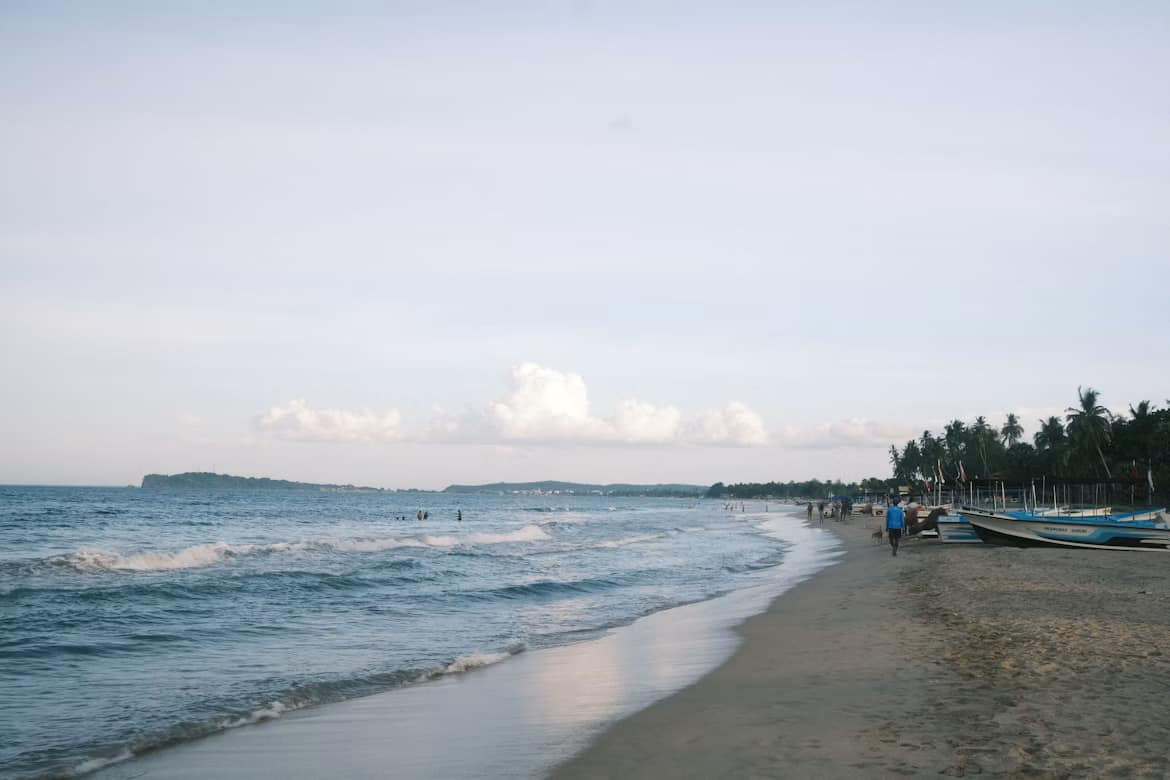
Pasikudah is a shallow, sheltered bay on Sri Lanka's east coast, about 35 kilometres north of Batticaloa, and one of the safest swimming beaches in the country because the water stays waist deep a long way out. Its season runs from about May to September, opposite the south coast. Batticaloa is a lagoon city known for its Dutch fort, its bridges and the singing fish phenomenon. The area is quieter and less developed than Trincomalee, with a strong Tamil and Muslim east coast culture.
Key takeaways
- Pasikudah's bay is exceptionally shallow and sheltered, staying waist deep for a long distance offshore.
- The east coast season runs roughly May to September, the opposite of the south and west.
- Batticaloa is about 35 kilometres south of Pasikudah and is built across a large lagoon system.
- The singing fish of Batticaloa lagoon are a genuine local tradition, best heard on quiet nights near Kallady Bridge.
- The area is markedly quieter and less touristed than Trincomalee or the south coast.
Pasikudah: the shallow bay
Pasikudah's defining feature is its bathymetry. The bay is protected by a reef and shelves so gently that the water remains shallow far offshore, with barely any wave action in season. For families with small children, nervous swimmers or anyone who simply wants to stand in warm sea and read the horizon, there are few better beaches in Asia.
The trade-off is that the bay was heavily developed with resort hotels in the years after the war, and the character is more resort strip than fishing village. Kalkudah, the adjacent bay just to the north, is longer, wilder and far less developed, and it is where to go if Pasikudah feels too managed.
- →Reef-protected bay with very shallow, calm water far from shore.
- →One of the best beaches in Sri Lanka for small children and nervous swimmers.
- →Concentrated resort development; Kalkudah next door is quieter and wilder.
- →Season: roughly May to September, with the calmest water in June and July.
Batticaloa: the lagoon city
Batticaloa is built on and around a long lagoon system, and water is the organising fact of the city. Bridges link the districts, fishing boats work the channels, and much of daily life happens on the water's edge. It is a Tamil-majority city with a substantial Muslim population, and its rhythm is quite different from anywhere in the south.
The Dutch fort, built in 1628 and later held by the British, sits by the lagoon and can be walked around in an hour. St Mary's Cathedral, the lighthouse at the lagoon mouth, and the busy fish market are the other fixtures. Batticaloa is not a sightseeing city in the Galle sense; it is a place to spend an evening watching a working waterfront.
- →Dutch fort dating from 1628, on the lagoon edge in the city centre.
- →Kallady Bridge, the lighthouse and the fish market are the other landmarks.
- →Tamil-majority city with a large Muslim community and a distinct east coast culture.
- →Around 35 km south of Pasikudah, roughly 45 minutes by road.
The singing fish of Batticaloa
Batticaloa's best-known story is its singing fish. On quiet nights, particularly around the full moon between about April and September, a faint humming or plucking sound is reported from the lagoon near Kallady Bridge. The tradition is centuries old and the sound is genuinely documented, though its source is still debated: candidates include shellfish, catfish and other sound-producing marine life.
To listen for it, go out on the lagoon after dark with a boatman who knows the spots, and put an oar in the water with your ear to the dry end, which is the traditional method. It is a quiet, atmospheric hour rather than a spectacle, and there is no guarantee you will hear anything.
- →Best chance: quiet full-moon nights, roughly April to September.
- →Traditional method: listen through an oar blade placed in the water.
- →Reported near Kallady Bridge; go with a local boatman after dark.
- →The sound is documented but its biological source remains debated.
When to visit
This coast follows the east coast calendar: roughly May to September for calm sea and dry weather, with June and July the most reliable. Pasikudah is at its glassiest then, and the singing fish season overlaps with it.
From November to February the north-east monsoon brings heavy rain and rough seas to Batticaloa and Pasikudah, and the region is subject to flooding. March and April improve but are not yet dependable. Outside the season many hotels reduce operations.
- →Best: May to September, especially June and July.
- →Avoid: November to February, when the north-east monsoon brings rain and flooding.
- →March and April: improving but unreliable.
- →Hotel operations reduce substantially outside the season.
Around the area
Kalkudah bay, immediately north of Pasikudah, is a long undeveloped stretch of sand with better waves and far fewer people. Diving and snorkelling are possible on the reefs offshore in calm conditions, and there are wrecks in the area for qualified divers.
Inland, the east opens into paddy country and tanks that see almost no visitors. Maduru Oya National Park to the west holds elephants and is a genuinely quiet alternative to the busy southern parks. Further south towards Arugam Bay, the coast strings together lagoons, mangrove and small fishing towns.
- →Kalkudah: long, undeveloped, better waves, few visitors.
- →Reef and wreck diving offshore in calm conditions.
- →Maduru Oya National Park inland: elephants, tanks, almost no traffic.
- →The coast road south links towards Arugam Bay through lagoon country.
Practicalities
Batticaloa is roughly six to seven hours from Colombo by road and about four hours from Kandy, and it is served by the eastern railway line, which is slow but scenic. From Trincomalee it is around three and a half hours down the coast, and from Arugam Bay around three hours north.
Facilities are more limited than the south coast. Carry cash, expect patchy card acceptance outside the resort hotels, and note that alcohol availability is more restricted in this predominantly Tamil and Muslim region than elsewhere. Dress a little more conservatively away from the resort beaches than you would in Mirissa.
- →About 6 to 7 hours from Colombo, 4 from Kandy, 3.5 from Trincomalee.
- →Served by the eastern railway line; slow but scenic.
- →Carry cash; card acceptance is patchy outside resort hotels.
- →Dress modestly away from resort beaches out of respect for local norms.
Fitting it into an itinerary
Pasikudah works best as a stop on an east coast run rather than a destination flown into. The strongest shape is Cultural Triangle, then Trincomalee and Nilaveli, then south to Pasikudah and Batticaloa, and on to Arugam Bay if you surf, exiting via Ella and the hill country. That takes a fortnight and follows dry weather the entire way between May and September.
Lankan Stays & Trails uses this route in the east coast season and can arrange a lagoon boatman in Batticaloa for the singing fish, which is not something you will organise easily on arrival.
Frequently asked questions
Is Pasikudah worth visiting?
Yes, particularly for families. The reef-protected bay stays shallow and calm a long way out, making it one of the safest swimming beaches in Sri Lanka during its May to September season. It is developed with resorts, so choose Kalkudah next door if you prefer somewhere wilder.
When is the best time to visit Pasikudah?
Roughly May to September, with June and July the most reliable. This is the east coast season, the opposite of the south and west. From November to February the north-east monsoon brings heavy rain, rough seas and flooding to this part of the coast.
How far is Pasikudah from Batticaloa?
About 35 kilometres, or roughly 45 minutes by road. Batticaloa is the nearest city and transport hub, around six to seven hours from Colombo, four from Kandy, three and a half from Trincomalee and three from Arugam Bay.
What are the singing fish of Batticaloa?
A centuries-old tradition describing a faint humming or plucking sound heard from the Batticaloa lagoon on quiet nights, particularly around the full moon between about April and September. The sound is documented but its biological source, possibly shellfish or catfish, is still debated.
Is Batticaloa safe for tourists?
Yes. Batticaloa is a quiet provincial city with normal precautions applying as anywhere. It sees far fewer visitors than the south coast, so expect more curiosity and less tourist infrastructure. Dress modestly away from resort beaches out of respect for local norms.
Pasikudah or Nilaveli, which is better?
Both share the May to September season. Pasikudah has the shallower, calmer bay and is the safer choice for very small children. Nilaveli has wider sand, a less resort-dominated feel and access to Pigeon Island snorkelling, which Pasikudah cannot match.
What is there to do in Batticaloa?
Walk the 1628 Dutch fort by the lagoon, visit St Mary's Cathedral and the lighthouse, watch the fish market, take a lagoon boat at dusk to listen for the singing fish, and use the city as a base for Pasikudah and Kalkudah beaches and Maduru Oya National Park inland.