
Quick answer
The best stupas to visit in Sri Lanka are Ruwanwelisaya, Jetavanaramaya, Abhayagiri, Thuparamaya and Mirisawetiya in Anuradhapura; Rankoth Vehera and Kiri Vehera in Polonnaruwa; the Mahiyangana stupa, linked to the Buddha's first visit; Seruwila near Trincomalee; Kiri Vehera at Kataragama; the Tissamaharama stupa in the south; Deegavapi near Ampara; and Kalutara's hollow stupa, which you can walk inside.
Key takeaways
- Stupas hold relics and are walked around clockwise.
- Jetavanaramaya was once one of the tallest structures in the ancient world.
- Anuradhapura has the greatest concentration of giant stupas.
- Kalutara's stupa is hollow, so visitors can walk inside.
- Shoes and hats come off on the stupa terrace; white clothing is ideal.
What a stupa is
A stupa is a dome-shaped monument built over relics of the Buddha or of revered monks, or to mark a sacred place. In Sri Lanka it is usually called a dagoba or chaitya. The shape is symbolic: a platform, a bell or bubble dome, a square box called the hatares kotuwa and a tall spire.
Pilgrims walk around a stupa clockwise, offering flowers, lamps and incense on the altars at its base. On full moon days, called Poya, the terraces fill with people dressed in white, chanting and meditating. Visiting at that time is moving, though busy.
Sri Lanka's earliest stupas date from the third century BC, after Buddhism arrived from India. Many were enlarged over centuries, and several were restored in the twentieth century, so their gleaming white plaster can hide very old brick.
- →Walk clockwise around the dome.
- →Remove shoes and hats on the terrace.
- →Full moon days are busiest and most atmospheric.
Anuradhapura's giants
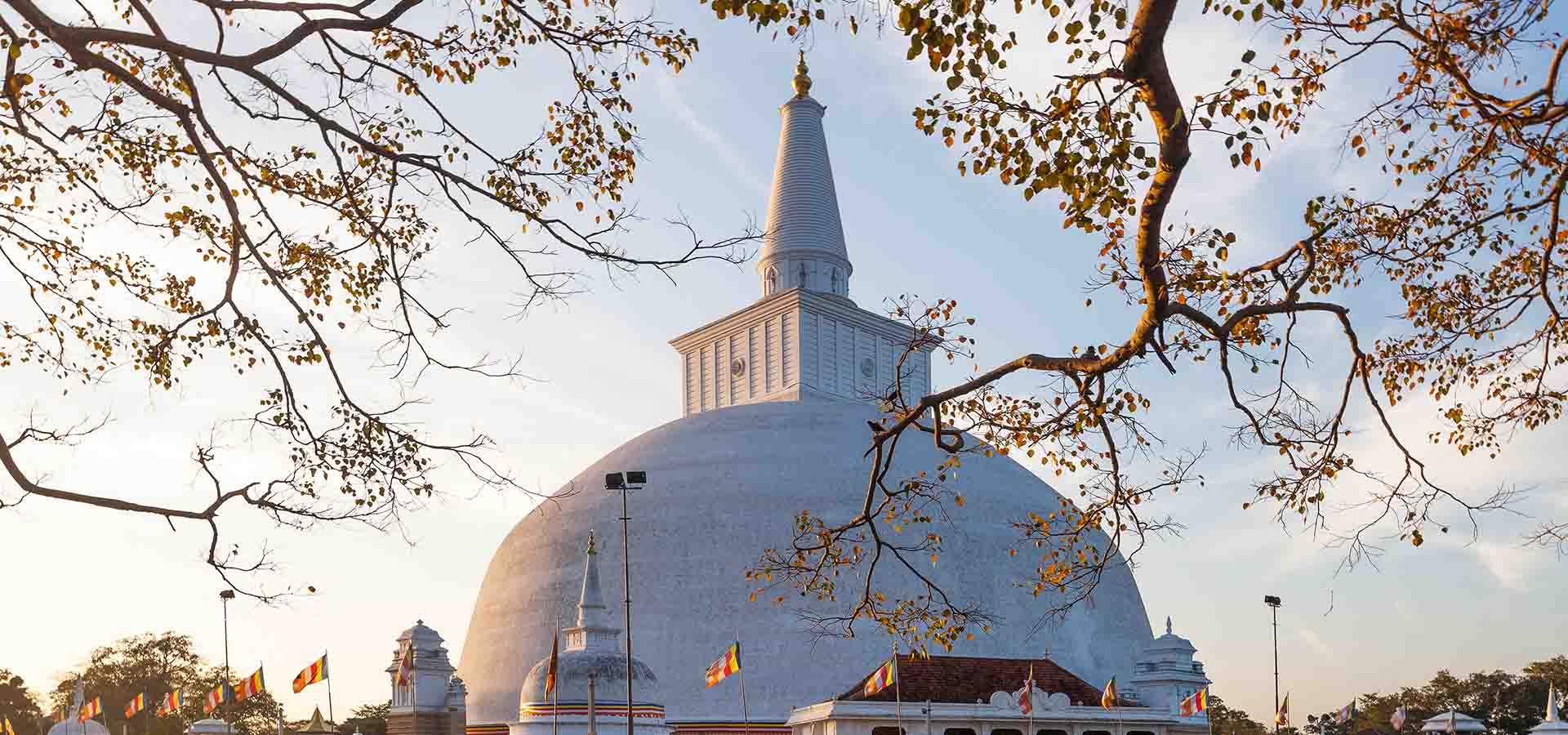
Anuradhapura has the greatest group of stupas in Sri Lanka. Ruwanwelisaya, gleaming white and ringed by a wall of carved elephants, is the most venerated and most visited, especially at dusk. Thuparamaya, the oldest, is small and elegant, with slender stone pillars that once held a roof around it.
Jetavanaramaya, built of brick in the third and fourth centuries, was once one of the tallest structures in the world, and its sheer mass still astonishes. Abhayagiri, in the forested north of the city, has been restored and stands among the ruins of a great monastery. Mirisawetiya, near the Tissa Wewa, is less visited and peaceful.
Seeing them in one long morning by bicycle, starting at Thuparamaya and finishing at Ruwanwelisaya as pilgrims arrive, is one of the great experiences in Sri Lanka.
- →Ruwanwelisaya: the most venerated.
- →Jetavanaramaya: the brick giant.
- →Thuparamaya: the oldest.
- →Mirisawetiya: the quiet one.
Polonnaruwa and the Cultural Triangle
Polonnaruwa's two great stupas are Rankoth Vehera, a massive brick dome built in the twelfth century, and Kiri Vehera, whose original plaster has survived remarkably well, giving it a pale, milky colour that matches its name. Both stand among the ruins of the medieval city.
Mihintale, near Anuradhapura, has stupas on its hill, including the Kantaka Chaitya, with fine early carvings, and the Maha Seya at the summit. Dambulla's cave temple and Sigiriya's surroundings have smaller stupas, often with sweeping views.
Medirigiriya's circular relic house, a vatadage that once roofed a small stupa, is one of the most graceful structures in the region.
- →Rankoth Vehera: medieval brick.
- →Kiri Vehera: original plaster.
- →Mihintale: hilltop stupas.
Stupas around the rest of the island
Mahiyangana, on the Mahaweli river east of Kandy, has a stupa believed to mark the place of the Buddha's first visit to Sri Lanka. It is an important pilgrimage site and is often visited on the road between Kandy and the east coast. Seruwila, south of Trincomalee, is an ancient stupa said to hold a relic of the Buddha's forehead bone, standing in quiet countryside.
In the south, the Tissamaharama stupa and its neighbours recall the Ruhuna kingdom, and Kiri Vehera at Kataragama is the Buddhist heart of that multi-faith town. Deegavapi near Ampara, Somawathiya on the Mahaweli flood plains and Nagadeepa on Nainativu island are other sacred stupas in the east and north.
Lankan Stays & Trails often builds in one of these quieter stupas on longer routes, where they break a long drive and show the faith outside the famous sites.
- →Mahiyangana: the Buddha's first visit.
- →Seruwila: near Trincomalee.
- →Tissamaharama and Kataragama: the south.
Modern and unusual stupas
Kalutara's large white stupa, beside the bridge on the Galle road, is unusual because it is hollow: visitors can walk inside and see paintings around the inner wall. Drivers often stop to make an offering for safe travel.
The Japanese Peace Pagoda on Rumassala hill near Galle, built in the twentieth century, gives views over Unawatuna and the fort. Gangaramaya in Colombo, with its eclectic collection, has stupas of many styles.
These are easy stops on the coastal route and give a sense of how stupa building continues today.
- →Kalutara: walk inside.
- →Rumassala: peace pagoda above the sea.
- →Gangaramaya: many styles in one temple.
How to visit a stupa
Wear light, modest clothing that covers shoulders and knees; white is ideal. Remove shoes and hats before stepping onto the terrace, and carry socks, as the stone can burn by midday. Walk clockwise, keep your voice low and never climb on any part of the structure.
Early morning and late afternoon are the best times, for cooler stone and for the light on the white domes. On Poya days, expect crowds and a festive atmosphere. Photography is generally allowed outside, but never pose with your back to a Buddha image.
Frequently asked questions
What is the biggest stupa in Sri Lanka?
Jetavanaramaya in Anuradhapura is usually considered the largest ancient stupa in Sri Lanka by volume. Built of brick in the third and fourth centuries, it was once among the tallest structures in the ancient world. Abhayagiri and Ruwanwelisaya are also very large.
Which is the oldest stupa in Sri Lanka?
Thuparamaya in Anuradhapura is traditionally considered the oldest stupa in Sri Lanka, built in the third century BC soon after Buddhism arrived. It is small, with slender stone pillars that once supported a roof. It is said to hold the Buddha's collarbone relic.
Do I need to remove my shoes at a stupa?
You need to remove your shoes and hats before stepping onto a stupa's terrace in Sri Lanka. Carry socks, as stone surfaces can be very hot by late morning. Leave shoes at the entrance or with an attendant for a small fee.
Why are stupas white in Sri Lanka?
Stupas in Sri Lanka are usually covered in white lime plaster, which protects the brick and symbolises purity. Many are regularly repainted, especially before festivals. A few, such as Polonnaruwa's Kiri Vehera, retain old plaster, while some ruined ones show bare brick.
What is the difference between a stupa and a dagoba?
There is no difference in meaning. Stupa is the Sanskrit word, and dagoba is the term traditionally used in Sri Lanka, from Sinhala. Chaitya and seya are other local names for the same dome-shaped relic monument.
When is the best time to visit Ruwanwelisaya?
The best time to visit Ruwanwelisaya is late afternoon into dusk, when the white dome glows, the stone cools and pilgrims come to offer flowers and lamps. Full moon Poya days are especially atmospheric, though crowded. Early morning is also calm and cool.
Can you go inside a stupa?
Most stupas are solid and cannot be entered. Kalutara's stupa on the Galle road is a rare exception: it is hollow, and visitors can walk inside to see paintings on the inner wall. Elsewhere, you walk around the dome on the terrace.