
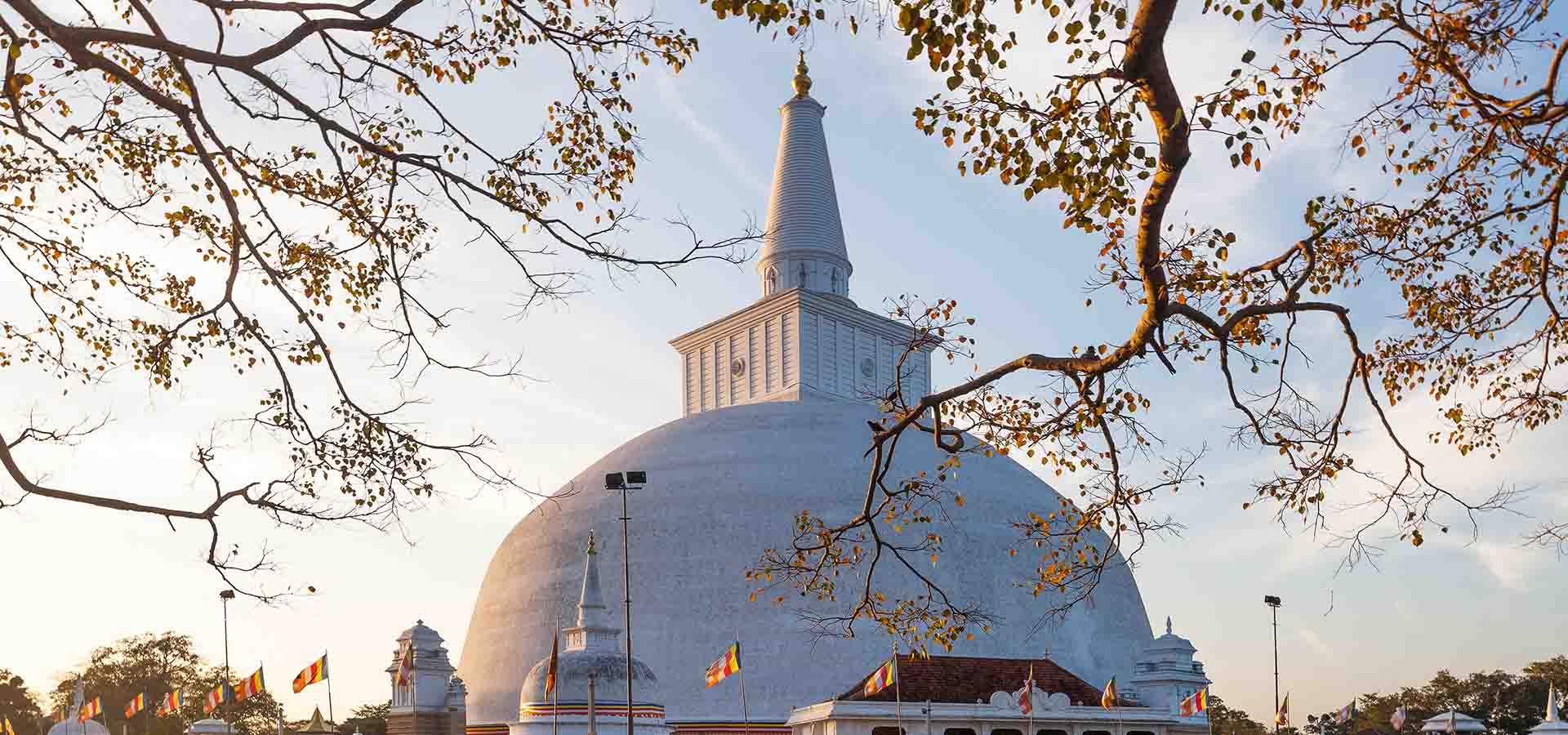
Quick answer
Thuparamaya is traditionally considered the first stupa built in Sri Lanka after the arrival of Buddhism, raised by King Devanampiya Tissa in the 3rd century BC in Anuradhapura. It is said to enshrine the right collarbone relic of the Buddha. The bell-shaped dagoba seen today was rebuilt in 1862, but the slender stone pillars around it, remains of a vatadage, are ancient. It lies near Ruwanwelisaya and is free as an active temple. Allow 20 to 30 minutes.
Key takeaways
- Thuparamaya is traditionally regarded as the first stupa built in Sri Lanka after Buddhism arrived in the 3rd century BC.
- Thuparamaya is said to enshrine the right collarbone relic of the Buddha, sent from India.
- The current bell-shaped dagoba at Thuparamaya was rebuilt in 1862.
- Rows of slender stone pillars around Thuparamaya are the remains of a vatadage, a roofed relic house.
- Thuparamaya sits a short walk from Ruwanwelisaya and the Sri Maha Bodhi in Anuradhapura's sacred city.
History
Thuparamaya is traditionally said to be the first stupa built in Sri Lanka after Buddhism arrived. King Devanampiya Tissa raised it in the 3rd century BC, soon after the monk Mahinda's mission at Mihintale. It enshrined a relic sent from India, said to be the Buddha's right collarbone.
Over the centuries Thuparamaya was rebuilt several times. A vatadage, a circular relic house with stone pillars, was built around it, and later the stupa itself was restored. The bell-shaped dagoba seen today dates from a rebuilding in 1862.
Despite the restoration, Thuparamaya's age and associations give it deep sacredness for Sri Lankan Buddhists.
The chronicles tell how the collarbone relic arrived. Mahinda asked King Devanampiya Tissa for a relic to worship, and the novice Sumana travelled to India to fetch it. The relic was received with great ceremony, and the king built Thuparamaya to enshrine it, making Anuradhapura a place of Buddhist pilgrimage from that moment.
- →3rd century BC: built by King Devanampiya Tissa.
- →Relic: the Buddha's right collarbone, by tradition.
- →Later: vatadage built around it.
- →1862: present dagoba rebuilt.
The pillars
The slender stone pillars around Thuparamaya are its most distinctive feature. Arranged in concentric rings, they once supported the roof of a vatadage. Their capitals are carved, and many lean slightly with age, giving the site a graceful, almost forest-like feel.
The pillars show how vatadages worked before Polonnaruwa's more famous example. Seeing Thuparamaya first, then the Polonnaruwa Vatadage the next day, shows how the form developed.
Thuparamaya's pillars have carved capitals with bands of decoration, including figures of geese, lions and dwarfs. Look closely at a few of the better-preserved capitals. Some scholars think the pillars once supported a conical roof rather than a flat one, though how the roof was built is still debated by archaeologists.
Visiting Thuparamaya
Thuparamaya is an active temple within Anuradhapura's sacred city, and there is no separate charge, though the surrounding area is part of the main site. Remove shoes and hats, walk clockwise and dress modestly. Allow 20 to 30 minutes.
The terrace is open and heats quickly, so visit early or late. Thuparamaya is a few minutes' walk from Ruwanwelisaya and the Sri Maha Bodhi, so all three combine easily on foot. Lankan Stays & Trails guides often start here to explain the beginning of Buddhism in Sri Lanka before moving on to the larger stupas.
Thuparamaya is quieter than Ruwanwelisaya and the Sri Maha Bodhi for most of the day. Its smaller size and shaded pillars make it a good place to pause, especially in the late afternoon. Monks from the attached temple sometimes chant in the evening, adding to the atmosphere for visitors who linger.
- →Allow 20 to 30 minutes.
- →Shoes off; terrace heats quickly.
- →Combine with Ruwanwelisaya and the Sri Maha Bodhi.
- →Visit early morning or late afternoon.
Why it matters
Thuparamaya matters because it marks the beginning. Mahinda's mission brought Buddhism to Sri Lanka, and the first stupa gave it a physical heart in the capital. Every stupa built afterwards, including the giants of Jetavanaramaya and Ruwanwelisaya, follows from this one.
For a first-time visitor, starting the Anuradhapura story here helps the rest of the sacred city make sense.
Thuparamaya also shows how Sri Lankan Buddhism treats its monuments. Rather than preserving the stupa as a ruin, devotees rebuilt it as a place of living worship. That approach, renewing the sacred rather than freezing it, is common across the Cultural Triangle and explains why some sites look newer than their age.
- →First stupa after Buddhism's arrival.
- →Linked to Mahinda's mission at Mihintale.
- →The model for every stupa that followed.
Nearby
Thuparamaya sits at the heart of the sacred city. Ruwanwelisaya is a few minutes' walk south, the Sri Maha Bodhi a little further, and Lovamahapaya, the ruins of the brazen palace with its forest of 1,600 stone pillars, lies between them.
Jetavanaramaya is a short ride east, and Abhayagiri north. A first Anuradhapura morning often starts at Thuparamaya, then Ruwanwelisaya and the Sri Maha Bodhi, before the heat.
- →Ruwanwelisaya: a few minutes' walk.
- →Sri Maha Bodhi: nearby.
- →Lovamahapaya: the forest of pillars.
Frequently asked questions
What is Thuparamaya?
Thuparamaya is a stupa in Anuradhapura, traditionally considered the first built in Sri Lanka after Buddhism arrived in the 3rd century BC. It is said to hold the Buddha's right collarbone relic.
Who built Thuparamaya?
King Devanampiya Tissa built Thuparamaya in the 3rd century BC, soon after Mahinda brought Buddhism to Sri Lanka. It was rebuilt several times, most recently in 1862. It is still an active place of worship.
What relic is in Thuparamaya?
By tradition, the right collarbone relic of the Buddha, sent from India in the 3rd century BC. The stupa is solid, and the relic is not on display. Pilgrims honour it with flowers.
Why are there pillars around Thuparamaya?
The pillars are the remains of a vatadage, a circular relic house that once had a roof over the stupa. Many lean slightly with age, giving the site its distinctive look.
Do I need a ticket for Thuparamaya?
Thuparamaya is an active temple and does not charge separately, though it lies within the sacred city area. Confirm locally, as checks and access arrangements change. Dress modestly and remove shoes.
How far is Thuparamaya from the Sri Maha Bodhi?
Only a few minutes on foot. Thuparamaya, Ruwanwelisaya, Lovamahapaya and the Sri Maha Bodhi are clustered together in the centre of Anuradhapura's sacred city. All four are easily covered on foot in one morning.