
Quick answer
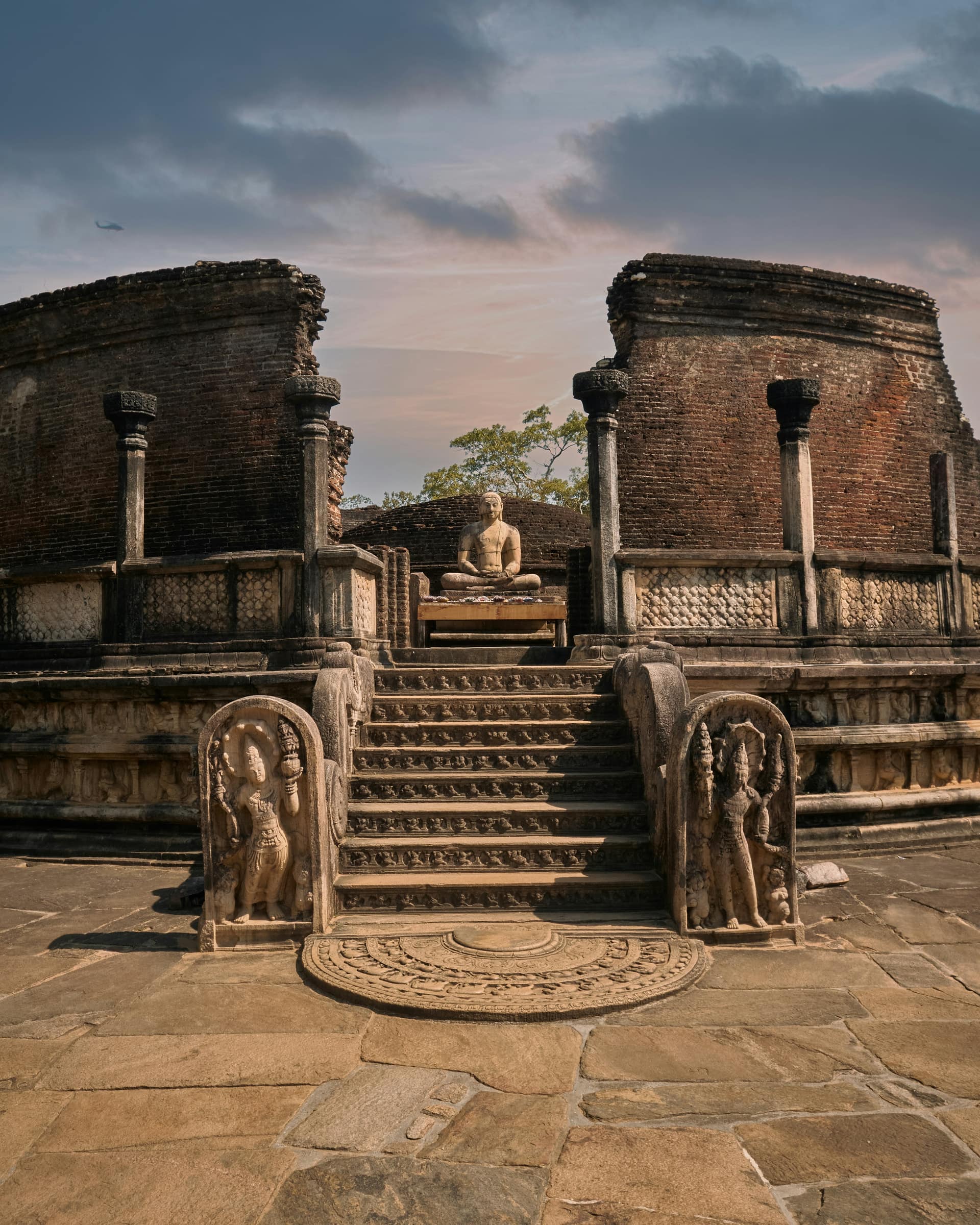
Buddha statues in Sri Lanka's Cultural Triangle appear in three main postures: seated, usually in meditation; standing, often blessing or teaching; and reclining, which depicts the Buddha's final passing into parinirvana. Hand gestures, called mudras, add meaning: dhyana mudra (hands in the lap) is meditation, abhaya mudra (raised palm) is reassurance or fearlessness, and asisa mudra (raised hand at Avukana) is blessing. Gal Vihara in Polonnaruwa shows seated, standing and reclining forms side by side.
Key takeaways
- The reclining Buddha in Sri Lanka usually depicts the parinirvana, the Buddha's passing, rather than sleep.
- Gal Vihara in Polonnaruwa shows a seated, a standing and a reclining Buddha carved from one granite face in the 12th century.
- The Samadhi Buddha in Anuradhapura is a seated image in dhyana mudra, the gesture of meditation, with hands resting in the lap.
- The Avukana Buddha, roughly 12 metres tall, raises its right hand in a gesture usually identified as asisa mudra, the blessing.
- In a reclining Buddha, feet placed slightly unevenly indicate parinirvana, while feet together suggest rest.
The three main postures
Buddha statues in the Cultural Triangle appear in three main postures: seated, standing and reclining. Seated Buddhas are the most common, usually in meditation with legs crossed. Standing Buddhas often show blessing, teaching or reassurance. Reclining Buddhas depict the Buddha's final passing, the parinirvana.
Each posture is tied to an event in the Buddha's life. The seated meditation recalls the enlightenment under the Bo tree. Standing images recall teaching and blessing. The reclining image recalls the death of the Buddha at Kushinagar.
Robes are another clue. Anuradhapura-period statues often show the robe over one shoulder or with pleats in parallel ridges, influenced by the Amaravati school of south India. Polonnaruwa images, such as those at Gal Vihara, show finer, thinner pleats. Comparing the Samadhi Buddha with Gal Vihara on consecutive days makes the change visible.
- →Seated: meditation and enlightenment.
- →Standing: blessing, teaching, reassurance.
- →Reclining: the parinirvana, the final passing.
The main hand gestures
Mudras, the hand gestures of Buddha statues, add meaning beyond the posture. In the Cultural Triangle, the most common is dhyana mudra, the meditation gesture, with both hands resting in the lap, palms up. The Samadhi Buddha in Anuradhapura is the classic example.
Abhaya mudra, the raised right palm facing outward, means reassurance or fearlessness. Vitarka mudra, with thumb and finger forming a circle, shows teaching. Bhumisparsha mudra, the right hand touching the earth, calls the earth to witness the enlightenment and is more common in later and Southeast Asian images.
Avukana's raised right hand is usually identified as asisa mudra, the blessing, a form particularly associated with Sri Lanka.
- →Dhyana mudra: hands in the lap, meditation.
- →Abhaya mudra: raised palm, fearlessness.
- →Vitarka mudra: circle of thumb and finger, teaching.
- →Asisa mudra: raised hand, blessing.
Reading a reclining Buddha
Reclining Buddhas are often misunderstood. In Sri Lanka they usually depict the parinirvana, the final passing away of the Buddha, not sleep. The Buddha lies on the right side, head on a pillow, with a calm face.
A detail helps tell the two apart: in a parinirvana image, the upper foot is often drawn slightly back, so the feet are not quite aligned. In an image of the Buddha resting, the feet are together. Guides at Gal Vihara and Dambulla love to point this out.
- →Right side, head on a pillow.
- →Feet slightly unaligned: parinirvana.
- →Feet together: rest.
Where to see each form
Gal Vihara in Polonnaruwa is the best place in the Cultural Triangle to see all three postures together, carved from one granite face in the 12th century. The reclining Buddha there is about 14 metres long. Dambulla's caves hold dozens of statues in different postures and gestures.
The Samadhi Buddha in Anuradhapura is the finest seated meditation image. The Avukana Buddha, standing roughly 12 metres tall, is the finest standing image. The Lankatilaka image house in Polonnaruwa holds a towering, now headless, standing Buddha.
Dambulla's cave temple is the best single place to practise reading postures and mudras, because the five caves hold over 150 images in a small space. Cave two alone contains seated, standing and reclining Buddhas. Look at the hands first, then the posture, then the robe, and the sequence of gestures starts to become familiar within a few minutes.
- →Gal Vihara, Polonnaruwa: seated, standing and reclining.
- →Samadhi Buddha, Anuradhapura: seated in meditation.
- →Avukana: standing in blessing.
- →Dambulla caves: many postures and gestures.
Respect around Buddha images
Buddha images in the Cultural Triangle are objects of worship, not just art. Remove shoes and hats, never touch statues, and never pose with your back to a Buddha for a photo. Pointing feet towards an image is considered disrespectful, so sit with feet tucked to one side.
Lankan Stays & Trails guides often suggest pausing in front of the Samadhi Buddha or Gal Vihara for a few quiet minutes. Many visitors find the faces, calm and inward, the most memorable part of a first visit.
Frequently asked questions
What does a reclining Buddha mean?
A reclining Buddha usually depicts the parinirvana, the Buddha's final passing, rather than sleep. The Buddha lies on the right side, head on a pillow. Feet slightly unaligned indicate parinirvana, while feet together suggest rest.
What is the Samadhi Buddha?
The Samadhi Buddha is a seated statue in Anuradhapura, dating to roughly the 3rd or 4th century AD, in dhyana mudra, the meditation gesture, with hands resting in the lap. It is considered one of the finest Buddha images in Sri Lanka.
What is the hand gesture on the Avukana Buddha?
The Avukana Buddha raises its right hand in a gesture usually identified as asisa mudra, the blessing. It is a form particularly associated with Sri Lanka. The statue stands roughly 12 metres tall near Kala Wewa.
What are mudras?
Mudras are symbolic hand gestures of Buddha statues, each with a meaning, such as meditation, fearlessness, teaching or blessing. Combined with the posture, they show which moment or quality of the Buddha the statue represents.
Where can I see all three Buddha postures?
Gal Vihara in Polonnaruwa shows a seated, a standing and a reclining Buddha carved side by side from one granite face in the 12th century. Dambulla's caves also hold many examples of each.
Can I touch Buddha statues in Sri Lanka?
No. Touching Buddha statues is disrespectful, and climbing on them is a serious offence. Remove shoes and hats, keep a respectful distance and never pose with your back to an image.