
Quick answer
The culture, wildlife and beach route is a good first trip for visitors whose main interests are temples, wildlife and beaches. It covers the island's most famous cultural sites, three safaris, whale watching and four beach nights, but leaves out the hill country, Ella and the scenic train that feature in most first-timer itineraries. First-timers who want a taste of everything should consider the classic 14-day route, or add Ella to this one.
Key takeaways
- The route suits first-timers whose main interests are temples, wildlife and beaches.
- It covers Sigiriya, Kandy, the ancient cities, three safaris, whales and the south coast.
- It leaves out the hill country, Ella and the scenic train.
- First-timers who want a taste of everything should consider the classic route or add Ella.
- A private driver-guide makes a first trip much easier.
Does it suit a first trip
A first trip to Sri Lanka usually tries to cover the island's main highlights. The culture, wildlife and beach route includes most of them: Sigiriya, the Temple of the Tooth, Dambulla, Polonnaruwa, Yala, the whales and the south coast. It adds Anuradhapura and Udawalawe, which many first-timers miss.
What it leaves out is the hill country: Nuwara Eliya, Horton Plains, Ella and the train. For many first-timers, these are as much a part of the Sri Lanka they imagine as the beaches. If the train through the tea estates is on your wish list, choose the classic route or add Ella.
First-timers who are unsure can ask themselves which they would regret missing most: the train and tea estates, or a full day at Yala and a third safari park.
- →Includes most of the island's main highlights.
- →Adds Anuradhapura and Udawalawe.
- →Leaves out the hill country.
Compared with the classic route
The classic 14-day route runs Sigiriya 3, Kandy 2, Nuwara Eliya 1, Ella 2, Tissamaharama 1, Mirissa 3 and Galle Fort 1. The culture, wildlife and beach route runs Anuradhapura 1, Sigiriya 3, Kandy 2, Udawalawe 1, Tissamaharama 2, Tangalle 2 and Mirissa 2. Both have seven check-ins and similar costs.
The classic route gives a broader introduction, with landscapes and the train. The culture, wildlife and beach route gives more depth in culture and wildlife, a calmer pace and fewer winding roads. Neither is objectively better; it depends on what you want.
- →Classic: broader, with the hills and train.
- →This route: deeper culture and wildlife, calmer.
- →Similar costs and check-ins.
What first-timers should know
Sri Lanka is friendly, safe and easy to travel, but a few things help. Distances look short on a map but roads are slow, so allow for drive times. Temples require modest dress and bare feet. The heat in the Cultural Triangle is significant. Entry fees to the main sites are high for foreign visitors.
Most first-timers travel with a private driver-guide, which is affordable and makes the trip much easier. English is widely spoken. Cash is useful in small towns, though cards are accepted in hotels and larger shops. Tipping is customary for drivers, guides and hotel staff.
An electronic travel authorisation is required for most nationalities; check the current rules before you travel.
- →Roads are slow; allow time.
- →Modest dress at temples.
- →Significant heat.
- →A private driver-guide helps.
How to prepare
Book flights and the main hotels early, especially for December to March. Arrange a driver-guide for the whole trip, and book safaris and whale watching in advance in peak season. Pack light clothes, modest clothing for temples, sun protection, insect repellent and comfortable shoes.
Read a little about the history before you go; it makes the ancient cities far more rewarding. Lankan Stays & Trails briefs first-time visitors on customs, money and practicalities before they arrive, and is available throughout the trip.
Arriving with a loose plan rather than a rigid one also helps. Sri Lanka rewards flexibility: a festival in a village, a herd of elephants beside the road or an invitation to a family lunch can be the best moments of a first trip, and a good driver will know when to stop.
First-timer highlights on the route
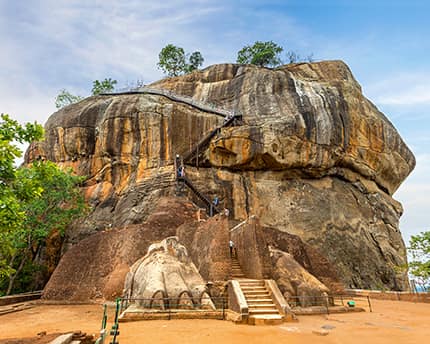
For most first-timers, the highlights of this route are the climb up Sigiriya, the evening puja at the Temple of the Tooth, the first sight of a wild elephant, a leopard in Yala, blue whales off Mirissa and the first swim on the south coast. Anuradhapura's Bo tree at dusk often surprises visitors with its power.
The route's stable bases and slower second week give first-timers time to absorb the country, rather than rushing from site to site.
- →Sigiriya at opening.
- →The Temple of the Tooth.
- →Elephants and leopards.
- →Whales and the south coast.
Frequently asked questions
Is the culture, wildlife and beach route good for a first trip?
Yes, for first-timers whose main interests are temples, wildlife and beaches. It covers most of the island's main highlights, adds Anuradhapura and Udawalawe and has a calm pace. First-timers who want the hill country and train should choose the classic route or add Ella.
What does this route miss compared with the classic route?
The hill country: Nuwara Eliya, Horton Plains, Ella and the scenic train. In return, it adds Anuradhapura, Udawalawe, a full day at Yala and two nights at Tangalle, with fewer winding roads.
Should first-timers include the hill country?
It depends on interests. The train and tea estates are iconic, and many first-timers love them. Others prefer more time for culture, wildlife and beaches. Ask yourself which you would regret missing most.
Do first-timers need a driver?
Not strictly, but most choose one. A private driver-guide is affordable, makes the trip much easier and adds local knowledge. Public transport is possible for parts of the route, but Sigiriya, Udawalawe and Yala are harder without a driver.
What should first-timers pack?
Light, breathable clothes, modest clothing covering shoulders and knees for temples, a hat, sunscreen, insect repellent, comfortable walking shoes, socks for hot temple floors and a light rain jacket. Binoculars are useful for the safaris.
Is Sri Lanka safe for first-time visitors?
Yes. Sri Lanka is generally safe and welcoming. Petty theft and scams are the main risks. Keep valuables secure, agree prices before journeys and follow local advice on swimming. Most first-timers find it easy and friendly.
Is two weeks the right length for a first trip?
Two weeks is ideal for most first trips. It allows the main highlights at a comfortable pace, with time to rest on the beach at the end. Ten days works for a faster trip, and three weeks allows the hill country as well as everything on this route.