
Quick answer
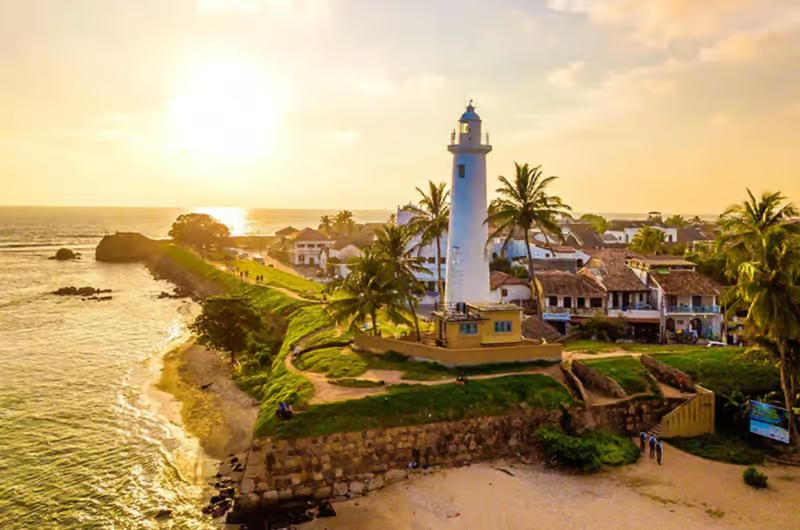
Galle is better than Mirissa for photography if you like streets, architecture and people, with whitewashed colonial buildings, the lighthouse, ramparts and daily life packed into a walkable fort. Mirissa is better for tropical seascapes: Coconut Tree Hill at sunrise, Parrot Rock, fishing boats in the harbour and whales in season. The best light in both falls between roughly six and eight in the morning and from five until sunset.
Key takeaways
- The best light on the south coast is from roughly six to eight in the morning and from five until sunset.
- Galle's lighthouse and the palms beside it face east, so they photograph best in the morning.
- Coconut Tree Hill in Mirissa is nearly empty at sunrise and has a queue by mid-morning.
- Drones need permission in Sri Lanka and should not be flown over Galle Fort or Mirissa harbour without it.
- A lens of 200 millimetres or longer is useful for whales, which stay at a regulated distance from the boat.
Photographing Galle
Galle Fort is a gift to a street photographer. The buildings are low, white and ochre, with deep verandas, carved doors and shuttered windows that throw strong shadows. Bicycles lean on walls, tuk-tuks are parked under frangipani, and schoolchildren in white cross the green.
The classic frames are the lighthouse with its fringe of palms, the clock tower above the cricket ground, the long line of the western ramparts at dusk, and Pedlar Street looking towards the sea. The interior of the Dutch Reformed Church and the arcades of the old Dutch Hospital work well in the flat light of midday.
- →Lighthouse and palms: morning light, from the rampart to the north.
- →Western ramparts: silhouettes and kites at sunset.
- →Church Street and Leyn Baan Street: doors, verandas and shadows.
- →Cricket from the wall: when a match is on at the stadium.
Photographing Mirissa
Mirissa's photographs are seascapes. Coconut Tree Hill, a rust-red headland with a stand of leaning palms, is the best known and is at its finest in the first half hour after sunrise. Parrot Rock gives a view back along the whole bay, and the harbour at dawn is a mass of painted trawlers.
Secret Beach offers small coves framed by palms, and the eastern rocks sometimes have turtles surfacing in the shallows. In the late afternoon the fishermen's outrigger boats on the sand make simple, strong subjects. Mirissa has less variety than Galle, so most photographers finish their list in a day and a half.
- →Coconut Tree Hill: sunrise, wide lens, stay back from the cliff edge.
- →Parrot Rock: the bay at low tide, mid-afternoon.
- →Harbour: colour and activity from half past five.
- →Eastern rocks: turtles on calm days, from a distance.
Light and timing
Light on the south coast is hard and overhead for much of the day, in Galle and Mirissa alike. From nine until four, shadows are short and the sky is bleached. Sunrise and sunset both fall between roughly 5.45 and 6.30 all year, and the soft light lasts only about forty minutes either side.
Galle's western ramparts face the setting sun, which is why everyone gathers there. Mirissa's bay faces south, so the sun sets behind the western headland and the sky colours over the water without the sun dropping into the sea. From May to September, storm light and heavy cloud make Galle dramatic and Mirissa grey.
People, drones and manners
Photographing people in Galle and Mirissa calls for the usual courtesy and a little more. Galle Fort is a residential and partly Muslim neighbourhood; ask before photographing people, especially women and worshippers, and do not shoot into homes through open doors. The stilt fishermen near Koggala usually expect a payment.
Drones require permission from the civil aviation authority in Sri Lanka, and flying over the fort, the harbour, crowds or military sites invites confiscation. Wedding shoots on the ramparts are common on weekends; give them room. At sea, a zoom lens matters because responsible boats keep their distance from whales.
- →Ask before photographing people, and accept a no.
- →Do not fly a drone without permission.
- →Stilt fishermen pose for a fee; agree it first.
- →Dress modestly when photographing in and around places of worship.
Kit and keeping it safe
Camera kit for Galle and Mirissa can be modest. A phone or a small camera with a wide-to-normal lens covers the fort. For Mirissa, add a telephoto of 200 millimetres or more for whales, a polarising filter for the sea, and a dry bag, since spray comes over the bow on most trips.
Humidity is constant on the coast. Let equipment warm up for ten minutes when leaving an air-conditioned room, or the lens will fog. Lankan Stays & Trails can arrange an early fort walk with a local guide who knows which doors and rooftops are open, and a driver who will have you at Coconut Tree Hill before the sun.
- →Dry bag and lens cloths for the boat.
- →Telephoto for whales; wide lens for the fort.
- →Spare batteries: there is nowhere to charge at sea.
- →Allow lenses to acclimatise after air conditioning.
Frequently asked questions
Is Galle or Mirissa more photogenic?
Galle offers more variety for photographers, with colonial streets, ramparts, churches, the lighthouse and constant street life in a small area. Mirissa has fewer subjects but more striking tropical scenes, especially Coconut Tree Hill at sunrise and the harbour at dawn. Many photographers find Galle fills two days and Mirissa one.
Where are the best photo spots in Galle Fort?
The lighthouse with its palms, the western ramparts at sunset, the clock tower, Church Street and Pedlar Street, the Dutch Reformed Church and the arcades of the old Dutch Hospital are the best-known photo spots in Galle Fort. Early morning gives the cleanest streets and the softest light.
What time should I go to Coconut Tree Hill?
Go at sunrise, arriving around a quarter to six. Coconut Tree Hill is close to empty then, the light is warm and low, and the heat has not built. By mid-morning there is usually a queue for the popular angles, and at sunset it is crowded again.
Can I fly a drone in Galle or Mirissa?
Only with permission. Sri Lanka requires drone registration and approval from the civil aviation authority, and additional consent near sensitive sites. Galle Fort includes naval and court premises, and Mirissa harbour is a working port. Flying without clearance risks a fine and confiscation of the drone.
What lens do I need for whale watching in Mirissa?
A telephoto of 200 to 400 millimetres is ideal for whale watching from Mirissa, because responsible boats stay well back from the animals. A fast shutter speed helps on a moving deck. Phones capture the scene but rarely the detail. Keep everything in a dry bag between sightings.
Is it okay to photograph local people in Galle?
Usually, if you ask first. Most people in Galle Fort are used to cameras and will say yes, but residents are not exhibits. Avoid photographing worshippers, women who seem uncomfortable, or the inside of homes. A smile, a question and a thank you go a long way.