
Quick answer
The best hikes around Kandy are the Hantana tea trail on the ridges south of the city, the Udawattakele Forest Reserve directly behind the Temple of the Tooth, the short climb to Bahirawakanda Buddha statue, and the Knuckles Conservation Forest foothills roughly an hour and a half to the north-east. Hantana takes about three to five hours depending on the route, Udawattakele one to three hours on marked loops, and Bahirawakanda under an hour. Start early: the hills cloud over by mid-morning.
Key takeaways
- Udawattakele Forest Reserve sits directly behind the Temple of the Tooth and has marked loop trails of one to three hours.
- The Hantana range south of Kandy offers a tea-estate ridge walk of roughly three to five hours.
- Bahirawakanda's Buddha statue is a short climb with the best overview of Kandy and the lake.
- The Knuckles Conservation Forest is about an hour and a half from Kandy and offers the area's most serious trekking.
- Kandy sits at around 500 metres, so walks here are cooler than the lowlands but hotter than Nuwara Eliya.
Udawattakele Forest Reserve
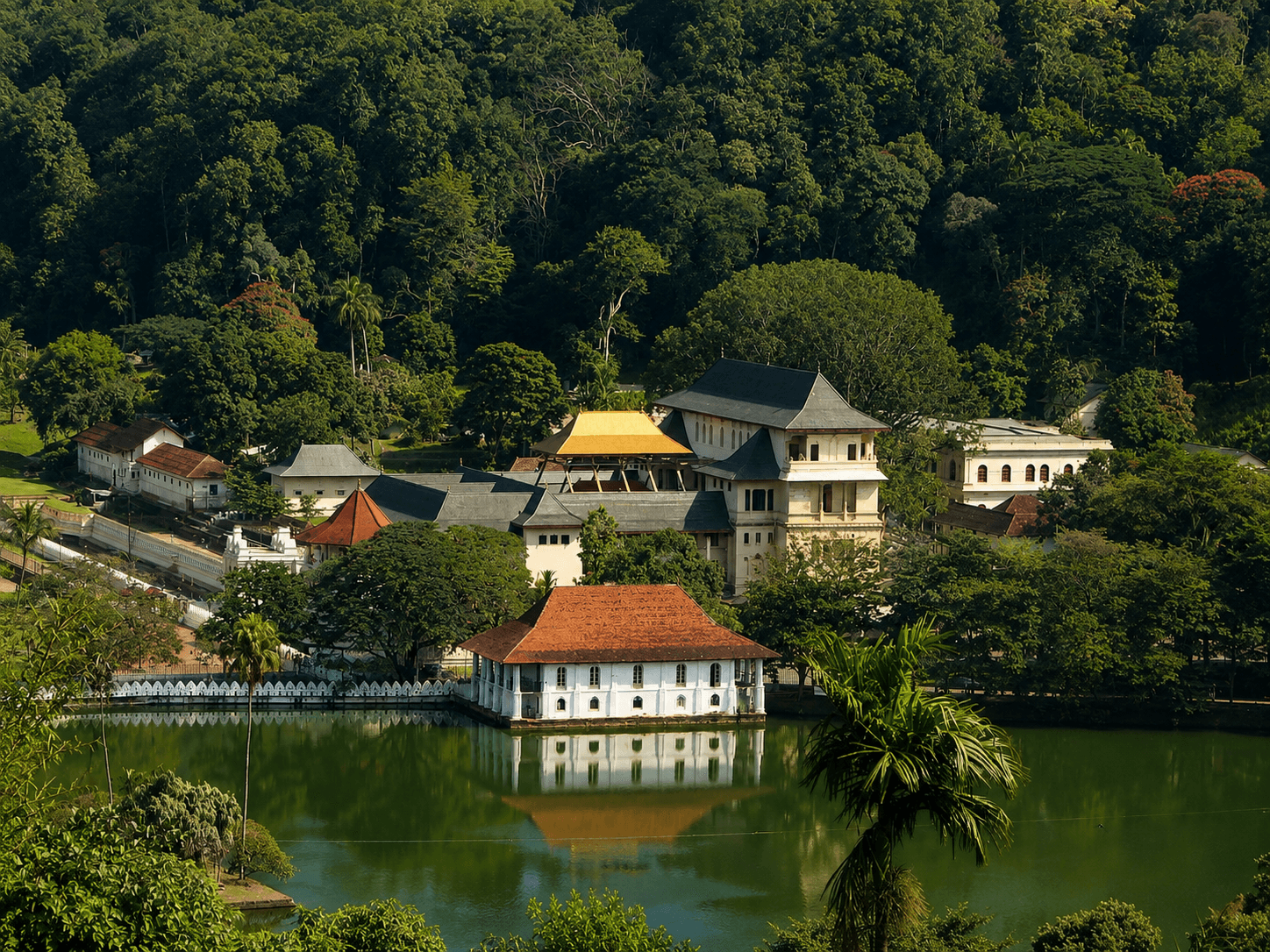
Udawattakele is a genuine tropical forest reserve of roughly 100 hectares immediately behind the Temple of the Tooth, once the royal forest garden of the Kandyan kings and now a sanctuary in the middle of a working city. Within ten minutes of leaving the temple you are under closed canopy with giant lianas, buttressed trees and troops of macaques and purple-faced langurs overhead.
There are marked paths, including a loop around the perimeter and routes to the Garrison Cemetery viewpoint and to several meditation caves still used by forest monks. Allow one to three hours depending on how much you link together. Birding is excellent in the first two hours after dawn: layard's parakeet, brown-capped babbler and orange-billed babbler are all possible.
- →Entrance is a short walk behind the Temple of the Tooth; small entry fee payable.
- →Marked loops of roughly one to three hours; the perimeter path is the classic.
- →Best for wildlife in the first two hours after opening.
- →Do not walk alone at dusk, and keep bags closed against macaques.
The Hantana tea trail
The Hantana range rises south of Kandy behind the university and the tea research institute, and it is the area's best half-day walk. The classic route climbs through tea estates onto a series of grassy ridge tops, with views north over Kandy and the lake and, on a clear morning, east to the Knuckles massif.
Depending on which of the seven ridge peaks you link, expect three to five hours and a decent amount of ascent. Paths are informal estate tracks and can be confusing where they branch, so a local guide or an offline map is worth having. Start at dawn: this is open, exposed walking and it becomes unpleasant by mid-morning.
- →Roughly three to five hours depending on how many ridge tops you link.
- →Open, exposed tea-estate walking; start at first light.
- →Views north over Kandy and east to the Knuckles on a clear day.
- →Informal paths with unmarked branches. Take a guide or an offline map.
Bahirawakanda and the short walks
The white Buddha statue at Bahirawakanda stands on the hill directly above Kandy and can be reached on foot in about 30 to 45 minutes of steady uphill from the town centre, or by tuk-tuk in a few minutes. The terrace at the base gives the best single overview of the city, the lake and the temple complex, and it is at its best in the last hour of daylight.
The Kandy Lake circuit is the other easy option: a flat walk of roughly three and a half kilometres around the water, best at dawn when the water birds are active and before the traffic builds. Neither is a hike in a serious sense, but both are worth doing.
- →Bahirawakanda: 30 to 45 minutes uphill on foot, best in late afternoon light.
- →Kandy Lake circuit: roughly 3.5 km, flat, best at dawn.
- →Modest dress and shoes off apply at the Bahirawakanda temple terrace.
The Knuckles foothills from Kandy
The Knuckles Conservation Forest, a UNESCO World Heritage listed montane range, begins roughly an hour and a half north-east of Kandy and offers the most serious walking in the region: cloud forest, pygmy forest at altitude, river valleys and villages that still farm on terraces. Day trips from Kandy are entirely feasible, with routes from the Hunnasgiriya, Corbett's Gap or Riverston sides.
Guides are compulsory on many Knuckles routes and sensible on all of them, and permits are required for some sectors. Leeches are a serious presence during and after rain, so leech socks are not optional. This is genuine mountain terrain and the weather changes fast.
- →About 1.5 hours from Kandy to the main access points.
- →Guides required on many routes, and permits needed in some sectors.
- →Leech socks essential in the wet; the range holds cloud forest and montane grassland.
- →Day trips are feasible, but two days in the range is far better.
When to walk around Kandy
Kandy sits at roughly 500 metres, which makes it noticeably cooler than the lowlands but far warmer than Nuwara Eliya. The best walking months are broadly January to March, when mornings are clearest. The hills cloud over most days by mid-morning throughout the year, so a dawn start is the single most useful piece of advice.
Both monsoons touch this part of the island to some degree, and Kandy sees rain in most months. Paths become slippery and leeches appear quickly after rain, particularly in Udawattakele and the Knuckles.
- →Best months: roughly January to March for clear mornings.
- →Start at first light in any month; cloud usually arrives by mid-morning.
- →Rain is possible year-round. Expect leeches in forest after wet weather.
- →Kandy is around 500 m: cooler than the coast, warmer than Nuwara Eliya.
Practicalities and safety
Carry more water than you think you need, particularly on the exposed Hantana ridges. Wear proper shoes; the estate tracks and forest paths are slippery. Sun protection matters even in cloud at this altitude.
Macaques in Udawattakele and around the temple are habituated and will investigate open bags and visible food. Keep everything zipped and do not feed them. On any of the longer routes, tell someone where you are going and roughly when you expect to be back, and avoid walking alone at dusk.
Fitting walking into a Kandy stay
Most itineraries give Kandy a single night, which is enough for the Temple of the Tooth and nothing else. Two nights lets you add a dawn walk in Udawattakele and a sunset at Bahirawakanda. Three nights makes Hantana or a Knuckles day trip possible.
Lankan Stays & Trails arranges Knuckles guides and permits, and can build a Kandy stay around morning walking rather than midday sightseeing, which suits the climate far better.
Frequently asked questions
What are the best hikes around Kandy?
The Hantana tea trail on the ridges south of the city, the Udawattakele Forest Reserve behind the Temple of the Tooth, the short climb to the Bahirawakanda Buddha statue, and day trips into the Knuckles Conservation Forest about an hour and a half to the north-east.
How long is the Hantana trail?
Roughly three to five hours depending on how many of the ridge tops you link together. It climbs through tea estates onto open grassy ridges with views over Kandy and towards the Knuckles. Paths are informal estate tracks, so take a guide or an offline map.
Can you walk in Udawattakele Forest Reserve?
Yes. Udawattakele has marked loop trails taking one to three hours, including a perimeter path and routes to viewpoints and meditation caves. There is a small entry fee, and the first two hours after opening are best for birds and langurs.
Is Kandy good for hiking?
Better than its reputation. Kandy sits at around 500 metres with a genuine forest reserve in the city, tea ridges immediately south, and the Knuckles range within a ninety-minute drive. It is not the hill country proper, but two or three days of good walking are easily filled.
How do you get to the Knuckles from Kandy?
The main access points are roughly an hour and a half north-east of Kandy, via Hunnasgiriya, Corbett's Gap or the Riverston side. Guides are compulsory on many routes and permits are required in some sectors, so arrange both in advance rather than on arrival.
When is the best time to hike around Kandy?
Broadly January to March for the clearest mornings, though Kandy sees some rain in most months. Whatever the season, start at first light: the hills usually cloud over by mid-morning, and open routes such as Hantana become uncomfortably hot.
Are there leeches on Kandy hikes?
Yes, in forest and after rain, particularly in Udawattakele and throughout the Knuckles. They are harmless but persistent. Leech socks or long socks tucked into trousers, with a little salt or repellent, make a substantial difference during and after wet weather.