
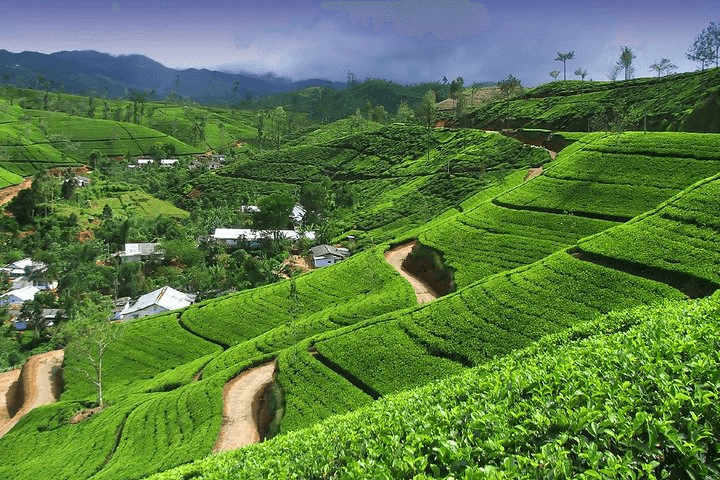
Quick answer
Sri Lanka's hill country is clearest and driest roughly from January to March. The western slopes, including Nuwara Eliya, Hatton and Adam's Peak, are wettest and windiest in the southwest monsoon from about May to September, while the eastern slopes around Ella, Haputale and Badulla are wettest in the northeast monsoon from about October to January. October and November are wet on both sides. Temperatures fall with altitude: Kandy about 28 °C by day, Ella about 25 °C, Nuwara Eliya about 20 °C.
Key takeaways
- January to March is the clearest, driest period across the whole hill country.
- The western slopes, including Nuwara Eliya, are wettest from about May to September.
- The eastern slopes, including Ella and Badulla, are wettest from about October to January.
- October and November bring rain to both sides, with landslide warnings possible.
- Altitude sets the temperature: roughly 6 °C cooler for every 1,000 m.
Two sides of the hills
The central highlands rise to over 2,500 m at Pidurutalagala and form a wall across the monsoon winds. The western and southern slopes, facing the Indian Ocean, take the southwest monsoon from May to September. The eastern slopes, in the Uva province, take the northeast monsoon from November to January, and sit in a rain shadow in summer.
In practice, that means Nuwara Eliya, Hatton, Talawakele and the Adam's Peak area are wet and misty in summer, while Ella, Bandarawela, Haputale and Badulla are often sunny at the same time. In December and January, the pattern reverses. Kandy, at the northern edge of the hills, sits between the two and gets rain from both, in moderation.
- →Western slopes: Nuwara Eliya, Hatton, Adam's Peak.
- →Eastern slopes: Ella, Bandarawela, Haputale, Badulla.
- →In between: Kandy.
Altitude and temperature
Temperature falls with height, by roughly 6 °C for every 1,000 m. Kandy, at about 500 m, has daytime highs of about 27 to 31 °C. Ella, at about 1,000 m, is about 23 to 27 °C. Haputale, at about 1,400 m, is cooler still. Nuwara Eliya, at about 1,870 m, has days of about 18 to 21 °C and nights of 8 to 14 °C.
The coldest nights come in January and February, when clear skies allow ground frost on Horton Plains and in the valleys around Nuwara Eliya. Mist, wind and rain make the higher hills feel colder than the thermometer suggests.
- →Kandy: about 27 to 31 °C by day.
- →Ella: about 23 to 27 °C by day.
- →Nuwara Eliya: about 18 to 21 °C by day, 8 to 14 °C at night.
Month by month
January to March are the best months for views across the hills. Rain is low on both sides, mornings are clear, and the Adam's Peak season is in full swing. Ella can still get showers in early January from the end of the northeast monsoon. April is warm and busy, with afternoon storms.
May to September belong to the southwest monsoon. The western hills are wet, windy and misty, with Nuwara Eliya averaging roughly 150 to 230 mm a month. Ella and Haputale are often dry and bright with breezy afternoons, and the Ella side is the better base. July and August are usually lighter than June.
October and November are wet across the hills, with heavy afternoon storms, mist and landslide warnings after long rain. December and January bring the northeast monsoon to the Ella side, while Nuwara Eliya dries out and the views to the west open up.
- →Best views: January to March.
- →Summer base: Ella side.
- →Winter base: Nuwara Eliya side.
Mist and the daily pattern
In every season, mornings are clearer than afternoons. Cloud builds over the ridges from late morning, and by 2 pm many viewpoints are in mist. That is why Horton Plains, Little Adam's Peak, Lipton's Seat and Ella Rock are best started at or before dawn.
The Kandy to Ella train follows the same rule: morning trains usually have clearer views than afternoon ones, and the side of the line in the rain shadow is the clearer section.
Planning hill country days
Choose the base by the season: the Ella side from May to September, the Nuwara Eliya side from December to March, and either from January to April. Start walks early, pack a warm layer for evenings, and keep a spare half day in October and November.
Lankan Stays & Trails plans hill country stays on the drier side of the mountains for each trip's dates and books early-morning walks to catch the clearest views.
Frequently asked questions
When is the best time to visit Sri Lanka's hill country?
January to March is the clearest and driest period across the whole hill country. From May to September, the Ella side is drier than Nuwara Eliya; from October to January, Nuwara Eliya's side becomes drier from mid-December. Mornings are clearest in every season.
When is the rainy season in the hill country?
It depends on the side. The western slopes, including Nuwara Eliya, are wettest from about May to September. The eastern slopes, including Ella and Badulla, are wettest from about October to January. October and November bring rain to both sides.
Is Ella drier than Nuwara Eliya?
From about May to September, usually yes, because Ella sits in the rain shadow of the southwest monsoon. From about November to January, Ella is often wetter, because it faces the northeast monsoon. Both are clearest from about January to March.
How cold does the hill country get?
Nuwara Eliya has daytime highs of about 18 to 21 °C and nights of 8 to 14 °C, with ground frost possible on clear January and February nights. Ella is milder, about 23 to 27 °C by day, and Kandy warmer, about 27 to 31 °C.
Why is the hill country misty in the afternoon?
Warm, moist air rises up the slopes during the day, cools and condenses into cloud, which settles over the ridges from late morning. Mornings are usually clearer. Plan viewpoints such as Horton Plains and Little Adam's Peak for early starts.
Are there landslides in the hill country?
Landslides are possible after long heavy rain, most often in late May to June and October to December. Warnings are issued by the National Building Research Organisation. Drivers avoid long hill drives after heavy rain, and trains on the hill line can be suspended.
How does Lankan Stays & Trails plan hill country stays by season?
Hill country bases are chosen on the drier side for each trip's dates: Ella from May to September and Nuwara Eliya from December to March. Early-morning walks are booked for the clearest views, and a spare half day is kept in October and November.