
Quick answer
The 12-day Alps-to-beach Sri Lanka itinerary's 2/2/3/4-5 night split reflects what each stop needs: 2 Cultural Triangle nights for one climb and one temple visit, 2 Kandy nights for the Temple of the Tooth and a cultural show around the scenic railway's departure, 3 hill country nights to allow both a tea estate day and the optional Horton Plains excursion, and 4 to 5 coast nights because whale watching and snorkelling both benefit from more than one attempt at good conditions.
Key takeaways
- The Cultural Triangle's 2 nights cover exactly one full day (Sigiriya plus Dambulla) either side of the arrival and departure transfers, leaving little genuine spare time.
- Kandy's 2 nights are built around 2 fixed evening commitments, the Temple of the Tooth ceremony and the Kandyan dance performance, plus positioning for the next morning's scenic railway departure.
- Hill country's 3 nights split as 2 in Nuwara Eliya and 1 in Ella specifically because Nuwara Eliya carries 2 separate activities (a tea estate day and the optional Horton Plains dawn trip) while Ella's walks fit into a single afternoon.
- The coast's 4 to 5 night range exists because whale watching (season permitting, roughly November to April) is weather dependent, and more nights improve the odds of catching a good outing rather than relying on a single scheduled attempt.
- Shifting a night from the coast to hill country is more defensible than shifting one from Kandy, since Kandy's night count is tied to fixed evening events rather than flexible daytime activity.
Why the Cultural Triangle gets 2 nights
The Cultural Triangle's 2 nights map directly onto a single full day of activity: day 2's early Sigiriya climb (roughly 1,200 steps, 2 to 3 hours return) followed by an afternoon at Dambulla's cave temples, bookended by day 1's arrival transfer and day 3's departure towards Kandy. There is genuinely only one full day of unencumbered time here, which is why 2 nights, not 3, is the standard allocation.
A third night would only make sense if a traveller wanted a second, separate day for something like a village and lake safari by bullock cart and boat, an activity the fixed route already treats as optional within day 2 rather than requiring its own day.
It is worth noting that day 1's transfer time (roughly 3 to 4 hours from Colombo) already eats into what would otherwise be free time on arrival evening, which is one reason the Cultural Triangle stop is not stretched to 3 nights by default. Travellers arriving on an earlier flight sometimes have a little extra time on day 1 itself, but this is opportunistic rather than something the fixed route relies on.
- →Day 1: arrival transfer, roughly 3 to 4 hours, limited spare time on arrival evening.
- →Day 2: Sigiriya climb in the morning, Dambulla cave temples in the afternoon.
- →Day 3: departure transfer towards Kandy, optionally via Polonnaruwa.
Why Kandy gets 2 nights
Kandy's 2 nights exist because of 2 separate evening commitments: the Temple of the Tooth's evening drumming ceremony, best timed around arrival on day 3, and the Kandyan dance performance on day 4's evening, alongside a relaxed lake walk during the day. Structurally, Kandy's night count is driven by evenings rather than daytime activity, which makes it less flexible to compress than it might first appear.
Kandy's second night also positions travellers to catch the Kandy-Ella scenic railway the following morning, day 5, without an early transfer into Kandy on the day of departure, which would risk missing the train's departure time.
This positioning function is easy to underestimate. Because the scenic railway typically departs Kandy early in the morning, arriving into Kandy on the same day as the train would mean an overnight journey or a very early road transfer beforehand, neither of which suits the route's pacing. Staying the second Kandy night removes that risk entirely.
- →Night 1 (day 3): Temple of the Tooth evening ceremony.
- →Night 2 (day 4): Kandyan dance performance, plus a daytime lake walk.
- →Positions travellers to catch the scenic railway the next morning without a rushed connection.
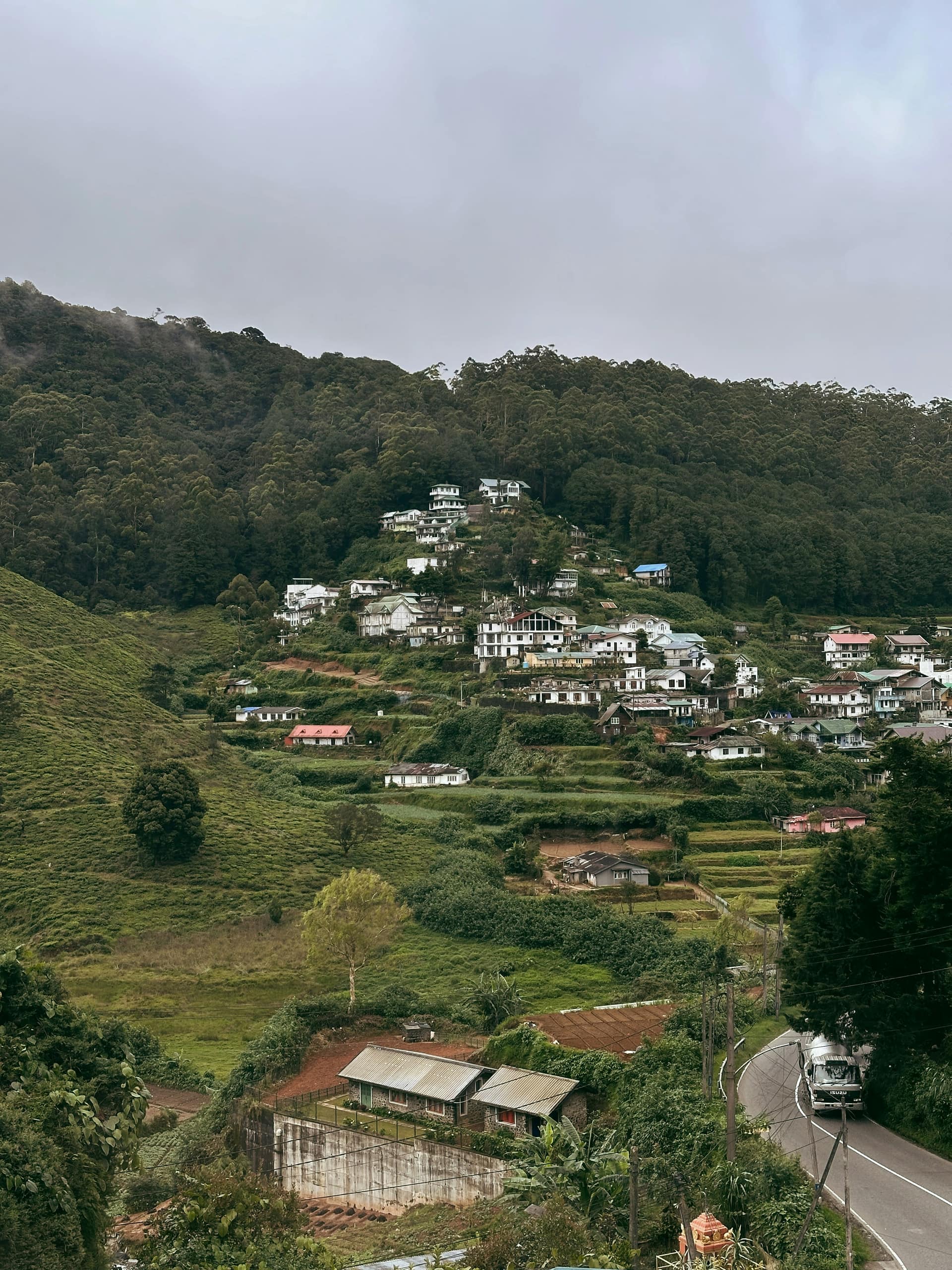
Why hill country gets 3 nights, split 2 and 1
Hill country's 3 nights split as 2 in Nuwara Eliya and 1 in Ella, and this specific split reflects how much there genuinely is to do at each. Nuwara Eliya carries 2 distinct activities, a tea factory and estate walk on one day, and an optional but genuinely worthwhile dawn excursion to Horton Plains and World's End (roughly 1.5 to 2 hours each way) that needs its own early start rather than being combined with the tea estate day.
Ella, by contrast, fits its main activities, a walk to Nine Arch Bridge and a walk to Little Adam's Peak, into a single afternoon and following morning, which is why 1 night, not 2, is the standard allocation there. Giving Ella a second night without a specific additional activity to fill it tends to produce a genuinely slower day rather than more sightseeing.
Travellers who do want more time in Ella specifically, perhaps for a longer hike or simply a quieter pace after the scenic railway, generally borrow that extra night from the coast leg rather than shortening Nuwara Eliya, since Nuwara Eliya's 2 activities do not compress into 1 day without dropping one of them.
- →Nuwara Eliya: 2 nights for 2 separate activities (tea estate day, Horton Plains dawn trip).
- →Ella: 1 night for activities that fit into one afternoon and morning.
- →The split reflects activity density, not simply travel convenience.
Why the coast gets a 4 to 5 night range
The coast leg's 4 to 5 night range, wider than any other stop's allocation, reflects that its two headline activities, whale watching (season permitting, roughly November to April) and reef snorkelling, are both weather and condition dependent rather than guaranteed on a fixed schedule. More nights simply improve the odds of a good outing for either activity, rather than adding a new activity that needs its own day.
This is also the stop where unstructured time is the point rather than a gap to fill, so the exact choice between 4 and 5 nights often comes down to overall trip length and how much beach time a traveller wants, rather than a specific activity requiring the extra night.
A 4-night coast stay generally still allows one attempt at whale watching and one at snorkelling with a small buffer for weather, while 5 nights adds genuine margin if either outing needs to be rescheduled, or simply more open beach time. Neither figure is wrong; it is more a question of how much slack a traveller wants built in against a weather-dependent activity.
- →4 nights: comfortably covers one whale watching and one snorkelling attempt with light buffer.
- →5 nights: adds margin for rescheduling either activity, or simply more open beach time.
- →The choice between 4 and 5 nights rarely changes the daytime structure, only the amount of buffer.
When shifting a night between stops makes sense
Shifting a night from the coast to hill country is the most defensible adjustment, since it adds flexibility to a stop (hill country) whose activities can genuinely use more time, particularly if both the tea estate day and Horton Plains are priorities. Shifting a night away from Kandy is harder to justify, since Kandy's 2 nights are tied to 2 fixed evening events rather than to flexible daytime activity, so removing one usually means losing one of those events outright rather than simply having a faster-paced day.
Shifting a night from the Cultural Triangle is only sensible if a traveller is willing to drop either Sigiriya or Dambulla, since 1 night genuinely only fits one of the two comfortably, as covered in the guide on compressing this route to 9 days.
- →Coast to hill country: generally the most defensible shift.
- →Away from Kandy: usually costs one of its two fixed evening events.
- →Away from the Cultural Triangle: usually costs either Sigiriya or Dambulla.
Working out your own split
Understanding why each stop has the night count it does makes it easier to decide, with a local operator, whether a specific priority, an extra tea estate day, more coast time, or simply a lighter overall pace, justifies moving a night from one stop to another.
We at Lankan Stays & Trails treat the 2/2/3/4-5 split as a well-tested starting point rather than a fixed rule, and most adjustments we make for Swiss travellers move a night towards hill country or the coast rather than away from Kandy or the Cultural Triangle.
Frequently asked questions
Why does the Cultural Triangle only get 2 nights?
Because its activities, the Sigiriya climb and Dambulla's cave temples, fit into a single full day between the arrival and departure transfers. A third night would only be useful for an additional activity such as a village and lake safari.
Why does Nuwara Eliya get 2 nights while Ella only gets 1?
Nuwara Eliya carries 2 distinct activities, a tea estate day and the optional Horton Plains dawn excursion, that need separate days, while Ella's walks to Nine Arch Bridge and Little Adam's Peak fit into a single afternoon and morning.
Can I move a night from the coast to hill country?
Yes, this is generally the most defensible adjustment to the fixed split, since hill country's activities, particularly a tea estate day plus Horton Plains, can genuinely use the extra time more than a coast stay strictly requires it.
Can I shorten Kandy's 2 nights without losing anything?
Not easily. Kandy's 2 nights are tied to 2 fixed evening commitments, the Temple of the Tooth ceremony and the Kandyan dance performance, so removing a night usually means dropping one of those events rather than simply speeding up the daytime schedule.
Why does the coast get a range (4 to 5 nights) rather than a fixed number?
Because its two main activities, whale watching and reef snorkelling, are weather and season dependent rather than guaranteed on a fixed day, so more nights simply improve the odds of good conditions rather than adding a new fixed activity.
Is the 2/2/3/4-5 split fixed, or can it be changed?
It is a well-tested starting point rather than a strict rule. It can be adjusted, most defensibly by moving a night towards hill country or the coast, with a local operator based on which stop's activities matter most to a given traveller.