
Quick answer
The Jaffna islands are a group of low limestone and coral islands off the northern tip of Sri Lanka, reached by causeway or ferry from Jaffna. Delft, the furthest, is known for its wild ponies, coral-block walls and Dutch-era ruins, and takes about an hour by ferry from Kurikadduwan. Nainativu holds two major pilgrimage sites, the Nagapooshani Amman Kovil and the Buddhist Nagadeepa Purana Viharaya, and is a short ferry from the same jetty. Kayts and Karainagar are connected by road causeways.
Key takeaways
- Delft island is famous for its free-roaming wild ponies, descended from Portuguese and Dutch-era stock.
- Nainativu holds both a major Hindu kovil and a Buddhist temple, and is one of the few sites revered by both faiths.
- Ferries to Delft and Nainativu leave from Kurikadduwan jetty, roughly an hour from Jaffna town by road.
- Kayts and Karainagar are reached by long road causeways rather than by boat.
- Ferries are free or very cheap, run to limited timetables, and can be crowded; go early.
How the islands fit together
The Jaffna archipelago lies in shallow lagoon water off the peninsula's western end. Some islands, including Kayts, Karainagar and Punkudutivu, are joined to the mainland by long causeways that carry roads directly across the sea. Others, including Delft, Nainativu and Analativu, are reached only by ferry.
The jumping-off point for the ferries is Kurikadduwan jetty, usually shortened to KKD, at the far end of the Punkudutivu causeway roughly an hour's drive from Jaffna town. From there, boats run to Nainativu, a short crossing, and to Delft, roughly an hour across open water.
- →Road causeways reach Kayts, Karainagar and Punkudutivu.
- →Ferries from Kurikadduwan (KKD) jetty reach Nainativu and Delft.
- →KKD is about an hour by road from Jaffna town.
- →Nainativu is a short crossing; Delft takes roughly an hour each way.
Delft: ponies, coral walls and baobabs
Delft, known in Tamil as Neduntheevu, is the most distinctive place in the archipelago and one of the strangest landscapes in Sri Lanka. It is flat, dry and open, and its field boundaries are built from blocks of dead coral quarried from the surrounding shallows, which gives the island a pale, honeycombed look nothing like the rest of the country.
The island's best-known inhabitants are its wild ponies, a free-roaming population descended from stock introduced during the Portuguese and Dutch periods. They graze the open scrub and are genuinely wild: watch them from a distance and do not attempt to approach or feed them. Elsewhere on the island are the ruins of a Dutch fort, a giant baobab tree of uncertain age, a curious growing stone and an ancient banyan.
- →Free-roaming wild ponies, descended from colonial-era stock. Keep your distance.
- →Field walls built from quarried coral blocks, unique in Sri Lanka.
- →Dutch fort ruins, a giant baobab, and the growing stone.
- →Almost no facilities. Bring water, food, sun protection and cash.
Nainativu: two faiths, one small island
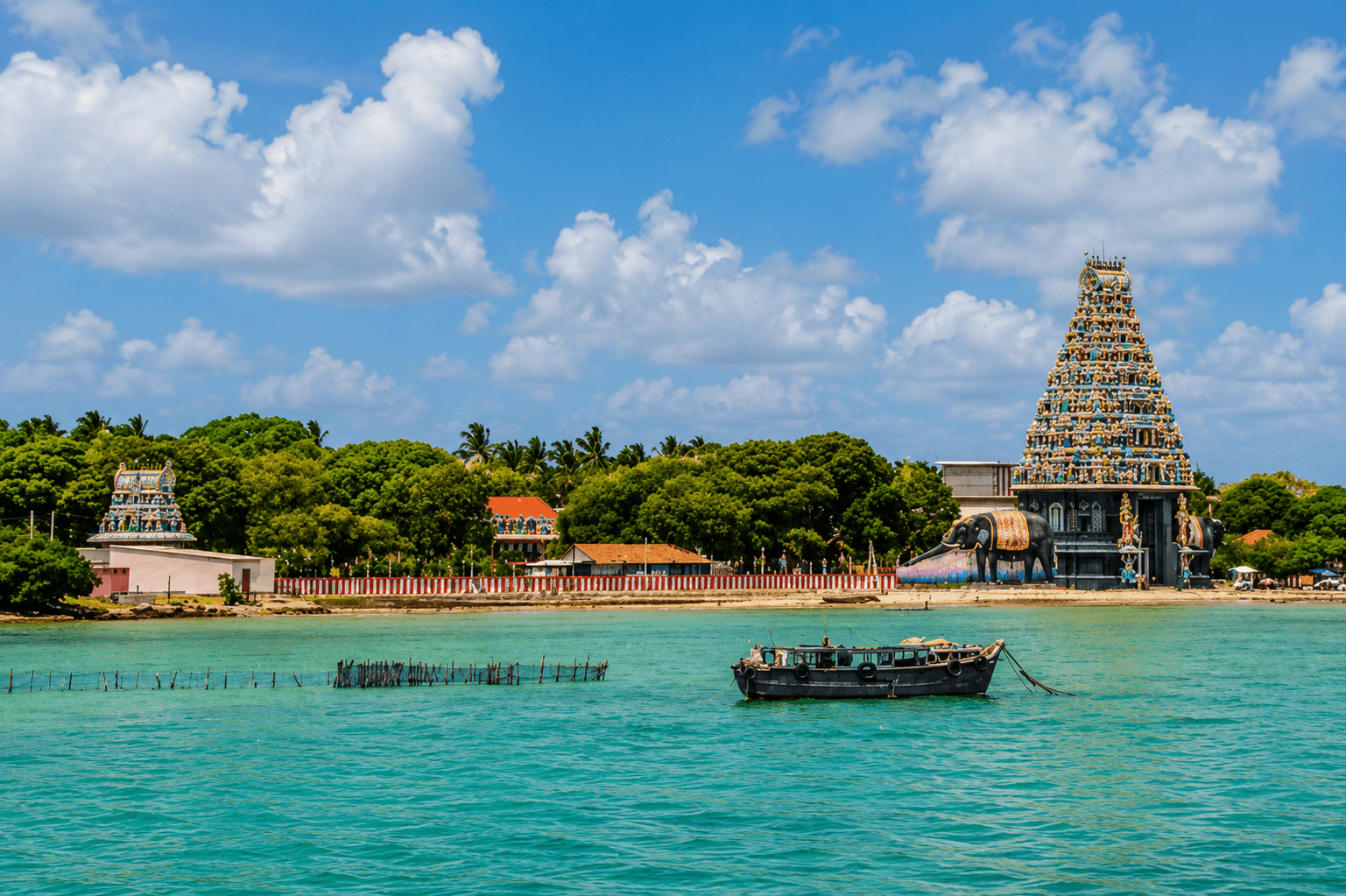
Nainativu is tiny and holds two of the most significant religious sites in northern Sri Lanka, a few hundred metres apart. The Nagapooshani Amman Kovil is a major Hindu temple to the goddess Parvati in her serpent form, with a towering painted gopuram visible from the boat, and it draws pilgrims from across the island and from India.
The Nagadeepa Purana Viharaya, close by, is one of the sixteen holiest Buddhist sites in Sri Lanka, believed to mark a place where the Buddha visited to settle a dispute between two naga kings. That a single small island holds a major site for both faiths, with pilgrims of each passing one another on the same path, is quietly remarkable.
- →Nagapooshani Amman Kovil: major Hindu temple with a painted gopuram.
- →Nagadeepa Purana Viharaya: one of the sixteen holiest Buddhist sites in Sri Lanka.
- →Both are active places of worship. Remove shoes and dress modestly.
- →The island is small enough to see both on foot in an hour or two.
Kayts, Karainagar and the causeways
Kayts is reached by causeway and holds Hammenhiel Fort, a Portuguese and Dutch fortification built on a tiny islet in the channel, now partly converted to accommodation and reached by a short boat hop. The drive out across the causeway, with shallow water on both sides and fishermen working the flats, is much of the pleasure.
Karainagar, further north-west, has Casuarina Beach, the north's best-known swimming beach, with shallow calm water and casuarina trees along the sand. It is popular with domestic visitors at weekends and quiet on weekdays.
- →Kayts: Hammenhiel Fort on an islet in the channel, reached by short boat.
- →Karainagar: Casuarina Beach, shallow and calm, busiest at weekends.
- →The causeway drives themselves are a highlight, with water on both sides.
- →Both are reachable by car or tuk-tuk from Jaffna without any ferry.
Ferries, timings and how to plan the day
Ferries from KKD are inexpensive or free, run to limited and changeable timetables, and can be crowded, particularly at weekends and on festival days. Boats fill on a first-come basis and queues form well before departure, which is the single most important thing to know.
For Delft, plan on a full day: an hour to KKD, an hour on the boat, a few hours on the island with a hired tuk-tuk or van to see the sights, and the same back. Nainativu can be a half day. Doing both properly in one day is possible but tight, and depends entirely on the boat timetable that week. Confirm timings locally the day before.
- →Boats fill first-come; arrive well before the scheduled departure.
- →Timetables change. Confirm locally the day before rather than online.
- →Delft is a full day from Jaffna; Nainativu can be a half day.
- →Hire a tuk-tuk or van on Delft; the island is too spread out to walk.
What to know before you go
These islands have very limited facilities. On Delft in particular there are few shops, no ATMs and little shade, so bring water, food, sun protection and cash. Mobile signal is patchy in places.
Both Nainativu temples are active places of worship with the usual expectations: shoes off, shoulders and knees covered, and at the kovil men are often expected to remove shirts before entering the inner areas, as is common at Hindu temples in the north. Photography is restricted inside. Behave as a guest at a service rather than a visitor at a monument.
- →Bring water, food, sun protection and cash. Facilities are minimal.
- →Shoes off and modest dress at both Nainativu temples.
- →Men may be asked to remove shirts inside the kovil's inner areas.
- →Photography is restricted inside temples; always ask first.
Fitting the islands into a northern trip
The islands need at least one full day and are best treated as a reason to give Jaffna three nights rather than one. A workable shape is a day for Jaffna town and Nallur, a day for the islands, and a day for the peninsula proper: Point Pedro, Keerimalai springs and the Casuarina coast.
The north is at its most comfortable from around May to September, when the rest of the island's south-west is wet. Lankan Stays & Trails arranges the KKD ferries and island transport, which is the part that most often derails an independent day trip.
Frequently asked questions
How do you get to Delft Island in Sri Lanka?
By ferry from Kurikadduwan jetty, known as KKD, at the end of the Punkudutivu causeway roughly an hour's drive from Jaffna town. The crossing takes about an hour. Boats are inexpensive, run to limited timetables and fill first-come, so arrive well before departure.
Are there really wild ponies on Delft Island?
Yes. Delft has a free-roaming population of ponies descended from stock introduced during the Portuguese and Dutch periods. They are genuinely wild and graze the open scrub across the island. Watch them from a distance and do not attempt to approach, touch or feed them.
What is Nainativu known for?
Nainativu is a small island holding two major pilgrimage sites: the Nagapooshani Amman Kovil, a significant Hindu temple with a painted gopuram, and the Nagadeepa Purana Viharaya, one of the sixteen holiest Buddhist sites in Sri Lanka. Both are within a short walk of each other.
How many islands are there off Jaffna?
The Jaffna archipelago comprises a scatter of low limestone islands, of which Delft, Nainativu, Kayts, Karainagar, Punkudutivu and Analativu are the ones most visitors encounter. Some are linked to the mainland by long road causeways and others are reached only by ferry.
Can you visit the Jaffna islands in one day?
Nainativu can be done as a half day from Jaffna, and Delft needs a full day allowing for an hour's drive to KKD and an hour's ferry each way. Combining both in one day is possible but tight and depends entirely on that week's boat timetable, which you should confirm locally.
Is there a beach on the Jaffna islands?
Casuarina Beach on Karainagar is the north's best-known swimming beach, with shallow calm water and casuarina trees along the sand, and it is reached by road causeway with no ferry needed. It is busy with domestic visitors at weekends and quiet on weekdays.
When is the best time to visit the Jaffna islands?
Roughly May to September, when the north is dry and the sea is calm, which is also when much of the south-west is under monsoon. Avoid November to February, when the north-east monsoon brings rain and rough water that can disrupt ferry services.