
Quick answer
The Nallur festival is a twenty-five day Hindu temple festival at the Nallur Kandaswamy Kovil in Jaffna, dedicated to Murugan, usually falling between July and September with dates set by the temple each year. Each day features processions of the deity on different vahanas or mounts, building to the ther or chariot day and the final water-cutting ceremony. Men must remove their shirts to enter the temple, and modest dress is required of everyone. Accommodation in Jaffna books out well in advance.
Key takeaways
- The festival runs for twenty-five days, usually between July and September, with dates set annually by the temple.
- Nallur Kandaswamy Kovil is dedicated to Murugan, also known as Skanda or Kataragama Deviyo.
- Men are required to remove their shirts to enter the temple, a strict and long-standing rule.
- The ther, or chariot day, and the final water-cutting ceremony are the two largest days.
- Jaffna accommodation books out well in advance for the main festival days.
Nallur Kandaswamy Kovil
Nallur is the principal Hindu temple of northern Sri Lanka and one of the most significant in the country. It is dedicated to Murugan, the warrior son of Shiva, known in Sri Lanka variously as Skanda, Kathirkamam or Kataragama Deviyo, and venerated by Hindus and Buddhists alike.
The present temple dates from the nineteenth century, rebuilt after earlier structures were destroyed during the Portuguese period. Its golden gopuram and long colonnaded halls are unmistakable, and even outside festival season it is the centre of religious life in Jaffna, with daily pujas drawing steady crowds.
- →The principal Hindu temple of northern Sri Lanka, dedicated to Murugan.
- →The present structure dates from the nineteenth century.
- →Murugan is venerated by both Hindus and Buddhists in Sri Lanka.
- →Active daily with multiple pujas, festival season or not.
What happens over twenty-five days
The festival unfolds as a sequence of daily processions in which the deity is carried around the temple precincts on a different vahana, or mount, each day: a peacock, an elephant, a horse, a bull, and others. Each has its own significance and its own following, and the crowds build steadily as the festival progresses.
The scale is difficult to convey. On major days the streets around the temple fill completely, stalls line every approach, and the sound of nadaswaram and thavil carries across the neighbourhood for hours. Acts of personal devotion, including kavadi dancing and forms of penance that visitors often find confronting, are performed by devotees fulfilling vows.
- →Daily processions with the deity on a different vahana each day.
- →Crowds build steadily across the twenty-five days.
- →Kavadi dancing and acts of penance are performed by devotees fulfilling vows.
- →Nadaswaram and thavil music accompanies the processions.
The chariot day and the water cutting
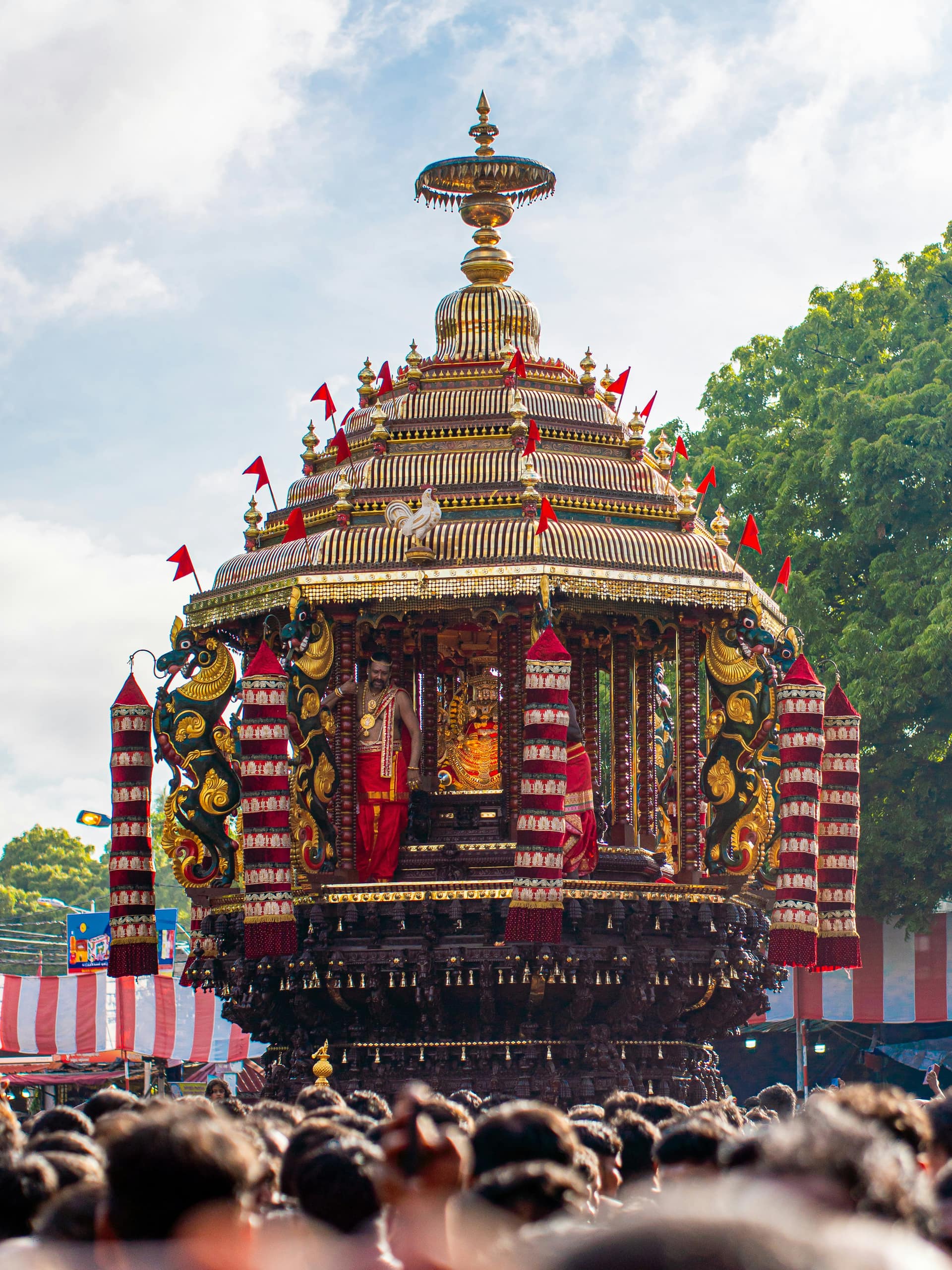
The ther, or chariot festival, is the largest day. An enormous wooden temple chariot carrying the deity is drawn through the streets by hundreds of devotees hauling on ropes, moving slowly through crowds that can number in the hundreds of thousands. It is one of the great sights of religious South Asia and it is not a spectator event: everyone present is participating.
The theertham, or water-cutting ceremony, closes the festival. The deity is taken in procession to water and a ritual immersion marks the end of the twenty-five days. Both days require being in position early and accepting that you will not move quickly once the crowds gather.
- →Ther, the chariot day, is the largest and most crowded.
- →Hundreds of devotees haul the chariot through the streets by rope.
- →Theertham, the water-cutting ceremony, closes the festival.
- →Arrive early on both days; movement becomes impossible once crowds build.
Dress and etiquette, which are strict here
Nallur enforces its rules more strictly than most Sri Lankan temples. Men must remove their shirts to enter the temple, exposing the upper body, which is a long-standing requirement and not negotiable. Trousers or a sarong below the waist are expected; shorts are not appropriate.
Women should dress modestly with shoulders, arms and legs covered, ideally in a sari, salwar kameez or a long skirt and covering top. Everyone removes shoes before entering. Leather items are traditionally not taken inside. Non-Hindus may be restricted from certain inner areas, which should be accepted without argument.
- →Men must remove their shirts to enter; this is strictly enforced.
- →Trousers or a sarong for men; shorts are not appropriate.
- →Women: shoulders, arms and legs covered; sari or salwar kameez is ideal.
- →Shoes off; leather items traditionally left outside.
- →Non-Hindus may be restricted from inner areas. Accept this graciously.
Photography and how to watch
Photography restrictions apply inside the temple and around certain ceremonies, and they are signposted and enforced. Ask before photographing individuals, particularly devotees performing acts of penance, where the answer may well be no and where a camera can be genuinely intrusive.
The broader point is one of framing. Acts of devotion at Nallur can be striking to an outside eye, and there is a real difference between witnessing something and consuming it. Watch first, photograph second, and if in doubt do not raise the camera at all. The processions in the streets are the appropriate place for photography; the interior of a devotee's vow is not.
- →Photography is restricted inside the temple and around certain ceremonies.
- →Always ask before photographing individuals, especially devotees under vow.
- →Street processions are the appropriate subject; personal penance is not.
- →Watch first, photograph second, and accept no as an answer.
Getting there and staying
Jaffna is roughly eight to nine hours from Colombo by road or about six hours by train on the northern line, with first class comfortable and considerably cheaper than flying. Domestic flights operate and take around ninety minutes, which on a short trip is the difference between including Jaffna and not.
Accommodation in Jaffna is limited compared with the south and fills completely around the major festival days. Book several months ahead if you are targeting the chariot day. Expect road closures around the temple, heavy traffic, and heat: the northern peninsula in the festival season is very hot and largely shadeless.
- →Jaffna: eight to nine hours by road, six by train, or ninety minutes by air.
- →Accommodation is limited and fills months ahead for the main festival days.
- →Road closures and heavy traffic around the temple on major days.
- →The north is very hot in festival season; carry water and cover your head outdoors.
The rest of Jaffna
If you have made the journey north, give the peninsula three days rather than one. Jaffna Fort, the public library rebuilt after its destruction in 1981, the Jaffna market, and the food, which is the most distinctive regional cuisine in Sri Lanka, all deserve time.
The islands off the peninsula are the other reason to stay: Delft with its wild ponies and coral walls, and Nainativu with its major Hindu kovil and Buddhist temple a few hundred metres apart. Both need a full day and a ferry from Kurikadduwan.
Planning a festival visit
Confirm the year's dates with the temple or a local source rather than assuming, as they are set annually and move within the July to September window. Decide whether you want the chariot day, which is overwhelming, or a mid-festival day, which is more manageable and still substantial.
Lankan Stays & Trails arranges northern itineraries around the festival calendar and briefs clients thoroughly on the dress requirements, which at Nallur are stricter than anywhere else most visitors will go.
Frequently asked questions
When is the Nallur festival in Jaffna?
The festival runs for twenty-five days, usually falling between July and September, with the exact dates set annually by the temple. Confirm the current year's dates with the temple or a local source rather than assuming, as they move within that window each year.
What happens at the Nallur festival?
The deity is carried in procession on a different vahana, or mount, each day across twenty-five days, building to the ther chariot day when an enormous wooden chariot is hauled through the streets by hundreds of devotees, and closing with the theertham water-cutting ceremony.
Do men have to remove their shirts at Nallur?
Yes. Men must remove their shirts to enter Nallur Kandaswamy Kovil, exposing the upper body. This is a long-standing requirement, strictly enforced, and not negotiable. Trousers or a sarong are expected below the waist, and shorts are not appropriate.
What should women wear to the Nallur festival?
Modest dress with shoulders, arms and legs covered, ideally a sari, salwar kameez, or a long skirt with a covering top. Shoes are removed before entering, and leather items are traditionally left outside. Non-Hindus may be restricted from certain inner areas.
Can you take photographs at the Nallur festival?
Restrictions apply inside the temple and around certain ceremonies, and they are signposted and enforced. Always ask before photographing individuals, particularly devotees performing acts of penance under vow, where a camera is genuinely intrusive and the answer may be no.
How do you get to Jaffna for the festival?
Roughly eight to nine hours from Colombo by road, about six hours by train on the northern line with comfortable first class, or around ninety minutes by domestic flight. Accommodation in Jaffna is limited and books out months ahead for the major festival days.
Is the Nallur festival suitable for visitors?
Yes, if attended respectfully. It is a genuine religious observance rather than a performance, with strict dress requirements and acts of personal devotion that some visitors find confronting. Watch rather than consume, follow the dress rules exactly, and ask before photographing anyone.