
Quick answer
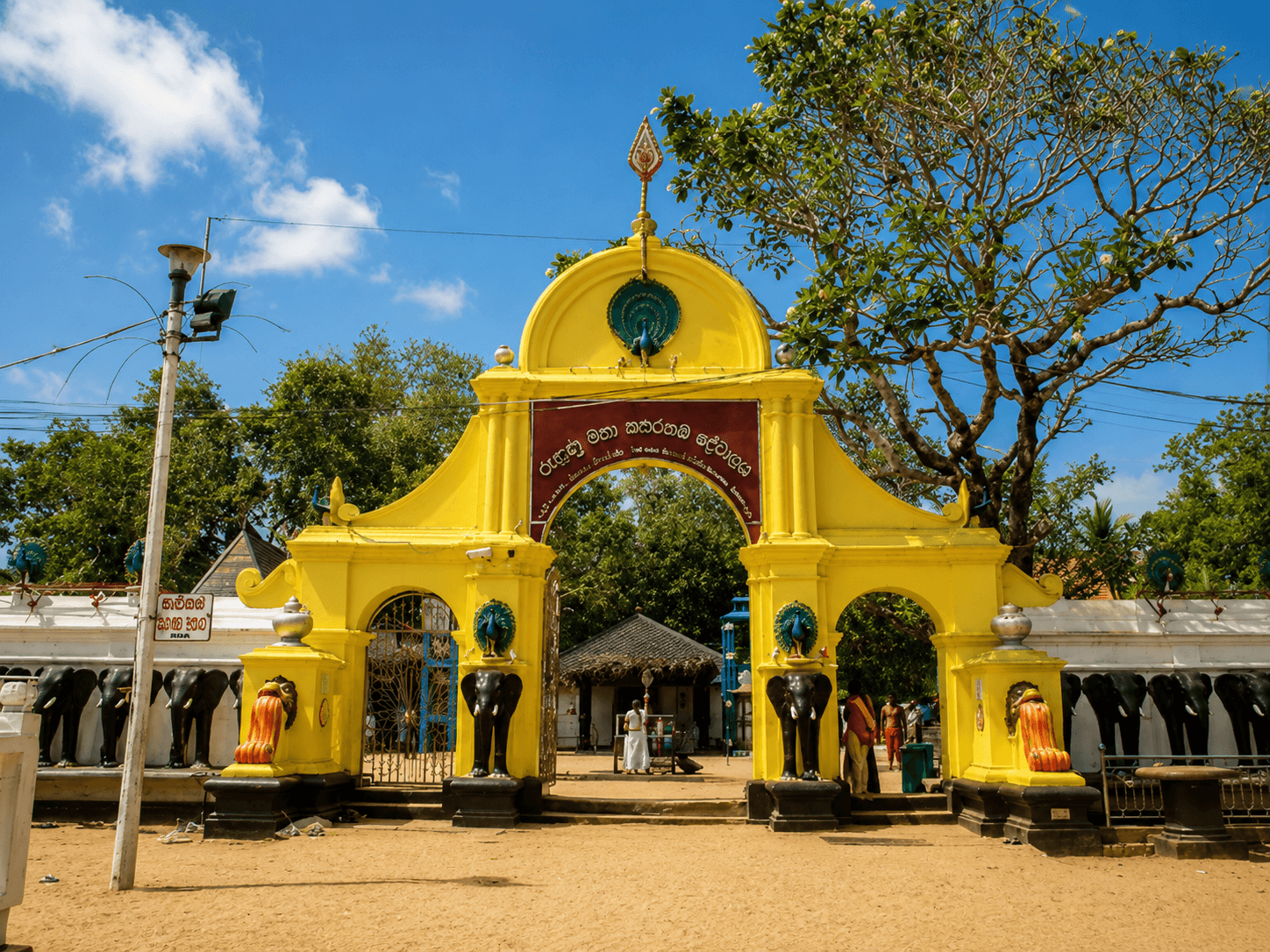
Sri Lanka is a multi-religious country in which Theravada Buddhism is the majority faith, practised principally by the Sinhalese, alongside Hinduism, practised mainly by Sri Lankan Tamils, Islam, practised by the Muslim community, and Christianity, which spans ethnic groups. Buddhism arrived in the third century BCE at Mihintale and shaped the island's kingship, art and architecture. Several sites, notably Kataragama and Adam's Peak, are sacred to more than one faith simultaneously.
Key takeaways
- Theravada Buddhism is Sri Lanka's majority religion and has shaped its art, architecture and calendar.
- Buddhism arrived at Mihintale in the third century BCE, when the monk Mahinda met King Devanampiya Tissa.
- Hinduism is longest established in the north and east, with major kovils at Jaffna, Trincomalee and Chilaw.
- Adam's Peak and Kataragama are sacred to multiple faiths at once.
- Full moon poya days are public holidays island-wide, and alcohol is not sold on them.
Theravada Buddhism
Buddhism is the majority religion and the one whose imprint on the landscape is most visible. The Theravada school practised here traces its lineage to the third century BCE, when the monk Mahinda, son of the Indian emperor Ashoka, met King Devanampiya Tissa at Mihintale and converted him. Within a generation the religion had transformed kingship, art, agriculture and architecture.
Sri Lanka preserved the Pali canon in writing when it was lost elsewhere, and the island has been a reference point for Theravada Buddhism across South-East Asia ever since. The physical legacy is everywhere: the great stupas of Anuradhapura, the rock temples of Dambulla, the Tooth Relic in Kandy, and the white-clad pilgrims who fill every sacred site on poya days.
- →Arrived in the third century BCE at Mihintale; commemorated at Poson Poya in June.
- →Key sites: Anuradhapura, Mihintale, Dambulla, Polonnaruwa, the Temple of the Tooth in Kandy.
- →The Tooth Relic in Kandy is the traditional symbol of legitimate rule.
- →Vesak in May and Poson in June are the two most important poya days.
Hinduism
Hinduism has been present on the island for as long as Buddhism and probably longer, and it is practised principally by Sri Lankan Tamils, concentrated in the north and east and in the hill country plantation districts. Shaivism, the worship of Shiva, is the dominant tradition, alongside strong devotion to Murugan, known here as Skanda or Kataragama Deviyo.
The great kovils are among the most vivid buildings in the country: Nallur Kandaswamy in Jaffna, Koneswaram on the cliff at Trincomalee, Munneswaram near Chilaw, and Nagapooshani Amman on the island of Nainativu. Puja is performed several times daily with drums, bells, camphor flame and fruit offerings, and visitors are generally welcome outside restricted inner areas.
- →Practised principally by Sri Lankan Tamils, in the north, east and hill country.
- →Shaivism dominates; Murugan, known as Skanda, is widely venerated.
- →Major kovils: Nallur in Jaffna, Koneswaram in Trincomalee, Munneswaram at Chilaw.
- →Thai Pongal in January and Deepavali in October or November are public holidays.
Islam
Sri Lanka's Muslim community traces its origins largely to Arab traders who settled the coasts from around the eighth century, drawn by the spice trade and the island's position on the Indian Ocean routes. The community is concentrated in the east, along the west coast around Beruwala and Puttalam, and in Colombo and Kandy.
Kechimalai Mosque at Beruwala is regarded as among the oldest in the country, and the Jami Ul-Alfar mosque in Colombo's Pettah district, with its red and white striped facade, is one of the capital's most photographed buildings. Ramadan and the two Eid festivals are public holidays, and Eid al-Fitr in particular transforms Muslim neighbourhoods.
- →Origins largely in Arab trading settlement from around the eighth century.
- →Concentrated in the east, the west coast around Beruwala, and Colombo.
- →Kechimalai Mosque at Beruwala is among the oldest in Sri Lanka.
- →Ramadan and both Eid festivals are public holidays.
Christianity
Christianity arrived with the Portuguese in the sixteenth century and expanded under Dutch and British rule, and it is the one Sri Lankan religion that cuts across ethnic lines, with both Sinhalese and Tamil congregations. Roman Catholicism predominates, particularly along the west coast from Negombo north, which is sometimes called Little Rome for the density of its churches.
The most significant site is the Basilica of Our Lady of Madhu in the northern Mannar district, a shrine venerated by Catholics of both communities and, notably, respected across religious lines during the civil war. Christmas, Easter and the Madhu feast in August are major occasions.
- →Arrived with the Portuguese in the sixteenth century; Roman Catholicism predominates.
- →Strongest along the west coast, particularly Negombo and the fishing communities.
- →Our Lady of Madhu in Mannar is the most important shrine.
- →Christmas and Good Friday are public holidays; Christmas is widely marked.
How religion shapes the calendar
Sri Lanka has an unusually large number of public holidays because it observes the festivals of all four faiths. Every full moon poya day is a public holiday, and there are twelve or thirteen a year. On poya days alcohol is not sold, meat is less widely served, and many businesses close.
Add Thai Pongal and Deepavali for Hindus, Eid al-Fitr and Eid al-Adha and the Prophet's birthday for Muslims, Christmas and Good Friday for Christians, and the Sinhala and Tamil New Year in April, and the practical planning point becomes clear: check the calendar before booking, because closures and domestic travel spikes are frequent.
- →Every full moon poya day is a public holiday; there are twelve or thirteen a year.
- →No alcohol is sold on poya days, and many businesses close.
- →Hindu, Muslim and Christian festivals are all public holidays too.
- →Check the holiday calendar before booking; closures and travel spikes are common.
Visiting religious sites
The rules are broadly consistent across faiths. Cover shoulders and knees, remove shoes and hats before entering, keep your voice low, and do not point your feet at an image or a person. At Buddhist sites, walk clockwise around a stupa and never turn your back on a Buddha image for a photograph.
Do not wear clothing or display tattoos featuring Buddha images. This causes genuine offence in Sri Lanka and has resulted in visitors being refused entry, detained and deported. At Hindu kovils, men may be asked to remove shirts in inner areas. At mosques, women should cover their heads and visits should avoid prayer times. When in doubt, watch what local worshippers do and follow.
- →Cover shoulders and knees; remove shoes and hats at all religious sites.
- →Never turn your back on a Buddha image for a photograph.
- →Do not wear or display Buddha images on clothing or as tattoos.
- →At kovils, men may be asked to remove shirts; at mosques, women cover their heads.
- →Watch what worshippers do and follow their lead.
Seeing it well
The best religious experiences in Sri Lanka are evening ones: the Kataragama puja, the Temple of the Tooth's evening thevava with drums and horns, a Nallur puja in Jaffna, a small village temple at Vesak with paper lanterns strung between the trees. Daytime visits to empty shrines tell you very little.
Lankan Stays & Trails times religious sites for the hours when they are in use rather than when they are convenient, and briefs clients properly on etiquette beforehand, which matters more here than at almost any monument.
Frequently asked questions
What is the main religion in Sri Lanka?
Theravada Buddhism is the majority religion, practised principally by the Sinhalese, and it has shaped the island's art, architecture, calendar and kingship since the third century BCE. Hinduism, Islam and Christianity are all also long established and widely practised.
When did Buddhism come to Sri Lanka?
In the third century BCE, when the monk Mahinda, son of the Indian emperor Ashoka, met King Devanampiya Tissa at Mihintale and converted him. The event is commemorated each year at Poson Poya in June, when hundreds of thousands of pilgrims climb Mihintale's steps.
Are there Hindu temples in Sri Lanka?
Yes, many, concentrated in the north and east and in the hill country plantation districts. Major kovils include Nallur Kandaswamy in Jaffna, Koneswaram on the cliff at Trincomalee, Munneswaram near Chilaw and Nagapooshani Amman on the island of Nainativu.
Which sites in Sri Lanka are sacred to more than one religion?
Adam's Peak, whose summit footprint is attributed by Buddhists to the Buddha, by Hindus to Shiva and by Muslims and Christians to Adam. Kataragama in the deep south is shared by Hindus, Buddhists, Muslims and the Vedda community within one complex.
What is a poya day in Sri Lanka?
A full moon day, each of which is a public holiday, with twelve or thirteen a year. On poya days alcohol is not sold, meat is less widely served, many businesses close, and temples are busy with white-clad worshippers. Vesak in May and Poson in June are the most significant.
What should I wear to visit a temple in Sri Lanka?
Cover shoulders and knees in plain clothing, and remove shoes and hats before entering. White is traditional at Buddhist sites. Never wear clothing or display tattoos featuring Buddha images, which causes genuine offence and has led to visitors being refused entry or deported.
Is Christianity practised in Sri Lanka?
Yes. Christianity arrived with the Portuguese in the sixteenth century and is the one Sri Lankan religion that spans ethnic lines, with both Sinhalese and Tamil congregations. Roman Catholicism predominates, particularly along the west coast around Negombo and in the fishing communities.