
Quick answer
The Basilica of Our Lady of Madhu, in the Mannar district of northern Sri Lanka, is the country's most important Catholic shrine, venerated by both Tamil and Sinhalese Catholics and traditionally regarded as a place of sanctuary. Its origins date to the seventeenth century. The main pilgrimage falls around the feast in August, drawing very large crowds. Christianity arrived in Sri Lanka with the Portuguese in the sixteenth century and is strongest along the west coast, particularly around Negombo.
Key takeaways
- The Basilica of Our Lady of Madhu is Sri Lanka's most important Catholic shrine, in the Mannar district.
- Madhu is venerated by both Tamil and Sinhalese Catholics and was treated as sanctuary during the civil war.
- The main annual feast falls in August and draws very large numbers of pilgrims.
- Christianity arrived with the Portuguese in the sixteenth century and expanded under Dutch and British rule.
- The west coast around Negombo has such a density of churches it is sometimes called Little Rome.
The shrine at Madhu
Our Lady of Madhu stands in forest in the Mannar district of the Northern Province, a long way from anywhere. Its origins trace to the seventeenth century, when Catholics fleeing persecution during the Dutch period are said to have carried a statue of the Virgin north to safety, establishing a shrine that grew over the following centuries.
The present basilica dates from the twentieth century and sits in a large compound designed to accommodate enormous pilgrim crowds. Outside the feast period it is quiet, remote and unexpectedly moving: a substantial church in a forest clearing with almost nobody in it.
- →In the Mannar district of the Northern Province, in forest, well off main routes.
- →Origins in the seventeenth century, associated with Catholics fleeing persecution.
- →The present basilica is twentieth century, with a large compound for pilgrims.
- →Quiet and remote outside the August feast period.
Sanctuary during the war
Madhu's significance goes beyond the religious. Throughout Sri Lanka's civil war the shrine was widely regarded as neutral ground, and large numbers of displaced people sheltered in and around the compound at various points. It was not untouched by the conflict, and the statue was moved for safety at times, but its status as a place of refuge held in a way that little else did.
That history is part of why the site matters to Sri Lankans of both communities. Tamil and Sinhalese Catholics have made the pilgrimage together for generations, and Madhu is frequently invoked in discussions of reconciliation. Visitors should understand that context rather than treating it as a church in a forest.
- →Widely regarded as neutral ground during the civil war.
- →Sheltered large numbers of displaced people at various points in the conflict.
- →Venerated by both Tamil and Sinhalese Catholics, who pilgrimage together.
- →Frequently invoked as a site of reconciliation; visit with that awareness.
The August feast
The principal annual pilgrimage falls around the feast in August, when very large numbers of pilgrims converge on the shrine, many walking considerable distances and camping in the compound. The atmosphere is intense and communal, with continuous masses, processions and vigils.
If you want to see Madhu at its most significant, this is when. If you want the shrine itself, come at any other time, when the forest setting and the emptiness are the whole experience. There are smaller feasts through the year as well, so check locally.
- →The main feast falls in August with very large pilgrim numbers.
- →Pilgrims walk long distances and camp in the compound.
- →Continuous masses, processions and vigils across the feast days.
- →Smaller feasts occur through the year; check dates locally.
How Christianity came to Sri Lanka
The Portuguese arrived in 1505 and brought Roman Catholicism, which took root particularly among coastal fishing communities in the west and north. The Dutch period from the mid-seventeenth century brought the Reformed Church and a period of restriction on Catholic practice, which is the context for the Madhu foundation story.
The British period from 1796 brought Anglicanism and Protestant missionary activity, alongside a relaxation of restrictions on Catholicism. Today Christianity is the one Sri Lankan religion that spans ethnic lines, with both Sinhalese and Tamil congregations, and Roman Catholicism predominates.
- →Portuguese arrival in 1505 brought Roman Catholicism.
- →Dutch rule brought the Reformed Church and restricted Catholic practice.
- →British rule from 1796 brought Anglicanism and eased restrictions.
- →Christianity today spans both Sinhalese and Tamil communities.
Negombo and the Catholic west coast
The coastal strip from Negombo north has such a concentration of Catholic churches, shrines and roadside statues that it is sometimes called Little Rome. The fishing communities here have been Catholic for centuries, and the churches are not heritage buildings but working parish centres with full congregations.
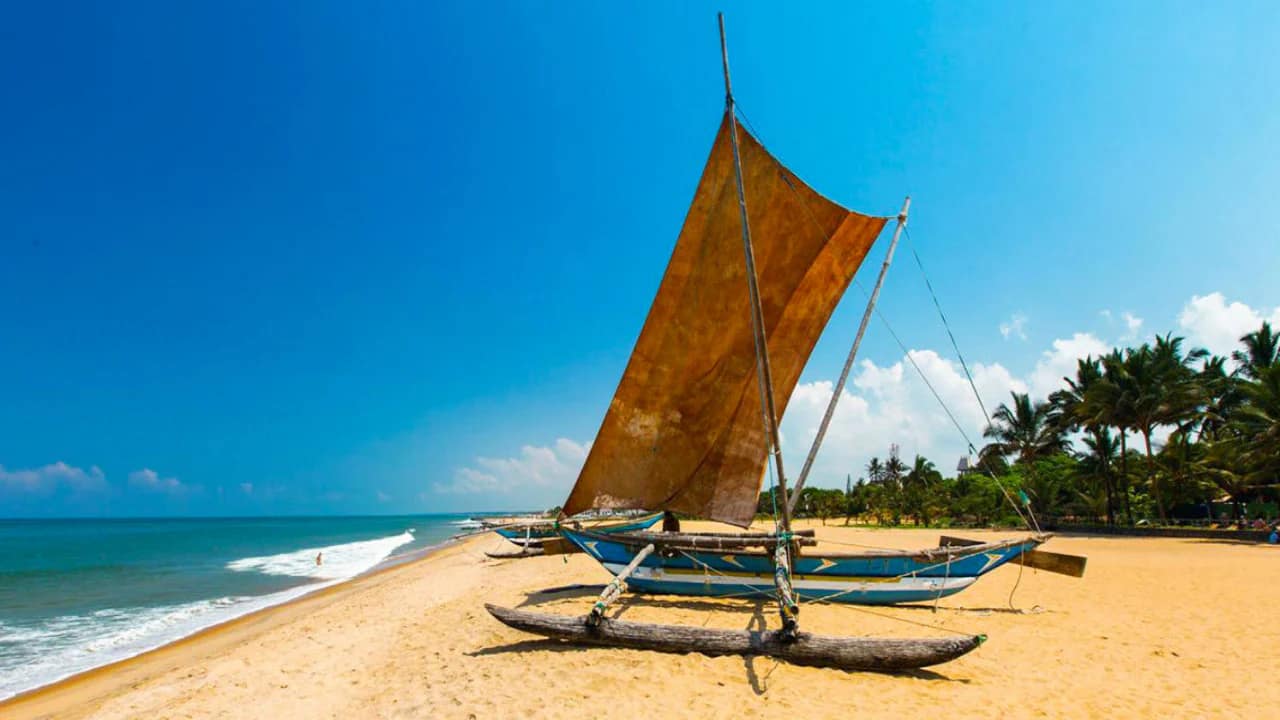
St Mary's Church in Negombo is the largest and most striking, with a painted ceiling and an interior scale that surprises visitors. Along the coast, wayside grottoes and crosses mark almost every junction, and boats carry saints' names. It is one of the more unexpected cultural landscapes in South Asia.
- →The coast north from Negombo is sometimes called Little Rome.
- →St Mary's Church, Negombo: large, ornate, with a painted ceiling.
- →Wayside grottoes, crosses and saint-named fishing boats throughout.
- →Working parish churches with full congregations, not heritage sites.
Christian sites elsewhere
In Colombo, St Anthony's Shrine at Kochchikade is notable for drawing worshippers of all faiths, with Buddhists, Hindus and Muslims lighting candles alongside Catholics, a pattern of shared devotion that recurs across Sri Lanka. Wolvendaal Church, a Dutch Reformed building of 1749, is one of the oldest Protestant churches in the country.
In Galle Fort, the Dutch Reformed Church of 1755 has a floor paved with gravestones from an older cemetery. Kandy, Jaffna, Trincomalee and the plantation districts all have significant churches, and the Anglican and Methodist presence in the hill country reflects the plantation era.
- →St Anthony's Shrine, Colombo: venerated across religious lines.
- →Wolvendaal Church, Colombo: Dutch Reformed, dating from 1749.
- →Dutch Reformed Church, Galle Fort: 1755, with a gravestone floor.
- →Hill country churches reflect the Anglican and Methodist plantation era.
Visiting respectfully
Ordinary respectful dress applies at churches: covered shoulders and knees, and quiet behaviour. Services should be observed from the back or not at all unless you are invited to participate. Photography during mass is inappropriate.
Madhu specifically is a place of pilgrimage rather than a tourist site, and during the feast it is full of people who have walked a very long way for reasons that have nothing to do with sightseeing. Behave as a guest at a service, keep cameras down, and do not treat pilgrims as subjects.
- →Covered shoulders and knees; quiet behaviour throughout.
- →Observe services from the back, or not at all unless invited.
- →No photography during mass or of individual worshippers without permission.
- →At Madhu during the feast, behave as a guest rather than a visitor.
Fitting Madhu into a northern trip
Madhu is remote, roughly on the route between Anuradhapura or Wilpattu and Mannar or Jaffna, and it is best included as part of a northern itinerary rather than as a destination in its own right. Combined with Adam's Bridge at Mannar, the baobabs of the peninsula and the drive north to Jaffna, it makes a genuinely unusual few days.
Lankan Stays & Trails includes Madhu on northern routes for travellers interested in the island's religious landscape, and can time a visit either into or well clear of the August feast, depending on what you want.
Frequently asked questions
What is Madhu Church in Sri Lanka?
The Basilica of Our Lady of Madhu, in the Mannar district of the Northern Province, is Sri Lanka's most important Catholic shrine. Its origins date to the seventeenth century, and it is venerated by both Tamil and Sinhalese Catholics who have pilgrimaged there together for generations.
When is the Madhu feast?
The principal annual pilgrimage falls around the feast in August, when very large numbers of pilgrims converge on the shrine, many walking long distances and camping in the compound. Smaller feasts occur through the year, so check dates locally before planning a visit.
Why is Madhu significant in Sri Lankan history?
Throughout the civil war it was widely regarded as neutral ground, and large numbers of displaced people sheltered in and around the compound. Its status as a shared sacred site for both Tamil and Sinhalese Catholics means it is frequently invoked in discussions of reconciliation.
How did Christianity come to Sri Lanka?
The Portuguese arrived in 1505 and brought Roman Catholicism, which took root among coastal fishing communities. The Dutch brought the Reformed Church and restricted Catholic practice, and the British brought Anglicanism from 1796. Roman Catholicism remains the largest denomination.
Why is Negombo called Little Rome?
Because of the density of Catholic churches, shrines and wayside grottoes along the coast north from Negombo, where fishing communities have been Catholic for centuries. St Mary's Church in Negombo is the largest, with a painted ceiling and a surprising interior scale.
Can non-Christians visit churches in Sri Lanka?
Yes, and at some sites the congregation is itself multi-faith. St Anthony's Shrine in Colombo draws Buddhists, Hindus and Muslims lighting candles alongside Catholics. Ordinary respectful dress applies, and services should be observed from the back or not at all unless invited.
How do you get to Madhu Church?
It is remote, in forest in the Mannar district, and best included on a northern itinerary rather than visited on its own. It sits roughly on the route between Anuradhapura or Wilpattu and Mannar or Jaffna, and combines well with Adam's Bridge and the Mannar peninsula.