
Quick answer
Luxury tea-estate bungalows are restored colonial-era planters' houses set on working or former tea estates in Sri Lanka's hill country, mainly around Nuwara Eliya and Ella, typically offering a handful of individually furnished rooms, a private cook or resident staff, log fires against the cool evening air, and views across the tea terraces. They suit two or three nights within a longer itinerary, are best combined with a factory visit or estate walk, and reward booking ahead during the December to March peak season.
Key takeaways
- Tea-estate bungalows cluster around Nuwara Eliya and Ella in the hill country, generally at elevations of roughly 1,200 to 2,000 metres, which keeps evenings cool enough for a log fire year-round.
- Most bungalows have only a handful of rooms (often under ten), so they suit couples or small groups wanting a quieter, more personal stay than a larger hotel.
- Many properties are genuinely colonial-era planters' houses, restored rather than newly built, with original verandas, high ceilings and estate-worker heritage still visible in the staff and setting.
- Nuwara Eliya's real historic nickname is 'Little England', not 'Little Switzerland', reflecting its colonial-era hill-station character rather than any Alpine equivalence.
- December to March is peak season in the hill country too, coinciding with Swiss Sportferien and Christmas school holidays, so the smallest and most characterful bungalows are worth booking several months ahead.
What a tea-estate bungalow stay actually is
A tea-estate bungalow is typically a restored colonial-era planter's house, originally built for the manager of a working tea estate, converted into a small guest property with anywhere from two or three rooms up to around ten or twelve. Furnishings tend to lean into the period: dark wood, brass fittings, claw-foot baths and verandas set up for reading rather than for a pool.
Many still sit on or beside an active tea estate, with staff who have often worked the property for years and can arrange a factory tour or a walk through the rows themselves. The atmosphere is closer to a private country house than a hotel, which is exactly the draw for a Swiss traveller wanting something quieter than a resort.
Meals are usually taken in the bungalow itself rather than a separate restaurant, often set menus built around what is fresh that day, and many properties will arrange a private dinner on the lawn or veranda on request, weather and season permitting.
Where the hill country's bungalows sit
The main concentration is around Nuwara Eliya, a former British hill station at roughly 1,800 to 2,000 metres elevation, and Ella, a smaller and more relaxed town further along the hill country at a somewhat lower elevation. Both sit within the same tea-growing belt but have a different character: Nuwara Eliya keeps more of its colonial-era architecture and formal gardens, Ella leans toward a younger, more scenic-walk-focused crowd.
The famous Kandy-to-Ella scenic railway runs through this region and is worth building into an itinerary that includes a tea-estate bungalow stay, since reserved seating sells out well ahead in peak season and the route itself passes through tea country the whole way.
- →Nuwara Eliya: more formal, colonial-era character, cooler nights, closer to Horton Plains.
- →Ella: smaller, scenic-walk focused, home to Little Adam's Peak and the Nine Arches Bridge.
- →Both sit within a roughly half-day's drive of Kandy, useful for stitching into a wider itinerary.
What the hill country actually feels like
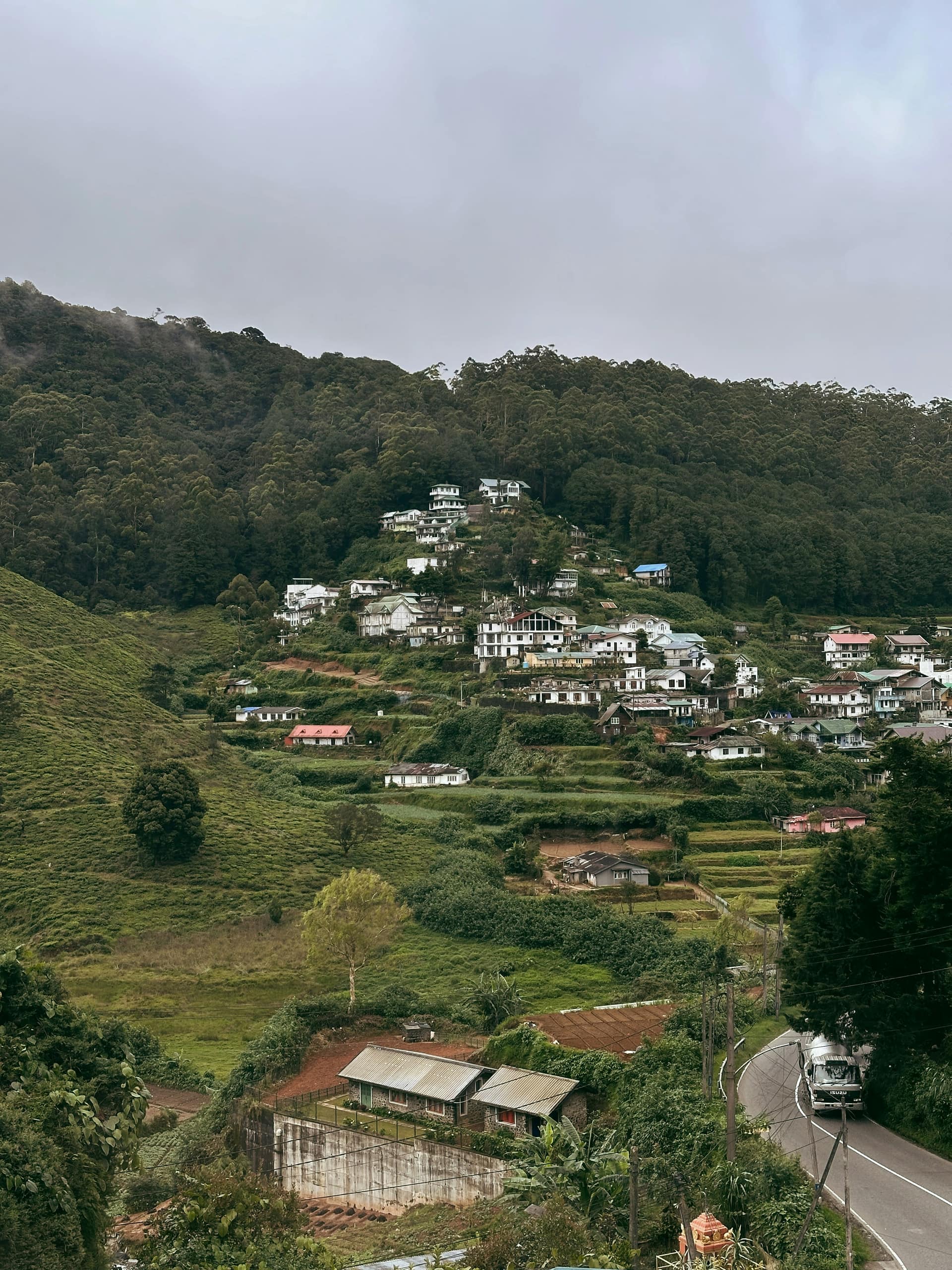
The comparison Swiss travellers naturally reach for is their own Alpine landscape, and it is worth being precise here: this is a sensory and climate comparison only, mist, cool air, terraced green hillsides, never an architectural or altitude equivalence. There is no snow, and the terrain is a working tea landscape rather than a mountain range.
Nuwara Eliya's genuine historic nickname from the colonial era is 'Little England', reflecting its red-brick post office, golf course and formal gardens, not 'Little Switzerland', a label sometimes used loosely online but not the town's actual heritage name.
What does translate well for a Swiss traveller is the relief from tropical heat: after a few days on the coast or in the Cultural Triangle, the hill country's cooler evenings and log fires genuinely change the register of a trip.
Cost, length of stay and booking lead time
Most operators price tea-estate bungalow stays in USD, and rates vary widely by property size, season and whether meals and a private guide are included. Two or three nights is the typical length within a broader itinerary, long enough to include a factory visit, an estate walk and at least one unhurried evening without stretching the hill-country leg past its natural interest.
Because many of the best-known bungalows have only a handful of rooms, availability rather than price is often the real constraint in the December to March peak season, which overlaps with both Swiss Sportferien and the Christmas and New Year school break. Booking several months ahead for that window is a reasonable rule of thumb.
Pairing a tea-estate stay with the rest of a luxury trip
A tea-estate bungalow works best as one leg of a wider itinerary rather than the whole trip, typically following the Cultural Triangle or Kandy and preceding a run down to the south coast. The contrast between cool hills and warm coast is part of what makes a Sri Lanka itinerary feel varied rather than repetitive.
We at Lankan Stays & Trails generally place a hill-country bungalow stay after the cultural sites and before the coast, timed so the scenic railway or a private drive through the tea estates becomes the transition between the two rather than just a travel day.
- →Pair with: a Cultural Triangle stay beforehand (Sigiriya, Dambulla) and a south-coast finish afterwards.
- →Add: a private tea-tasting or factory visit, generally low-cost and often arranged directly through the bungalow.
- →Consider: the reserved-seat scenic railway from Kandy as the transition leg into the hills.
Frequently asked questions
What is a tea-estate bungalow in Sri Lanka?
It is typically a restored colonial-era planter's house on or near a working tea estate in the hill country, converted into a small luxury guesthouse with a handful of individually furnished rooms, estate staff, and views across the tea terraces.
Where are Sri Lanka's tea-estate bungalows located?
Mainly around Nuwara Eliya and Ella in the hill country, at elevations of roughly 1,200 to 2,000 metres. Both sit within the same tea-growing belt and are within a roughly half-day's drive of Kandy.
Is Nuwara Eliya called Little Switzerland?
No, its genuine colonial-era nickname is 'Little England', reflecting its hill-station architecture, golf course and formal gardens. Any comparison to Switzerland's own Alpine landscape is a sensory or climate comparison only, not a historic or architectural one.
How many nights should I spend at a tea-estate bungalow?
Two or three nights is typical, enough time for a factory visit, an estate walk and at least one unhurried evening, without stretching the hill-country leg of a wider itinerary that also covers culture, wildlife and coast.
When should I book a tea-estate bungalow for peak season?
Several months ahead for December to March, since most bungalows have only a handful of rooms and this window overlaps with Swiss Sportferien and the Christmas school break, making availability the real constraint rather than price.
Is it cold in Sri Lanka's hill country at night?
Yes, evenings at Nuwara Eliya's elevation can be genuinely cool, which is why most tea-estate bungalows have working fireplaces. Bring a light jacket or jumper, since this is a noticeable contrast to the coast and Cultural Triangle.
Can I combine a tea-estate stay with the scenic railway?
Yes, the Kandy-to-Ella railway runs through the hill country and pairs naturally with a bungalow stay. Reserved seating sells out well ahead in peak season, so book it alongside the bungalow rather than as an afterthought.