
Quick answer
Pidurangala has been a Buddhist monastic site for over two thousand years. Rock shelters with drip ledges and early Brahmi inscriptions suggest monks lived here from roughly the 3rd to 1st century BCE. Tradition holds that King Kashyapa, building his palace on Sigiriya in the late 5th century CE, moved Sigiriya's monks to Pidurangala and endowed a monastery for them. A temple still works at the base today.
Key takeaways
- Monks are thought to have lived on Pidurangala from roughly the 3rd to 1st century BCE, long before Kashyapa (hedged).
- Drip-ledged caves and early Brahmi inscriptions are the main evidence of early monastic life.
- Tradition says King Kashyapa moved the monks living on Sigiriya to Pidurangala and built them a monastery.
- The reclining Buddha and the temple at the base belong to the rock's long monastic history.
- Pidurangala remains a working monastery today, which is why temple etiquette applies on the climb.
Early monks and rock shelters
Early monks and their rock shelters are the oldest part of Pidurangala's history. Across the dry zone, from about the 3rd century BCE, Buddhist monks lived in natural caves under boulders and overhangs. Donors had drip ledges cut above the entrances, a groove that stops rainwater running into the shelter, and often added a short inscription naming the gift.
Pidurangala has shelters of this kind, as does Sigiriya itself. Their inscriptions, written in an early form of the Brahmi script, record donations to the sangha, the community of monks. They show that both rocks were sacred places centuries before either had a palace.
Precise dates are hard to fix and should be treated as approximate. What matters for visitors is the continuity: monks have been living on or below this rock, with interruptions, for well over two thousand years.
- →Drip ledges: grooves cut above cave entrances.
- →Inscriptions: early Brahmi script recording donations.
- →Date: roughly the 3rd to 1st century BCE (hedged).
- →Similar shelters: at Sigiriya, Dambulla and across the dry zone.
King Kashyapa's gift
King Kashyapa's gift is the best-known episode in Pidurangala's story. Kashyapa reigned at Sigiriya from roughly 477 to 495 CE, after seizing the throne from his father, King Dhatusena. When he made the rock his citadel, tradition holds that he moved the monks who lived there to Pidurangala, and in return built them a monastery and endowed it.
The story is often told as an act of atonement, since Kashyapa was remembered as a parricide. Whether or not that was his motive, it fits a wider pattern in which Sri Lankan kings won legitimacy by supporting the sangha. A royal gift of a monastery was both piety and politics.
After Kashyapa's death in battle in 495, the capital returned to Anuradhapura and Sigiriya itself was handed back to the monks. Both rocks then served as monasteries for several centuries.
The monastery after Kashyapa
The monastery after Kashyapa continued on Pidurangala for centuries. The reclining Buddha under the overhang is usually linked with this period, although restoration makes its original date hard to judge. Monks would have climbed between the caves, the image and the summit, as visitors do today.
As the island's political centre moved south and east from the 11th to 13th centuries, many dry-zone monasteries declined, and forest grew back over their ruins. Pidurangala seems never to have been entirely forgotten, but its scale shrank to a small temple at the base.
- →3rd to 1st century BCE: early monks' caves (hedged).
- →Late 5th century CE: Kashyapa's monastery, by tradition.
- →First millennium: the reclining Buddha and later buildings.
- →Today: a working temple at the base.
Pidurangala as a monastery today
Pidurangala as a monastery today centres on the Pidurangala Raja Maha Viharaya at the base of the rock. Monks live there, local families bring offerings, and the temple is busy on poya days, the monthly full-moon holidays. The ticket fee paid by climbers supports it.
That is why the climb has a dress code and why noise matters at dawn. You are walking through a sacred place that happens to have a famous view. Cover shoulders and knees in the temple area, remove shoes and hats where asked, and keep your voice low near monks or worshippers.
Some visitors find the temple more memorable than the view, especially if they arrive while chanting is under way before dawn.
Reading the two rocks together
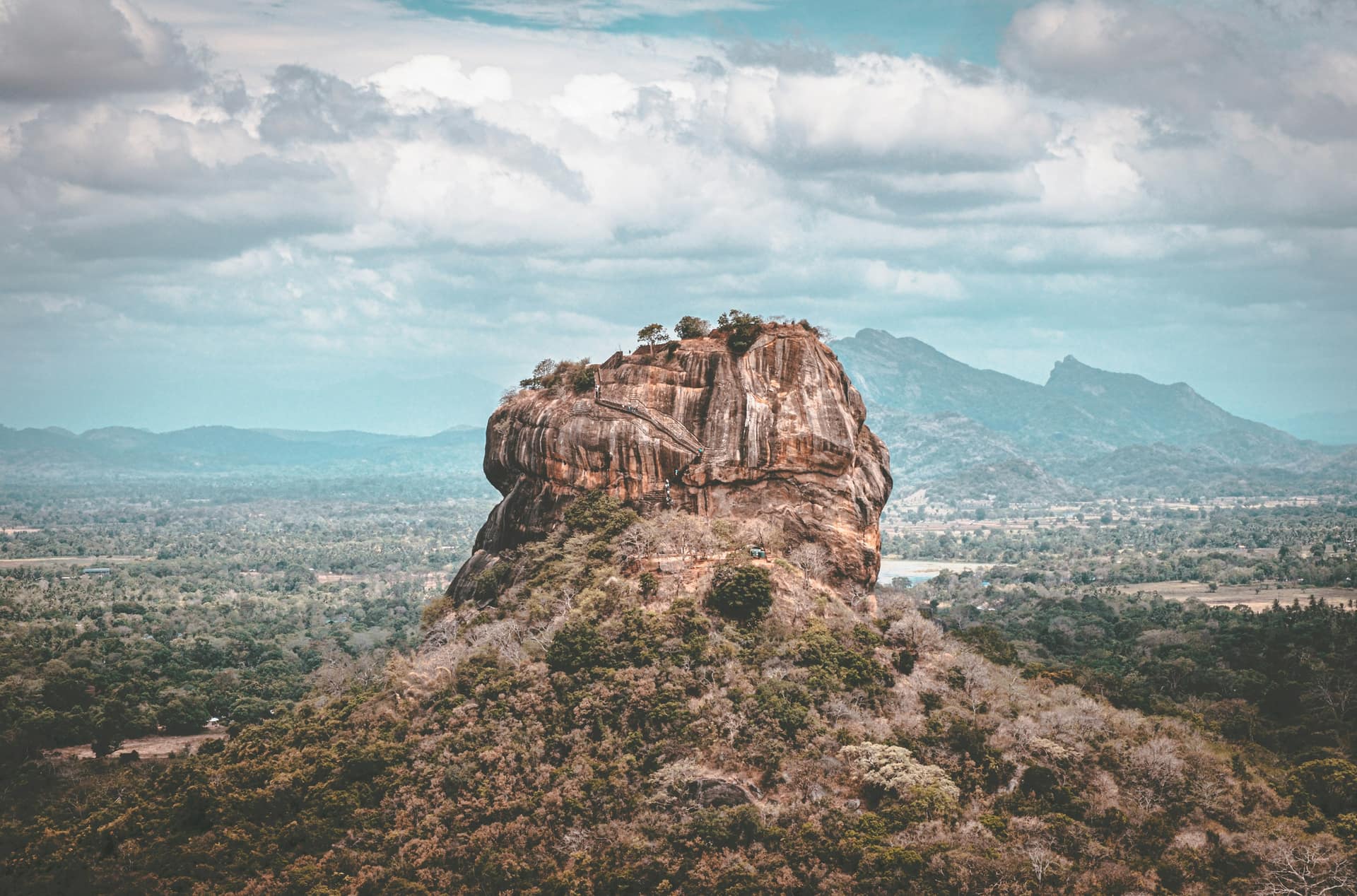
Reading Pidurangala and Sigiriya together changes how both feel. From Pidurangala's summit, you see the palace rock across the forest as the monks would have done: a royal citadel built on a place they once lived in. From Sigiriya, you look north to the rock that became their refuge.
Both rocks also share the longer story of the region. Before Kashyapa there were monks on both; after him there were monks on both again. The palace years, dramatic as they were, form a short episode in a much longer religious history.
- →Sigiriya: monks, then a palace, then monks again.
- →Pidurangala: monks throughout, with a royal gift.
- →The view: each rock seen from the other.
Visiting with the history in mind
Visiting Pidurangala with its history in mind takes only a few small changes. Look out for drip ledges above cave openings near the temple and along the lower path. Pause at the reclining Buddha on the descent. Walk around the dagoba at the base clockwise before you leave.
A good guide can point out inscriptions and explain the caves, which are easy to miss. At Lankan Stays & Trails we often suggest a guided daytime climb of Pidurangala for travellers more interested in history than sunrise.
Frequently asked questions
How old is Pidurangala?
The rock itself is ancient granite, but its human history as a monastery goes back over two thousand years. Rock shelters with drip ledges and early Brahmi inscriptions suggest monks lived here from roughly the 3rd to 1st century BCE. A working temple still stands at the base today.
What is the connection between Pidurangala and Sigiriya?
Both rocks were home to Buddhist monks long before King Kashyapa. When Kashyapa built his palace on Sigiriya in the late 5th century, tradition says he moved Sigiriya's monks to Pidurangala and built them a monastery. After his death, Sigiriya also returned to monastic use.
Did King Kashyapa build Pidurangala?
He did not build the rock or its first monastery, which are older. Tradition holds that he endowed a monastery on Pidurangala for the monks he moved from Sigiriya. The exact buildings he funded are hard to identify today, and the story is best treated as tradition supported by the wider evidence.
Are there inscriptions on Pidurangala?
Yes. Some rock shelters near the base and along the path have early Brahmi inscriptions recording donations to monks, along with drip ledges cut above their entrances. They are easy to miss without a guide, and some are worn or partly hidden by later buildings.
Is Pidurangala still a working temple?
Yes. The Pidurangala Raja Maha Viharaya at the base is a working Buddhist temple with resident monks. Local people come to worship, especially on poya days. Visitors pass through its grounds to reach the climb, so modest dress and quiet behaviour are expected.
Why is Pidurangala sacred?
Pidurangala is sacred because it has been a home for Buddhist monks for over two thousand years, with caves, inscriptions, a reclining Buddha and a working temple. For local Buddhists it is first a monastery and only second a viewpoint for Sigiriya.
Is a guide useful for the history of Pidurangala?
Yes, if the history interests you. A guide can point out drip ledges, inscriptions and the layout of the old monastery, and explain the reclining Buddha. Without one, these details are easy to miss, especially on a sunrise climb in the dark.