
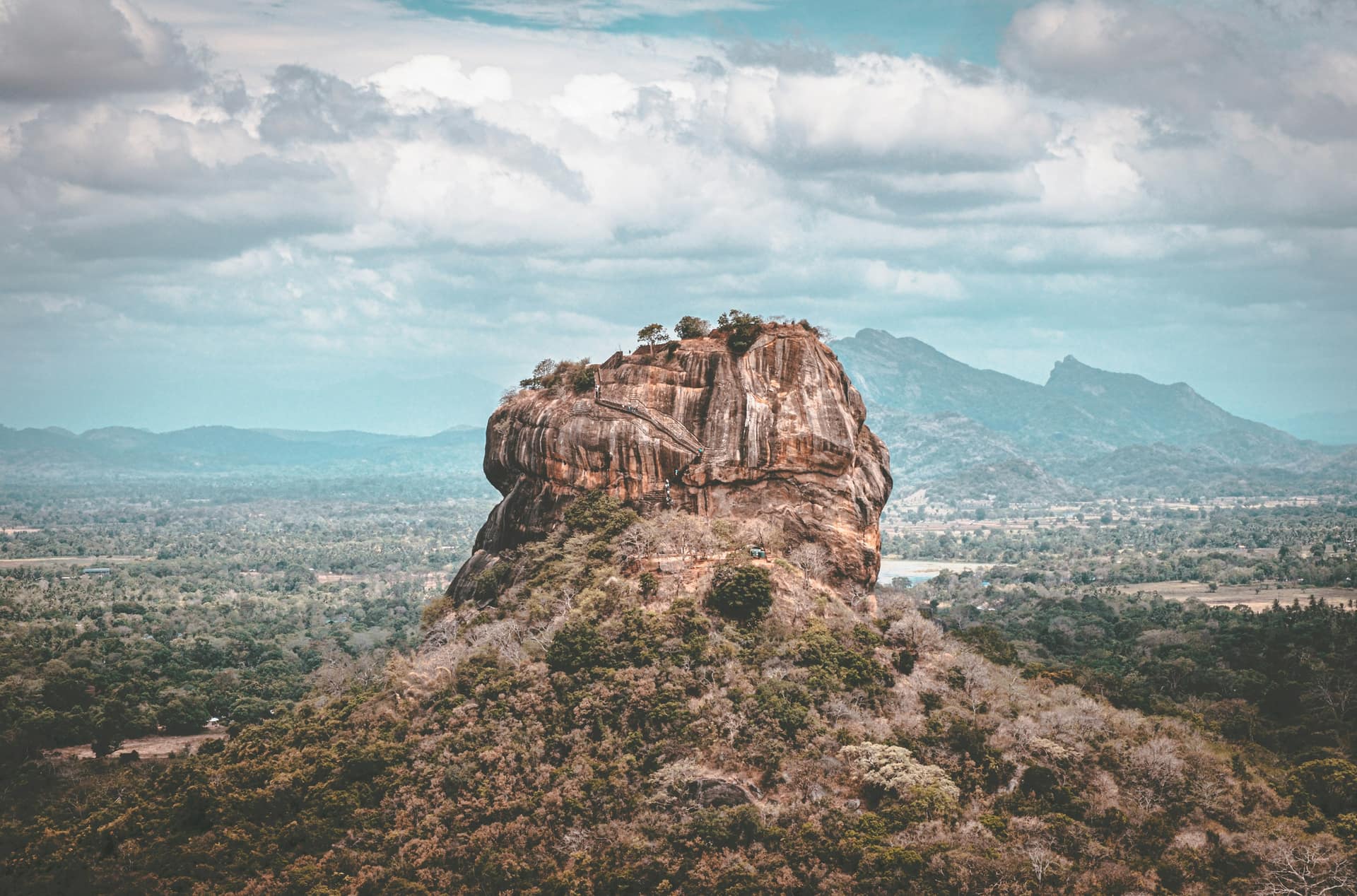
Quick answer
The Pidurangala climb has five stages: the temple at the base, where tickets are sold; a stone stairway through forest, taking roughly 15 to 20 minutes; the reclining Buddha under an overhang; a final boulder scramble of 5 to 10 minutes; and a broad open summit. Most people take roughly 30 to 45 minutes to the top and 25 to 35 minutes down. Allow about 2 hours for a sunrise visit.
Key takeaways
- The whole climb takes roughly 30 to 45 minutes up and 25 to 35 minutes down for most walkers.
- Stone steps through forest form the longest stage, at roughly 15 to 20 minutes.
- The reclining Buddha, roughly two thirds of the way up, is the natural rest point.
- The final scramble lasts only 5 to 10 minutes but is the one section that needs hands.
- The summit is broad and fairly flat, with room to spread out away from the edges.
Overview of the route
The Pidurangala route climbs roughly 200 metres from the temple at the base to a broad, flat summit facing Sigiriya rock. It is not long, but it is steeper and rougher than Sigiriya's built staircases. There are no metal walkways or handrails along most of it, and the steps were laid by hand over many years.
For planning, think of the climb in five stages. The first two are easy, the third is a pause, the fourth is the only tricky section, and the fifth is the reward. Rough timings are given for an average adult pace. Children, older travellers and anyone in the dark should add 10 to 15 minutes.
- →Stage 1, the temple: 5 to 10 minutes.
- →Stage 2, forest steps: roughly 15 to 20 minutes.
- →Stage 3, the reclining Buddha: a short pause.
- →Stage 4, the boulder scramble: 5 to 10 minutes.
- →Stage 5, the summit: as long as you like.
Stage 1: the temple at the base
Stage one of the Pidurangala route is the temple at the base, the Pidurangala Raja Maha Viharaya. You arrive by tuk-tuk at a small car park beside the temple buildings, buy your ticket at the desk and walk through the temple grounds to the start of the steps.
The temple is a working monastery, so dress modestly, with shoulders and knees covered, and remove shoes and hats where signs ask you to. There is usually a white image house and a dagoba near the start. At sunrise the buildings are only dimly lit, so this is the moment to switch on your torch.
Allow 5 to 10 minutes here, longer if you visit the temple itself on the way down. There are basic toilets near the base, and these are the last on the route.
Stage 2: the forest steps
Stage two of the Pidurangala route is the longest: a stairway of uneven stone steps climbing through dry-zone forest. The steps vary in height, some are polished smooth by feet, and in places the path becomes a rocky slope. Trees give shade, which helps on afternoon climbs.
Allow roughly 15 to 20 minutes at a steady pace. Take it slowly at first, because the gradient is steady rather than gentle, and the forest is humid even before dawn. Several flatter spots and rocks along the way make good places to catch your breath.
- →Terrain: uneven stone steps and rocky slopes.
- →Shade: good, under forest canopy.
- →Difficulty: steady climbing, no exposure.
- →Wildlife: monkeys and birds, especially after dawn.
Stage 3: the reclining Buddha
Stage three is the large brick reclining Buddha, lying under a rock overhang roughly two thirds of the way up. The figure was restored in recent decades, and its scale surprises most climbers who come across it in the half-light. It belongs to the monastery that has used the rock for centuries.
The Buddha makes the natural rest point. Stop for a few minutes, drink water and look along the length of the figure. This is also the last shaded spot before the scramble, so on hot afternoons it is a good place to cool down.
Remember that this is a sacred image. Do not pose with your back to it, climb on it or touch it, and keep voices low.
Stage 4: the boulder scramble
Stage four, the final boulder scramble, is the only section of the Pidurangala route that needs care. Beyond the Buddha, the path leaves the steps and climbs over and between large boulders. You use your hands, step up onto rocks of knee height or more and squeeze through a narrow gap in places.
The scramble takes about 5 to 10 minutes. There is some exposure, meaning a drop beside the route, but no rope work or technical climbing. Most people manage it without difficulty. Go one at a time at the narrowest points, and let more confident climbers pass.
- →Time: roughly 5 to 10 minutes.
- →Technique: hands for balance and pulling up.
- →Exposure: a short drop beside parts of the route.
- →Queues: likely at sunrise in the high season.
Stage 5: the summit and the way down
Stage five, the summit, is a broad expanse of rock, mostly flat and open, with the famous view of Sigiriya rock to the south across the forest. There is space to spread out, but stay well back from the edges, which have no barriers. Allow 20 to 40 minutes for the view, longer at sunrise or sunset.
The descent follows the same route. Allow roughly 25 to 35 minutes, and take the scramble slowly, as it is harder going down. At Lankan Stays & Trails we suggest a total of about two hours for a sunrise visit, from tuk-tuk drop-off to pick-up.
- →Summit time: 20 to 40 minutes.
- →Descent: roughly 25 to 35 minutes.
- →Whole visit at sunrise: about 2 hours.
- →Whole visit at sunset: about 2 hours, ending in the dark.
Frequently asked questions
How long does the Pidurangala climb take?
Most people take roughly 30 to 45 minutes to reach the summit and 25 to 35 minutes to come down. Add time at the temple for tickets and at the summit for the view. A sunrise or sunset visit usually takes about two hours from arrival at the base to departure.
How many steps are there on Pidurangala?
There is no official count, and the path mixes stone steps with rocky slopes and a boulder scramble, so figures vary. It is far fewer steps than Sigiriya's roughly 1,200, but steeper and rougher underfoot. Think of it as a short, steep hill walk rather than a staircase.
Which part of the Pidurangala climb is hardest?
The final boulder scramble, beyond the reclining Buddha, is the hardest part. It lasts only 5 to 10 minutes but needs hands, some high steps and care at a narrow gap. Most people find it fun rather than frightening, but it can feel tricky in the dark.
Is there shade on the Pidurangala route?
Yes, on most of the stone steps, which climb through forest. The reclining Buddha sits under a rock overhang and gives shade too. The scramble and the summit are open to the sun, so in the afternoon you will want a hat and water for the top.
Are there toilets on the Pidurangala climb?
There are basic toilets near the temple at the base, but none on the path or the summit. Use them before you start. If you are climbing at sunrise, your hotel is the more comfortable option before you leave.
Can you stop at the reclining Buddha if you do not want to scramble?
Yes. Many people who are nervous of the scramble rest at the reclining Buddha and turn back there. You will not get the full summit view, but there are glimpses through the trees, and the Buddha itself is worth the climb.
How long should you spend on the summit?
Allow 20 to 40 minutes for the view on a daytime climb, and longer at sunrise or sunset, when the light changes quickly. At sunset, start down as the colour fades, because twilight is short and the forest path becomes dark soon afterwards.