
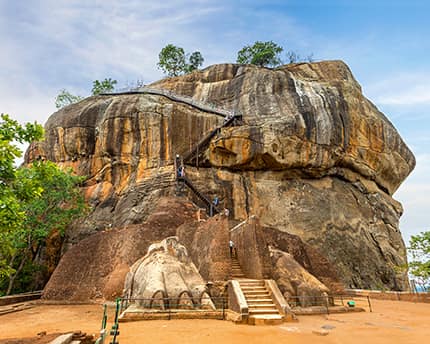
Quick answer
The Pidurangala boulder scramble is the last 5 to 10 minutes of the climb, beyond the reclining Buddha. You climb over and between large boulders, using your hands, with a few high steps, a narrow gap and a short drop beside the route in places. No rope or climbing experience is needed, and most reasonably fit people manage it. Go slowly, keep three points of contact and take it backwards on the way down if that feels safer.
Key takeaways
- The scramble lasts roughly 5 to 10 minutes and starts just beyond the reclining Buddha.
- It needs hands and some high steps but no technical climbing skill or equipment.
- The narrowest point is a gap between boulders that forms queues at sunrise in the high season.
- Coming down is harder than going up, so many people face the rock on the steepest moves.
- Anyone who does not want to scramble can stop at the reclining Buddha and still enjoy the climb.
Where the scramble starts
The Pidurangala boulder scramble starts just beyond the large reclining Buddha, roughly two thirds of the way up the rock. Here the stone steps end, and the path continues as a route over and between big granite boulders. You will see people ahead climbing with their hands, which is the clearest sign that you have reached it.
From the Buddha, the scramble takes roughly 5 to 10 minutes to the summit. It is not long, but it is the one part of the climb where you need to stop and think about where to put your feet and hands. The route is obvious from wear on the rock and from other climbers.
Above the boulders, the route opens onto the broad, flat summit, and the view of Sigiriya appears all at once.
What the scramble is like
The Pidurangala scramble is a series of short climbing moves rather than a single steep wall. You step up onto boulders of knee or thigh height, pull yourself up with your hands, and in one or two places pass through a gap between rocks that is narrow enough to need sideways movement with a small pack.
There is some exposure, meaning places with a drop of several metres beside the route, but you are never climbing a vertical face. Most of the time you are on solid rock with good holds. In the dry season the granite gives good grip; after rain, it can be slippery.
- →Big steps: some of knee or thigh height.
- →The narrow gap: a squeeze between boulders.
- →Exposure: short sections with a drop beside them.
- →Surface: rough granite, good grip when dry.
Technique going up
Technique on the Pidurangala scramble is simple: three points of contact. Keep two hands and one foot, or two feet and one hand, on the rock at all times, and move one limb at a time. Look for the polished, well-used holds, which show the easiest line.
Keep your weight over your feet rather than leaning into the rock, and use your legs to push up rather than your arms to pull. If a step feels too high, look for a smaller intermediate foothold or ask a companion for a hand.
Carry as little as you can. A small backpack is fine; a shoulder bag or a large camera on a strap swings around and gets in the way at the gap.
- →Both hands free: torch on your head, camera in your bag.
- →Three points of contact at all times.
- →Small daypack rather than a shoulder bag.
- →Shoes with grip, never flip-flops.
Coming back down
Coming back down the Pidurangala scramble is harder than going up for most people. You cannot see your footholds as easily, the drops look bigger, and tired legs are less steady. Take it slowly and consider facing the rock, as you would on a ladder, for the steepest moves.
Sit and slide on the larger boulders if that feels safer, and let your companions go first so they can guide your feet from below. There is no prize for speed, and stepping aside to let faster people pass is normal.
After sunset, the scramble is in fading light, so put your head torch on before you leave the summit.
Who should skip the scramble
The Pidurangala scramble is fine for most reasonably fit adults and older children, but some people should consider stopping at the reclining Buddha. That includes anyone with a serious fear of heights, recent knee, hip or back injuries, balance problems, or heart conditions that make exertion risky.
Very young children can be lifted through the scramble by confident adults, but it is not suitable for carrying a baby in a front carrier. Pregnant travellers should take medical advice and may prefer to stop at the Buddha.
Stopping at the Buddha is not a failure. The forest climb, the image itself and the glimpses of the plain are worthwhile, and the view of Sigiriya rock is available from other places.
Queues and safety
Queues at the Pidurangala scramble are common at sunrise from December to April, when the narrow gap lets one person through at a time. Waiting is safer than overtaking. Do not climb past people on the exposed sections, and keep a little distance from the person above you.
On the summit, stay well back from edges, which have no barriers, especially when taking photographs. When we plan sunrise climbs at Lankan Stays & Trails, we build in time so nobody feels rushed through the scramble.
- →Wait your turn at the narrow gap.
- →Never overtake on exposed rock.
- →Stay back from unfenced summit edges.
- →Avoid the scramble in heavy rain.
Frequently asked questions
How hard is the boulder scramble on Pidurangala?
It is short and moderately challenging, rather than difficult. It takes 5 to 10 minutes and needs hands, some high steps and care at a narrow gap. No climbing experience or equipment is needed. Most reasonably fit people manage it, though those nervous of heights may find it uncomfortable.
Is the Pidurangala scramble dangerous?
It is not dangerous for careful climbers in dry conditions, but there are short sections with a drop beside the route, and the rock can be slippery after rain. Accidents are most likely when people rush, overtake or carry bags that swing. Go slowly and use three points of contact.
Can children do the Pidurangala scramble?
Older children who enjoy climbing usually love it. Younger children can manage with an adult close behind and lifting them over the highest steps. It is not suitable for carrying babies in front carriers. Families should allow extra time and avoid the busiest sunrise mornings if possible.
Is there another route to the summit that avoids the scramble?
No. The scramble is the only route from the reclining Buddha to the summit. If you do not want to scramble, stop at the Buddha, which has its own atmosphere and some views, or watch sunrise from a flat viewpoint such as the Sigiriya tank bund.
What shoes are best for the scramble?
Trainers or walking shoes with a good rubber sole give the best grip on granite. Sports sandals with straps can work in dry weather. Avoid flip-flops, smooth-soled fashion shoes and new boots that pinch, as you need both grip and confidence for the high steps.
Is the scramble harder in the dark?
A little, because you cannot see the whole route at once. With a head torch and a steady pace, most people manage it fine before sunrise. Keep both hands free, follow others along the worn line and let faster climbers pass at the wider spots.
Can you do the scramble in the rain?
In light rain, yes, with care, as the granite still grips reasonably well. In heavy rain the rock becomes slippery and water runs over the holds, so it is safer to stop at the reclining Buddha or wait for the shower to pass before climbing on.