
Quick answer
February is a very good month for Polonnaruwa. The weather is dry and clear, and the park is green after the rains. Days are hot, reaching about 31 to 33°C by early afternoon, and stone floors heat up quickly. Start early, ideally at opening time, and explore by bicycle or with a driver. Allow three to four hours for the main sites, including the Royal Palace, the Quadrangle and Gal Vihara. Combine the visit with an elephant safari at Minneriya, Kaudulla or Hurulu in the afternoon.
Key takeaways
- February is dry and clear at Polonnaruwa, with green parkland after the rains.
- Days reach about 31 to 33°C, and stone floors get very hot.
- Exploring by bicycle in the early morning is the most enjoyable way to see the ruins.
- Allow three to four hours for the main sites.
- An afternoon elephant safari nearby makes a full day.
Polonnaruwa's weather in February
Polonnaruwa lies in the dry zone, east of Sigiriya, and receives much of its rain in the north-east monsoon from October to January. By February the rain has usually ended, and the days are dry and sunny with clear skies.
The parkland is still green from the recent rains, and the reservoir, Parakrama Samudra, is full. This makes February one of the most attractive months to visit, before the landscape turns dry and dusty later in the year.
Temperatures rise quickly. By 10am it is hot, and by early afternoon it can reach 31 to 33°C. The stone terraces of temples and palaces reflect and hold the heat.
- →Dry and clear skies.
- →Green parkland and full reservoir.
- →Hot by mid-morning.
The main sites to see
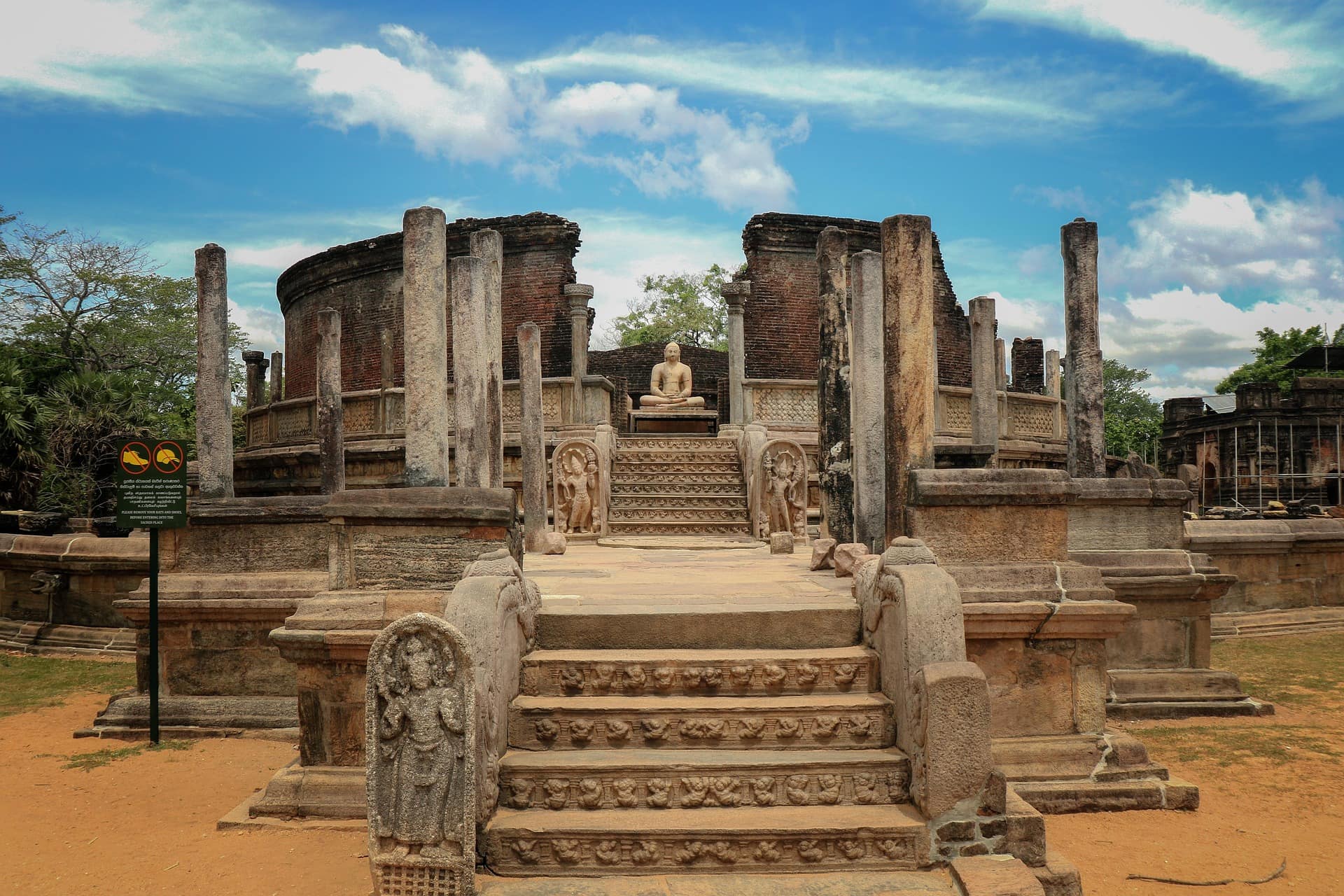
The Royal Palace of King Parakramabahu, once seven storeys high, and the nearby Council Chamber are among the first sites inside the park. The Quadrangle, or Dalada Maluwa, holds a cluster of fine buildings including the circular Vatadage, the Hatadage and the Gal Pota stone book.
Further north, the Rankoth Vehera stupa and the Lankatilaka image house rise high above the park. The highlight for many visitors is Gal Vihara, where four Buddha figures were carved from a single granite face, including a reclining Buddha 14 metres long.
The museum near the entrance gives useful context and is a cool place to start. Allow three to four hours for the main sites, more if you enjoy history.
- →Royal Palace and Council Chamber.
- →The Quadrangle and the Vatadage.
- →Rankoth Vehera and Lankatilaka.
- →Gal Vihara rock carvings.
Exploring by bicycle
Polonnaruwa's ruins are spread over several kilometres, and cycling between them is a pleasure in the cool of the morning. Bicycles can be rented from guesthouses in town, and the paths are mostly flat and shady.
Start at opening time, around 7.30am, and aim to finish the main sites by about 11am, when the heat becomes intense. Bring plenty of water, a hat and sunscreen.
If cycling feels too much in the heat, a driver can take you between the main sites with air-conditioned breaks. Tuk-tuks are also available in town.
Handling the heat and the stone
Shoes must be removed at the sacred sites, including the Quadrangle and Gal Vihara. By late morning the stone can be uncomfortably hot. Thin socks are allowed and help considerably.
Shoulders and knees must be covered at temples. Choose light, loose clothes and carry a sarong for quick cover.
Taking a long lunch break away from the ruins, perhaps by the reservoir or at your hotel, is the best way to handle the hottest hours.
- →Bring thin socks for hot stone.
- →Cover shoulders and knees.
- →Break for lunch in the shade.
What to combine with Polonnaruwa
Polonnaruwa is about an hour from Sigiriya and Habarana, and most visitors come as a day trip. An afternoon elephant safari at Minneriya, Kaudulla or Hurulu, all close by, makes a full and varied day.
In February the herds are smaller than during the famous gathering from July to October, and drivers choose the park depending on where elephants have been seen. Sightings are still common.
The planners at Lankan Stays & Trails usually pair Polonnaruwa with a safari in February, with an early start for the ruins and a long lunch before the afternoon drive.
Some travellers prefer to stay overnight in Polonnaruwa itself rather than drive from Sigiriya. Guesthouses near the reservoir are simple but well placed, and staying close allows a visit at opening time followed by a sunset walk along the bund of Parakrama Samudra, when local families come out to bathe and fish.
Frequently asked questions
Is February a good time to visit Polonnaruwa?
Yes. February is dry and clear, and the parkland is still green after the rains. Days are hot, so start early. It is one of the most attractive months to see the ruins, before the landscape turns dry and dusty later in the year.
How hot is Polonnaruwa in February?
Hot. Temperatures reach about 31 to 33°C by early afternoon, and stone floors at sacred sites become very hot underfoot. Starting at opening time and finishing the main sites by late morning is the most comfortable approach. Bring water, a hat and thin socks.
Can I cycle around Polonnaruwa in February?
Yes, and it is the most enjoyable way to explore. Paths are mostly flat and shady. Start at opening time and aim to finish by about 11am, before the strongest heat. Bicycles can be rented from guesthouses in town for the day.
How long do I need at Polonnaruwa?
Three to four hours for the main sites, including the Royal Palace, the Quadrangle, Rankoth Vehera, Lankatilaka and Gal Vihara. Add an hour for the museum at the entrance. Combining the visit with an afternoon elephant safari makes a full day.
Can I see elephants near Polonnaruwa in February?
Yes. Minneriya, Kaudulla and Hurulu are all close by. In February herds are smaller than during the famous gathering from July to October, and drivers choose the park depending on recent sightings. Afternoon safaris are common after a morning at the ruins.
What should I wear to Polonnaruwa?
Light, loose clothes covering shoulders and knees, which are required at sacred sites. A sarong is useful for quick cover. Bring slip-on shoes and thin socks, as shoes must be removed at many sites and the stone gets hot by late morning.
Is Polonnaruwa busy in February?
It is busier than in the shoulder months, but the ruins are spread over a wide area, so crowds thin out quickly. Gal Vihara and the Quadrangle are the busiest spots, mainly from mid-morning. Arriving at opening time keeps most visits calm and cool.