
Quick answer
A private tea tasting fits day 4 of a luxury 7-day Sri Lanka itinerary, on the drive from Kandy to Nanu Oya through the estates around Ramboda and Nuwara Eliya. Allow about two hours for a walk in the fields, a tour of a working factory and a guided tasting of five or six teas with a planter or tea maker. Factories process leaf from Monday to Saturday and are usually idle on Sundays and poya days.
Key takeaways
- Sri Lanka has seven tea regions, graded by altitude from low-grown Ruhuna to high-grown Nuwara Eliya.
- Commercial tea growing in Sri Lanka began in 1867 at Loolecondera estate, near Kandy.
- A tea factory turns fresh leaf into finished black tea in about 24 hours.
- Tea is plucked every seven to ten days from each bush, taking two leaves and a bud.
- Most factories do not process leaf on Sundays or on full moon poya days.
Why a private tasting is different
A private tea tasting on a luxury 7-day Sri Lanka itinerary replaces the standard factory stop. On the main road from Kandy to Nuwara Eliya, several large factories run free tours of 15 to 20 minutes for anyone who pulls in, ending at a sales counter.
A private visit is arranged in advance with an estate manager or tea maker. You see the same machinery with time to ask questions, and then taste properly, comparing grades and regions side by side the way buyers do.
- →Standard stop: 20 minutes, a group, a shop.
- →Private tasting: two hours, a planter, five or six teas.
- →Bungalow guests: usually included in the stay.
In the fields
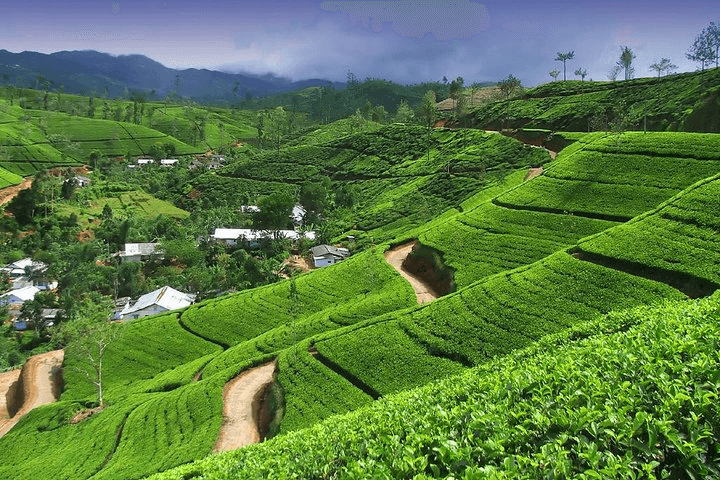
The tasting begins outdoors. Tea bushes are kept at waist height by pruning, and each is plucked every seven to ten days. Pluckers, nearly all of them women from the hill country Tamil community, take two leaves and a bud by hand and carry the leaf in baskets or sacks to be weighed.
Walking a field with a planter explains what the cup later confirms. Altitude, slope, shade trees and the age of the bush all change the leaf. You may be invited to pluck, and you will find it slower than it looks.
Inside the factory
A Sri Lankan tea factory is a tall building of several floors, many of them more than a century old. Fresh leaf is spread in long troughs on the upper floors to wither for 12 to 18 hours, losing about half its moisture.
The leaf then passes through rollers that twist and break it, rests on tables to oxidise from green to copper, and is fired in a dryer to stop the process. Sifting machines separate the grades by size. The smell on the firing floor is what most visitors remember.
- →Withering: 12 to 18 hours.
- →Rolling and oxidation: about two to three hours.
- →Firing: around 20 minutes.
- →Grading and packing: by particle size.
How to taste
A professional tasting follows a fixed method. A measured weight of each tea is brewed for the same time in lidded cups, then poured into bowls, with the wet leaf displayed on the lid. You look at the leaf, smell it, then slurp the liquor noisily from a spoon to spread it across the palate.
Compare a light, floral high-grown tea from Nuwara Eliya with a fuller Dimbula and a dark, malty low-grown tea from Ruhuna. Taste a large-leaf Orange Pekoe against a Broken Orange Pekoe from the same estate. The grades describe leaf size, not quality.
Where on the route to do it
The road from Kandy to Nanu Oya passes estates at 600 to 1,900 metres, and a visit fits naturally at mid-morning on day 4. Travellers staying in a tea bungalow have the estate at the door and can taste at leisure.
Ella sits in the Uva region, known for teas with a distinctive sharpness from the dry winds of July to September, and has factories within 20 minutes of town. Low-grown estates near Galle and Koggala also offer visits, including a few that produce white tea.
- →Day 4, Kandy to Nanu Oya: the classic stop.
- →Tea bungalow: on the estate, unhurried.
- →Ella or the Galle hinterland: alternatives if day 4 is tight.
Timing and fairness
Timing matters. Factories are busiest from early morning to early afternoon and stand quiet on Sundays and poya days, when there is nothing to see moving. If day 4 falls on one, move the tasting to Ella the next morning.
Lankan Stays & Trails arranges tastings with estates that welcome serious visitors, and encourages guests to buy tea there. Estate workers' wages remain low and are a subject of long dispute, and a traveller's questions about them are fair ones that a good planter will answer plainly.
Frequently asked questions
Where is the best place for a tea tasting in Sri Lanka?
The high-grown estates between Kandy, Nuwara Eliya and Hatton offer the widest choice, with working factories and bungalows that host private tastings. Ella and Haputale in the Uva region are good alternatives, and a few low-country estates near Galle also receive visitors.
How long does a tea factory tour take?
A standard walk-in tour takes 15 to 20 minutes. A private visit with a field walk, the full factory process and a guided tasting takes about two hours. Allow extra time if you want to buy tea and have it packed.
Are tea factories open on Sundays in Sri Lanka?
Many open their shops and tea rooms, but the machinery is usually idle, because no leaf is plucked on Sundays. The same applies on full moon poya days. To see a factory working, visit from Monday to Saturday, ideally in the morning.
What is the difference between OP and BOP tea?
They are leaf grades. Orange Pekoe, or OP, is whole, long, wiry leaf that brews a lighter cup. Broken Orange Pekoe, or BOP, is smaller broken leaf that brews stronger and faster. The terms describe size and not flavouring or quality.
Can I pick tea myself in Sri Lanka?
Yes, on many estate visits and at tea bungalows, where guests are lent a basket and shown the two leaves and a bud. It is done for a few minutes as an experience. Be respectful when photographing pluckers, and ask first.
Which Ceylon tea should I buy to take home?
Buy what you enjoyed at the tasting, in sealed foil packs. A high-grown Nuwara Eliya or Dimbula Orange Pekoe suits drinking without milk, while a BOP suits milk. Single-estate teas bought at the factory are fresher and cheaper than airport packs.