
Quick answer
Public displays of affection in Sri Lanka are more reserved than in most of Canada: holding hands is common and generally fine everywhere, but kissing, prolonged embracing or overtly romantic behaviour in public draws attention outside a hotel or resort. Swimwear that's normal at a pool needs a cover-up on public beaches, in towns and at temples, where shoulders and knees should be covered. None of this is usually a legal issue for tourists, but visible disregard for it reads as unaware rather than confident, and the norms relax noticeably on established tourist strips.
Key takeaways
- Holding hands is broadly acceptable across Sri Lanka, including for unmarried couples, but kissing or prolonged embracing in public draws attention even in tourist towns.
- Temple visits require shoulders and knees covered and shoes removed at the entrance, regardless of how a couple dresses on the beach that same morning.
- Resort pools and established beach strips like Unawatuna, Mirissa and Bentota are the most relaxed settings for Western swimwear and general affection.
- A double bed booking for an unmarried couple is not typically questioned at hotels used to international visitors, unlike the stricter public-affection norms outside the room.
- None of these expectations are usually enforced as law against tourists, but they shift sharply between a resort strip and an ordinary town or village a short drive away.
The baseline for couples travelling together
Sri Lanka runs more conservative on public affection than most Canadian cities, closer to a small conservative town than downtown Toronto or Vancouver, regardless of how relaxed a specific beach resort might otherwise feel. For a couple, this is a social expectation rather than a legal one in ordinary circumstances, and it shapes how you're perceived more than how you're policed.
The gap tends to surprise Canadian couples in the first day or two, particularly on a first visit to South Asia. It settles quickly once you've watched how local couples actually behave in a given setting rather than assuming the resort pool sets the tone for the whole island.
What's genuinely fine in public
Holding hands is common and unremarkable in Sri Lanka, including among unmarried couples, and doesn't carry much social weight. A hand on the back, a brief hug in greeting, or a supportive arm around a shoulder all read as ordinary in most everyday settings, from a market to a train platform.
The line sits at kissing and prolonged embracing, which draw a second look and mild disapproval even in tourist-heavy areas, not because it's uniquely scandalous but because it simply isn't how affection is shown in public locally.
- →Holding hands: fine in nearly every setting, including for unmarried couples.
- →A brief hug or supportive touch: generally unremarkable in everyday situations.
- →Kissing or prolonged embracing in public: draws attention even in tourist areas, better saved for the hotel or resort.
Swimwear, temples and everyday dress
Resort and hotel pools follow familiar Western norms, where a standard swimsuit or bikini is entirely unremarkable. That standard doesn't carry over to public beaches, ordinary towns or cultural sites, where a cover-up, sarong or shirt is expected once you step past the immediate shoreline.
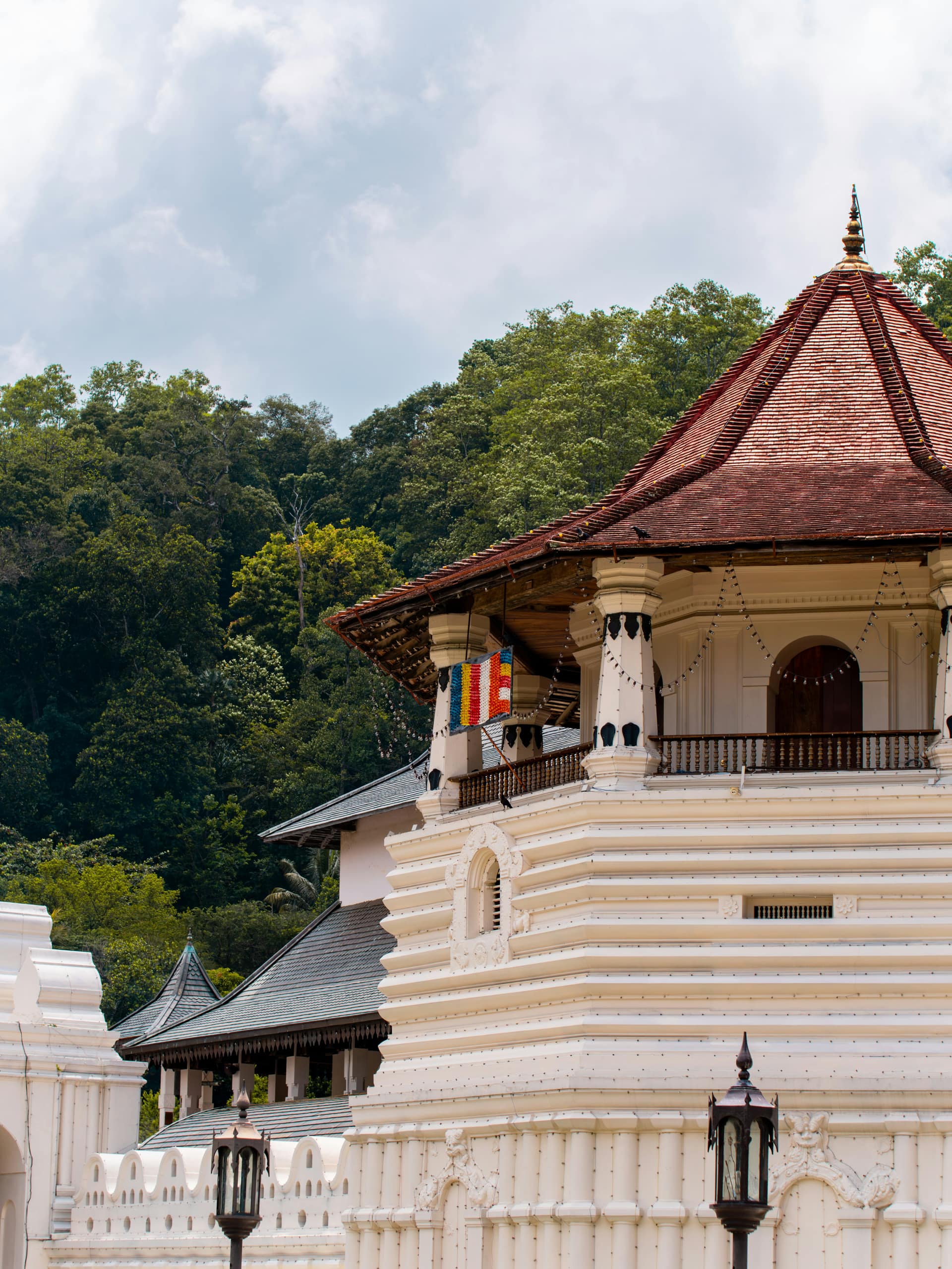
Temples are the strictest setting of all. Shoulders and knees covered, shoes and hats removed at the entrance, and a quiet, unhurried manner apply at every site, from the Temple of the Tooth in Kandy to the Dambulla Cave Temple, and this expectation doesn't loosen for a couple simply because it's a romantic stop on the itinerary.
- →Resort and hotel pools: standard Western swimwear is normal.
- →Public beaches and fishing villages: add a cover-up beyond the immediate shoreline.
- →Temples: shoulders and knees covered, shoes off at the entrance, regardless of the coast you've just come from.
Hotels, double beds and shared rooms
A double or single bed booking for an unmarried couple is not typically questioned at hotels and resorts used to international visitors, which is most of the accommodation a couple travelling with Lankan Stays & Trails would stay at. This applies whether the couple is married, engaged, dating or newly together.
The stricter norms sit outside the room, not inside it: a hotel's private grounds, pool and restaurant generally follow the more relaxed resort standard, while the street, temple or village just beyond the gate reverts to the everyday baseline.
Where the norms loosen and where they don't
Established tourist strips on the south coast, Unawatuna, Mirissa and Bentota among them, apply the most relaxed version of these norms given the volume of foreign visitors and the businesses built around them. A rural village, a local bus, a temple or an ordinary town centre apply the strictest version, where genuine local expectations rather than tourist-facing accommodation set the tone.
This distinction matters more in Sri Lanka than in many destinations because the two extremes sit close together geographically: a relaxed beach strip and a conservative fishing village can be a short tuk-tuk ride apart, sometimes within the same afternoon's driving.
Reading the room on the ground
Watching how local couples and families behave in a given setting, rather than assuming resort norms apply everywhere, is the fastest way to calibrate correctly. None of this requires suppressing genuine affection, simply adjusting its visible scale to match the surrounding context, and most couples find it becomes second nature within the first couple of days.
Our driver-guides are used to fielding this question quietly and honestly rather than letting a couple find out the hard way, and it's worth asking directly if you're unsure at a specific site or town.
Frequently asked questions
Is public displays of affection illegal in Sri Lanka?
It's not typically a legal issue for tourists in ordinary circumstances, but it is a strong social norm, more conservative than most of Canada. Holding hands is fine; kissing or prolonged embracing in public draws attention and mild disapproval, even in tourist areas.
Can couples hold hands in public in Sri Lanka?
Yes, holding hands is common and unremarkable in Sri Lanka, including for unmarried couples, in nearly every setting from markets to train platforms. It sits comfortably within the local baseline, unlike kissing or prolonged embracing.
Do hotels in Sri Lanka mind unmarried couples sharing a room?
No, a double bed booking for an unmarried couple is not typically questioned at hotels and resorts used to international visitors. The stricter public-affection norms apply outside the room, not to the booking itself.
What should couples wear at temples in Sri Lanka?
Shoulders and knees covered for both partners, with shoes and hats removed at the entrance. This applies at every temple, including the Temple of the Tooth in Kandy and Dambulla Cave Temple, regardless of how casually you've dressed elsewhere that day.
Can you wear a bikini on a beach in Sri Lanka?
Yes at resort and hotel pools and on established tourist beaches like Unawatuna, Mirissa and Bentota, where Western swimwear is normal. On quieter public beaches or near fishing villages, more coverage such as a rash guard or sarong is more appropriate.
Is Sri Lanka a romantic destination despite being conservative?
Yes. The conservatism applies to public behaviour, not to how hotels and resorts treat couples privately, where private dinners, quiet touches and romantic settings are commonly arranged. Public affection is simply better expressed within the room or resort grounds.
Where in Sri Lanka are these norms most relaxed?
Established tourist strips on the south coast, particularly Unawatuna, Mirissa and Bentota, apply the most relaxed version of these norms given the volume of foreign visitors. Villages, temples and ordinary town centres apply the strictest version, sometimes a short drive away.