
Quick answer
Foreign couples can marry legally in Sri Lanka, and the process is relatively straightforward compared with many countries. Requirements typically include valid passports, birth certificates, a declaration of marital status, and evidence of the dissolution of any previous marriage, with documents often requiring translation and authentication. Requirements change, so confirm current rules with the Sri Lankan Registrar General's Department or your embassy well in advance. Many couples add a traditional Poruwa ceremony, and vow renewals require no legal process at all.
Key takeaways
- Foreign couples can marry legally in Sri Lanka with a manageable documentary process.
- Requirements change, so confirm with the Registrar General's Department or your embassy.
- Documents typically need translation into English or Sinhala and authentication.
- The Poruwa is the traditional Sinhalese ceremony and can be combined with a civil marriage.
- Vow renewals and symbolic ceremonies require no legal process and are far simpler.
The legal process
Sri Lanka permits foreign nationals to marry, and unlike some countries there is no lengthy residency requirement, which is the single biggest reason it works as a destination wedding location. The process is administered by the Registrar General's Department, and marriages are registered locally.
Documentation typically required includes valid passports with entry stamps, birth certificates, a declaration or affidavit of marital status confirming you are free to marry, and, where applicable, a decree absolute or death certificate evidencing the end of a previous marriage. Documents in languages other than English or Sinhala generally require certified translation, and authentication or apostille is commonly needed.
Requirements do change, and they vary in detail by nationality. Confirm the current position with the Registrar General's Department and with your own embassy or high commission in Colombo well before you book anything, and factor in the time your home country needs to issue and authenticate documents.
- →No lengthy residency requirement, unlike many destination wedding countries.
- →Typically needed: passports, birth certificates, declaration of marital status.
- →Previous marriages need a decree absolute or death certificate.
- →Translation into English or Sinhala and authentication are commonly required.
- →Confirm current requirements with the Registrar General's Department and your embassy.
Practical planning of the legal side
Most couples use a wedding planner or their hotel's events team to handle registration, because the process involves local administration that is considerably easier with someone who does it regularly. Reputable venues on the south coast and in Colombo do this routinely.
Allow time. Obtaining, translating and authenticating documents in your home country is usually the slowest part, and it should be started several months ahead. Arrive in Sri Lanka a few days before the ceremony rather than the day before, both for the paperwork and because a delayed flight should not be able to derail the wedding.
- →Use a planner or hotel events team familiar with the registration process.
- →Start document collection and authentication several months ahead.
- →Arrive several days before the ceremony, not the day before.
- →Confirm exactly who is submitting what, and when, in writing.
The Poruwa ceremony
The Poruwa is the traditional Sinhalese wedding ceremony, and many foreign couples include it alongside or instead of a Western-style ceremony. The couple stand on a decorated wooden platform, the poruwa, and a sequence of rituals is conducted by an ashtaka reciter, with the exchange of betel leaves, the tying of the couple's little fingers with gold thread while water is poured over them, and the offering of milk rice.
It is genuinely beautiful and genuinely meaningful, and it is worth understanding rather than treating as decoration. Traditional dancers and drummers accompany the procession. If you are including it, engage someone who can explain the sequence to your guests, so it reads as a ceremony rather than a performance.
- →The couple stand on a decorated platform, the poruwa, for the ceremony.
- →Rituals include betel exchange, the tying of little fingers, and milk rice.
- →Traditional dancers and drummers accompany the procession.
- →Arrange an explanation for guests so it reads as ceremony, not spectacle.
Where to hold it
Galle Fort is the standout for couples wanting architecture and atmosphere: converted Dutch merchant houses with courtyards, the ramparts at sunset, and a walkable town where guests can stay within a few minutes of each other. It is also the most expensive option.
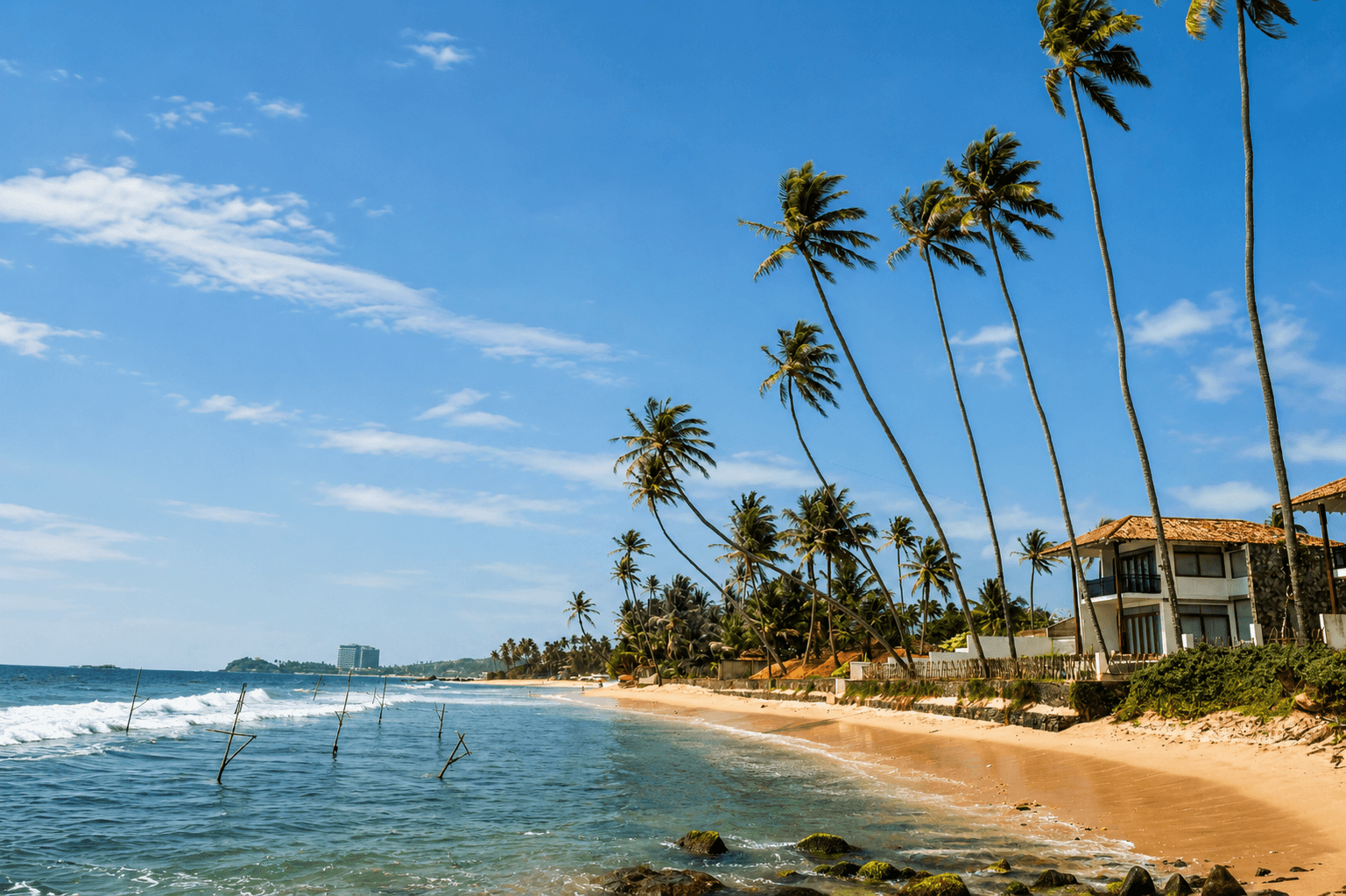
The south coast from Bentota through Tangalle offers beach ceremonies, with villas and boutique properties on the sand. The hill country offers something entirely different: colonial tea planters' bungalows around Hatton, Dickoya and Nuwara Eliya, at altitude, with fires in the evening and tea estates in every direction. Bentota and the west coast have the largest resort properties, which suit bigger guest lists.
- →Galle Fort: Dutch architecture, courtyards, ramparts, walkable for guests.
- →South coast: beach ceremonies at Bentota, Tangalle and the villas between.
- →Hill country: colonial tea bungalows at altitude, cool and green.
- →West coast resorts: the largest properties, suiting bigger guest lists.
Timing and season
Season matters enormously for an outdoor ceremony. The south and west coasts and the hill country are dry from roughly December to April, which is when the overwhelming majority of destination weddings take place, and it is also peak season for cost and availability. The east coast is dry from May to September, which is an under-used option for a beach wedding at a fraction of the price.
Avoid mid-April, when the Sinhala and Tamil New Year closes much of the country and domestic demand peaks, and check the poya calendar: alcohol is not sold on full moon days, which matters for a reception. Some couples deliberately schedule around a poya; most should schedule away from one.
- →South and west coasts and hills: dry roughly December to April, and peak priced.
- →East coast: dry May to September, much cheaper, and rarely used for weddings.
- →Avoid mid-April, when the new year closes much of the country.
- →Check the poya calendar: no alcohol is sold on full moon days.
Vow renewals and symbolic ceremonies
If you do not need the marriage to be legally recognised in Sri Lanka, everything becomes much simpler. Vow renewals and symbolic ceremonies require no documentation, no registration and no lead time beyond booking the venue, and many couples marry legally at home and hold the ceremony they actually want here.
This also opens up locations that would be impractical for a legal ceremony: a beach at dawn, a tea estate viewpoint, a temple blessing. Blessings can be arranged at Buddhist and Hindu sites with appropriate respect and the right introductions, and a Poruwa ceremony can be held symbolically with no legal component at all.
- →No documentation, registration or lead time required.
- →Many couples marry legally at home and hold the ceremony here.
- →Opens up locations impractical for a legal ceremony.
- →A Poruwa can be held symbolically with no legal component.
Thinking about guests
Sri Lanka is a long-haul destination for most guest lists, which means people will build a holiday around the wedding. Choosing a location where guests can also do something is worth more than choosing the most photogenic venue: Galle Fort, Bentota and the south coast all work because there is a trip attached.
Consider building a short group itinerary before or after: a Cultural Triangle day, a safari, a train journey. Many couples find this is what guests remember, and it converts a two-day obligation into a holiday people are glad to have taken. Blocks of rooms need booking a long way ahead in peak season.
- →Choose somewhere guests can also holiday, not just the most photogenic venue.
- →Consider a short group itinerary before or after the ceremony.
- →Room blocks in Galle Fort and the south coast need booking far ahead.
- →Factor long-haul flight costs into how much you ask of guests.
Planning timeline
Start twelve months out for a peak-season wedding, or nine for the east coast in its season. Confirm legal requirements first, before committing to a date, because document authentication timelines in your home country are the binding constraint.
Lankan Stays & Trails arranges wedding and vow renewal itineraries including venue introductions, Poruwa ceremonies and group travel for guests, and will be straight with you about which venues handle registration competently and which do not.
Frequently asked questions
Can foreigners get married in Sri Lanka?
Yes, and there is no lengthy residency requirement, which is the main reason Sri Lanka works as a destination wedding location. The process is administered by the Registrar General's Department. Requirements change and vary by nationality, so confirm current rules well in advance.
What documents do you need to marry in Sri Lanka?
Typically valid passports with entry stamps, birth certificates, a declaration or affidavit of marital status, and a decree absolute or death certificate where a previous marriage has ended. Documents in other languages usually need certified translation and often authentication or apostille.
What is a Poruwa ceremony?
The traditional Sinhalese wedding ceremony, in which the couple stand on a decorated wooden platform while an ashtaka reciter conducts a sequence of rituals including betel exchange, the tying of the couple's little fingers with gold thread, and the offering of milk rice.
Where are the best wedding venues in Sri Lanka?
Galle Fort for Dutch architecture, courtyards and rampart sunsets in a walkable town; the south coast from Bentota to Tangalle for beach ceremonies; colonial tea bungalows in the hill country for something cooler and greener; and west coast resorts for larger guest lists.
When is the best time for a wedding in Sri Lanka?
December to April for the south and west coasts and hill country, which is also peak season for cost. May to September for the east coast, which is dry then, much cheaper and rarely used. Avoid mid-April, and check the poya calendar since alcohol is not sold on full moon days.
Do you need documents for a vow renewal in Sri Lanka?
No. Vow renewals and symbolic ceremonies require no documentation, registration or lead time beyond booking the venue, which makes them far simpler. Many couples marry legally at home and hold the ceremony they actually want in Sri Lanka, including a symbolic Poruwa.
How far in advance should you plan a Sri Lanka wedding?
Twelve months for a peak-season wedding, or nine for the east coast in its season. Confirm legal requirements before committing to a date, since document authentication timelines in your home country are usually the binding constraint rather than venue availability.