
Quick answer
Sri Lanka's tea bungalows are former planters' residences on working tea estates, mostly around Hatton, Dickoya, Bogawantalawa and Nuwara Eliya at altitudes between roughly 1,200 and 1,900 metres. They typically take four to eight guests, include full board and a dedicated staff of cook, butler and housekeeper, and retain period furniture, fireplaces and gardens. Separately, colonial-era hotels in Nuwara Eliya, Kandy and Colombo offer a similar period atmosphere at a larger scale. Both are best from roughly January to March.
Key takeaways
- Tea bungalows are former planters' residences on working estates, mostly around Hatton and Dickoya.
- They typically take four to eight guests with a dedicated cook, butler and housekeeper.
- Altitudes of 1,200 to 1,900 metres mean fires, blankets and genuinely cold nights.
- Full board is usually included, as there is nowhere else to eat.
- The clearest weather is broadly January to March.
What a tea bungalow actually is
When British companies planted tea across the Sri Lankan highlands from the 1860s onwards, each estate needed a resident manager, and each manager needed a house. Those houses were substantial: verandas, gardens laid out with English planting, fireplaces, high ceilings, and a staff to run them. Many survived the transition to Sri Lankan ownership and have since been restored as small guest houses.
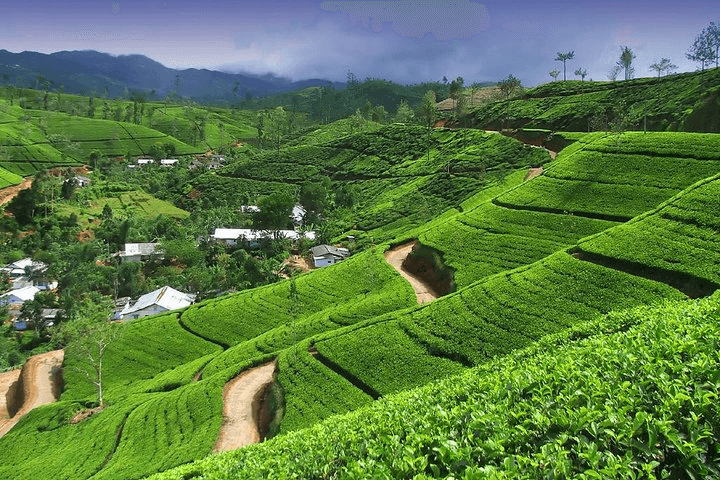
The experience is quite specific. You have the house, or a room in a house with three or four other rooms, and a staff who cook and look after it. Meals are served at a table rather than in a restaurant, often with a set menu discussed in advance. There is usually a fire lit in the evening, a garden, and tea in every direction outside the windows.
- →Former estate managers' houses from the tea planting era, largely from the 1860s.
- →Typically four to eight guest rooms, sometimes taken as a whole house.
- →Dedicated staff: cook, butler and housekeeper rather than hotel service.
- →Set meals at a table, a fire in the evening, and gardens.
Where they are
The greatest concentration is in the Hatton, Dickoya and Bogawantalawa area, in the high tea country west of Nuwara Eliya, around the Castlereagh and Maskeliya reservoirs. This is the heart of the industry and the altitude, roughly 1,200 to 1,400 metres, gives cool days and cold nights without Nuwara Eliya's chill.
Nuwara Eliya itself, at around 1,890 metres, has both bungalows and grand colonial hotels. Around Ella, Haputale and Bandarawela there are further estate properties at a range of standards. Kandy has heritage properties in the town and on the surrounding hills, and Colombo and Galle have colonial-era hotels that belong to the same category if not the same landscape.
- →Hatton, Dickoya and Bogawantalawa: the greatest concentration, around 1,200 to 1,400 m.
- →Nuwara Eliya at around 1,890 m: bungalows plus grand colonial hotels.
- →Ella, Haputale and Bandarawela: further estate properties at varied standards.
- →Kandy, Colombo and Galle: colonial-era hotels in a different landscape.
What to expect, practically
Cold. This is the thing visitors most consistently underestimate. At 1,400 metres a fire is not decorative, and at 1,890 metres in Nuwara Eliya nights can approach single figures Celsius. Hot water bottles in beds are standard practice at good properties. Bring a proper warm layer.
Full board is usually included, and this is practical rather than upselling: there is generally nowhere else to eat within a reasonable distance. Menus are typically a mix of Sri Lankan and colonial-era British dishes, and dietary requirements should be given in advance so the cook can shop. Wifi is often patchy and phone signal variable, which is either a feature or a problem depending on you.
- →Genuinely cold at night; fires and hot water bottles are standard, not decorative.
- →Full board is usually included as there is nowhere else to eat nearby.
- →Give dietary requirements in advance so the cook can shop for them.
- →Wifi and phone signal are often patchy in remote estate locations.
What you actually do there
Comparatively little, which is the point. Estate walks through the tea, guided or not, are the main activity, and walking through a working plantation with pickers on the slopes is genuinely absorbing. Factory tours are usually arranged, and a good one explains withering, rolling, oxidation and grading in about an hour.
Beyond that: Adam's Peak is within reach from the Hatton side for the overnight climb in season, Horton Plains is a dawn drive from Nuwara Eliya, and there are waterfalls, reservoirs and rail journeys nearby. Many guests find they do less than they planned, which is generally the correct outcome.
- →Estate walks through working tea are the main activity.
- →Factory tours cover withering, rolling, oxidation and grading in about an hour.
- →Adam's Peak is reachable from Hatton in season, December to May.
- →Horton Plains is a dawn drive from the Nuwara Eliya side.
The colonial hotels
A related but different category. Nuwara Eliya's grand hotels, built for the hot-weather retreat trade, offer billiard rooms, log fires, high tea and a faintly surreal Englishness at 1,890 metres in the tropics. Kandy has hill-station hotels above the lake. Colombo and Galle have properties dating from the colonial trading era.
These are hotels rather than houses: more rooms, more formality, a bar and a restaurant, and considerably more people. They suit travellers who want the period atmosphere without the isolation, and they are the better choice for anyone who would find a four-room house with set mealtimes constraining.
- →Nuwara Eliya's grand hotels: billiard rooms, log fires, high tea.
- →Kandy has hill-station hotels above the lake.
- →More rooms, more formality, a bar and a restaurant.
- →Better for travellers who would find a small house with set mealtimes constraining.
Cost and season
Tea bungalows are among the most expensive accommodation in Sri Lanka on a per-night basis, though full board and staff are included, which narrows the gap against a hotel plus meals. Taking a whole bungalow for a family or a group of friends is frequently better value per person than individual rooms and is a genuinely lovely way to travel.
The best weather is broadly January to March, when hill country mornings are clearest. Rates peak from mid-December to early January and again around April, when Nuwara Eliya's April Season fills every property in town. May to September is wetter on the western side of the hills but rates fall considerably, and a fire and a book in the rain is not the worst outcome.
- →Among Sri Lanka's most expensive accommodation, though full board is included.
- →Taking a whole bungalow for a group is frequently better value per person.
- →Best weather broadly January to March.
- →Peak rates mid-December to early January and around April.
- →May to September is wetter but considerably cheaper.
Choosing between them
Ask about altitude, because it determines how cold you will be and how far the drive is. Ask about the number of rooms, because a four-room house and a twelve-room hotel are entirely different experiences. Ask whether the estate is working, since a bungalow surrounded by an active plantation is considerably more interesting than one surrounded by garden.
Also ask about road access. Some estate bungalows are at the end of several kilometres of rough track, which is fine in a suitable vehicle and unpleasant in a small car, and matters if anyone in the party has mobility limitations.
- →Ask about altitude: it determines temperature and drive times.
- →Ask about room count; four rooms and twelve are different experiences.
- →Ask whether the surrounding estate is still working.
- →Ask about road access; some are at the end of rough tracks.
Fitting one into a trip
Two nights minimum, three if you can. A single night in a tea bungalow is a waste, because the arrival afternoon and departure morning consume most of it and the whole point is to slow down. Position it after the Cultural Triangle, when you have earned a fire and a book.
Lankan Stays & Trails books bungalows and colonial properties across the hill country and will tell you honestly which ones are worth the drive up the track and which are trading on the word colonial.
Frequently asked questions
What is a tea bungalow in Sri Lanka?
A former tea estate manager's residence, built during the British planting era from the 1860s onwards and now restored as small guest accommodation. They typically take four to eight guests with a dedicated cook, butler and housekeeper, and retain period furniture, fireplaces and gardens.
Where are the best tea bungalows in Sri Lanka?
The greatest concentration is around Hatton, Dickoya and Bogawantalawa in the high tea country west of Nuwara Eliya, near the Castlereagh and Maskeliya reservoirs. Nuwara Eliya, Ella, Haputale and Bandarawela have further estate properties at a range of standards.
Is it cold in Sri Lanka's tea bungalows?
Yes, genuinely. At around 1,400 metres a fire is not decorative, and Nuwara Eliya at 1,890 metres can approach single figures Celsius at night. Hot water bottles in beds are standard at good properties. Bring a proper warm layer, which visitors consistently underestimate.
Is full board included at Sri Lankan tea bungalows?
Usually, and it is practical rather than upselling, as there is generally nowhere else to eat within a reasonable distance. Menus mix Sri Lankan and colonial-era British dishes, and dietary requirements should be given in advance so the cook can shop for them.
How many nights should you stay in a tea bungalow?
Two minimum, three if possible. A single night is a waste because the arrival afternoon and departure morning consume most of it, and the entire point of the format is slowing down. Position it after the Cultural Triangle when you have earned a fire and a book.
When is the best time to stay in Sri Lanka's hill country?
Broadly January to March, when hill country mornings are clearest. Rates peak from mid-December to early January and again around April, when Nuwara Eliya's April Season fills every property. May to September is wetter on the western hills but considerably cheaper.
Are tea bungalows good value in Sri Lanka?
They are among the most expensive accommodation in the country per night, though full board and dedicated staff are included, which narrows the gap against a hotel plus meals. Taking a whole bungalow for a family or group is frequently much better value per person.