
Quick answer
Tangalle is driest and calmest roughly from December to April, its beach season. It receives roughly 1,300 to 1,600 mm of rain a year, much less than Galle, because it lies on the edge of the dry zone. From about late May to September it gets fewer showers than the west of the south coast, often with long dry spells, but the sea is rough and windy. October and November bring storms. Highs are about 30 to 32 °C all year.
Key takeaways
- Tangalle receives much less rain than Galle or Mirissa, roughly 1,300 to 1,600 mm a year.
- Its beach season runs roughly from December to April.
- In the southwest monsoon it is often dry and sunny, but the sea is rough and windy.
- October and November bring the year's heaviest storms.
- Sheltered spots such as Hiriketiya and Goyambokka are calmer than the long open beaches.
Why Tangalle is drier
Tangalle lies on the south coast about 75 km east of Galle, close to the edge of the dry zone. The southwest monsoon drops most of its rain on the hills and coast further west before it reaches here, so Tangalle receives roughly 1,300 to 1,600 mm a year, against roughly 2,300 to 2,500 mm in Galle. Hambantota, further east, receives roughly 1,000 mm.
Temperatures are slightly higher than further west: about 30 to 32 °C by day and 24 to 26 °C at night. The sea is about 27 to 29 °C. Humidity is a little lower, especially in the monsoon months, when a dry wind often blows.
The landscape shows the change. Around Galle, the coast is lined with dense palms, rubber and rainforest. Around Tangalle, the vegetation becomes thinner and drier, with lagoons, scrub and paddy, and beyond Hambantota it turns to the dry scrub of the Yala region. The weather follows the same gradient.
- →Annual rain: roughly 1,300 to 1,600 mm.
- →Days: about 30 to 32 °C.
- →Drier than Galle and Mirissa.
December to April
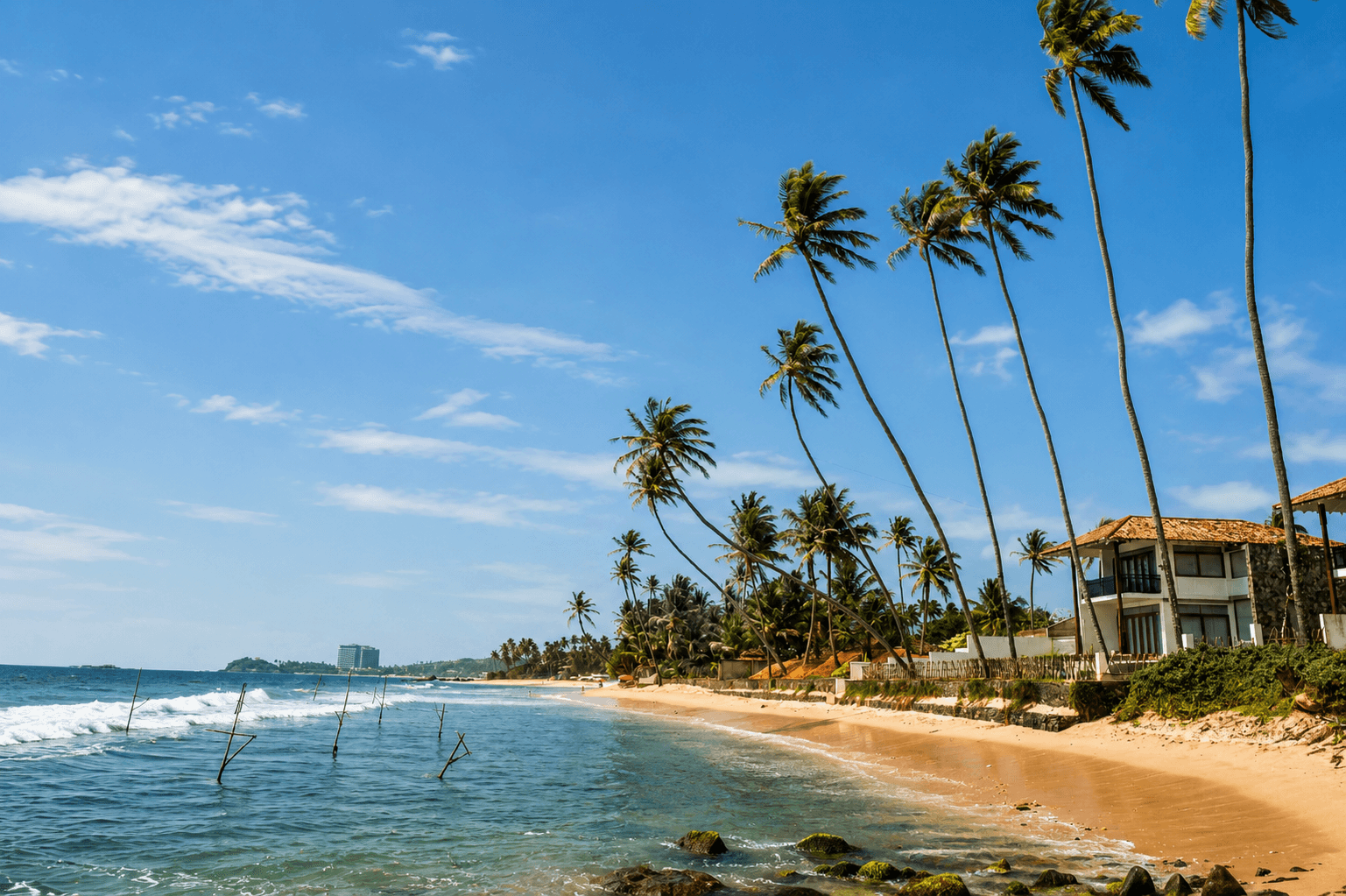
From December to April, Tangalle has dry, sunny days and a calm sea. January to March are the most reliable. The long beaches of Medaketiya and Marakolliya, the coves of Goyambokka and Silent Beach, and the horseshoe bay of Hiriketiya are all at their best.
Hiriketiya, about 20 minutes west, has its surf season in this period too, with gentle waves for beginners. Rekawa beach, east of town, is known for turtle nesting, which happens through much of the year.
April is hot, with occasional storms but a mostly calm sea.
- →Calm sea: roughly December to April.
- →Surf at Hiriketiya: roughly November to April.
- →Hottest: April.
Late May to September
The southwest monsoon brings wind and swell from late May to September, but much less rain than further west. Many days in Tangalle are dry and sunny, with a strong breeze, while Galle is under cloud. That makes Tangalle the best bet on the south coast for sunshine in the summer.
The sea is still rough. The long open beaches have strong currents and heavy shore break, and swimming is unsafe on most days. Some sheltered coves are calmer, but need care and local advice.
Tangalle in the monsoon suits travellers who want sun, walks, villas with pools and day trips to Mulkirigala, Yala or Udawalawe, rather than swimming.
- →Rain: much lighter than further west.
- →Sea: rough, strong currents.
- →Good base for Yala and Udawalawe.
October and November
Tangalle's heaviest rain comes in October and November, from the second inter-monsoon storms and the early northeast monsoon. Storms usually break in the afternoon or evening. The sea calms through November, and the beach season returns in December.
Because the dry zone gets much of its rain in this period, Tangalle can be wetter in November than in July, the opposite of Galle's pattern in summer.
- →Wettest: October and November.
- →Season restarts: December.
- →Mornings: usually dry.
Planning a Tangalle stay by season
Plan a Tangalle beach stay from December to April. In the southwest monsoon, Tangalle is a good choice for a south coast base with more sun than Galle or Mirissa, and for safari day trips, as long as swimming is not the priority.
Lankan Stays & Trails uses Tangalle for beach stays in the dry season and as a sunnier south coast base, close to Yala and Udawalawe, in the monsoon months.
Frequently asked questions
When is the best time to visit Tangalle?
For the beach, roughly December to April, with January to March the most reliable. The sea is calm and the coves at Goyambokka, Silent Beach and Hiriketiya are swimmable. In the monsoon months Tangalle is sunnier than Galle, but the sea is rough.
Is Tangalle drier than Mirissa and Galle?
Yes. Tangalle lies near the edge of the dry zone and receives roughly 1,300 to 1,600 mm of rain a year, much less than Galle. In the southwest monsoon months, it often has long dry spells while the west of the south coast is cloudy.
Can you swim in Tangalle in the monsoon?
Generally not on the long open beaches. From late May to September, the southwest monsoon brings swell, heavy shore break and strong currents. Some sheltered coves are calmer, but conditions change quickly. Follow flags and local advice.
When is the rainy season in Tangalle?
Tangalle's heaviest rain usually comes in October and November, from inter-monsoon storms and the early northeast monsoon. The southwest monsoon from late May to September brings wind and swell but much less rain than further west.
What is the weather like in Tangalle in July?
July is often dry and sunny in Tangalle, with a strong breeze from the southwest monsoon and highs of about 30 °C. The sea is rough and not safe for swimming on most days. It is a good base for walks, villas with pools and safaris at Yala or Udawalawe.
When is the surf season at Hiriketiya?
Hiriketiya's main surf season runs roughly from November to April, when gentle, clean waves suit beginners and intermediate surfers. From May to September the monsoon swell is bigger and less organised, though the bay can still produce rideable waves on some days.
How does Lankan Stays & Trails use Tangalle?
Tangalle is planned for beach stays from December to April, and as a sunnier south coast base in the monsoon months, with safari day trips to Yala or Udawalawe. Beach-focused trips in summer still move to the east coast for swimming.
Is Tangalle a good base for Yala?
Yes. Tangalle is roughly 1.5 to 2 hours from the Yala entrance at Palatupana, and it is often drier and sunnier than the rest of the south coast in the monsoon months. That makes it a good base for a Yala or Udawalawe safari day combined with a beach stay.