
Quick answer
American travellers visiting Sri Lankan temples should expect rules enforced far more strictly than at most US churches or synagogues open to visitors: shoes and hats off before entering any sacred area, shoulders and knees covered at all times, and no photographs taken with your back to a Buddha statue. These are not polite suggestions, temple staff and monks will ask visitors to cover up, remove footwear, or leave the grounds if the rules aren't followed. Carrying a scarf and slip-on shoes solves most of the practical friction.
Key takeaways
- Shoes and hats must come off before entering the inner sacred area at every Buddhist temple in Sri Lanka, including Kandy's Temple of the Sacred Tooth Relic.
- Shoulders and knees need covering at all times inside temple grounds, a stricter standard than the come-as-you-are approach common at many US churches.
- Posing with your back to a Buddha statue for a photograph is treated as a serious offence, not a minor faux pas, and has led to visitors being asked to leave.
- A light scarf or sarong plus a pair of slip-on shoes solves most of the practical friction American travellers hit at Sri Lankan temples.
- Major sacred sites such as Kandy, Anuradhapura and Kataragama enforce dress and behaviour rules more consistently than tourist-facing religious sites typically do in the US.
Why Sri Lankan temples feel stricter than a US church visit
Sri Lankan temples operate as active places of worship first and tourist attractions second, even at sites that see hundreds of visitors a day. That order matters: the dress code and behaviour expected of a worshipper apply to every visitor, not just to Buddhists, and there's no separate, more relaxed track for tourists the way there often is at a US cathedral offering a self-guided tour.
For American travellers, the closest comparison is a strict mosque or an Orthodox monastery back home rather than the average parish church. Sri Lanka simply applies that same level of formality at nearly every active Buddhist and Hindu site nationwide, from a small village temple to Kandy's Temple of the Sacred Tooth Relic.
Shoes, shoulders and knees: the non-negotiables
Shoes come off before you cross into the sacred area of any temple, usually marked by a change in floor surface or a low wall, and socks generally come off too at the more traditional sites. Shoulders and knees need covering the entire time you're inside, for men and women alike, and shorts or a sleeveless top will get you turned away or handed a wrap at the entrance.
This is a bigger shift than it sounds for American visitors used to summer travel wardrobes. Pack accordingly rather than improvising at the gate, where rental cloths are sometimes available but not guaranteed.
- →Remove shoes (and often socks) before entering the marked sacred area, not just the inner shrine room.
- →Cover both shoulders and knees at all times, regardless of gender or the day's heat.
- →Bring a lightweight scarf or sarong specifically for temple visits rather than relying on what you're already wearing.
Hats off, voices down: behaviour inside the grounds
Hats and sunglasses come off inside the sacred area, even a baseball cap worn purely for sun protection. Voices stay low, phones stay on silent, and running or boisterous group photos are out of place, a noticeably more subdued register than the chatter common in a US cathedral gift shop or courtyard.
Monks are treated with quiet deference: American visitors don't need to bow or initiate conversation, but stepping aside, lowering your voice, and not photographing a monk without asking first are all expected as a baseline.
The rule about photographing Buddha statues
Never pose with your back to a Buddha statue for a photograph. This is the single most common mistake American visitors make, usually without any intent to offend, and it is taken seriously: it has led to visitors being asked to leave, and in a small number of publicised cases, to formal removal from the country.
Photographing the statue itself, respectfully and without flash, is generally fine at most sites, but check for posted signs since some inner shrine rooms prohibit photography altogether. For the fuller picture on cameras, drones and sacred-site restrictions, see our guide to photographing people and sacred sites in Sri Lanka.
Where this is enforced most strictly
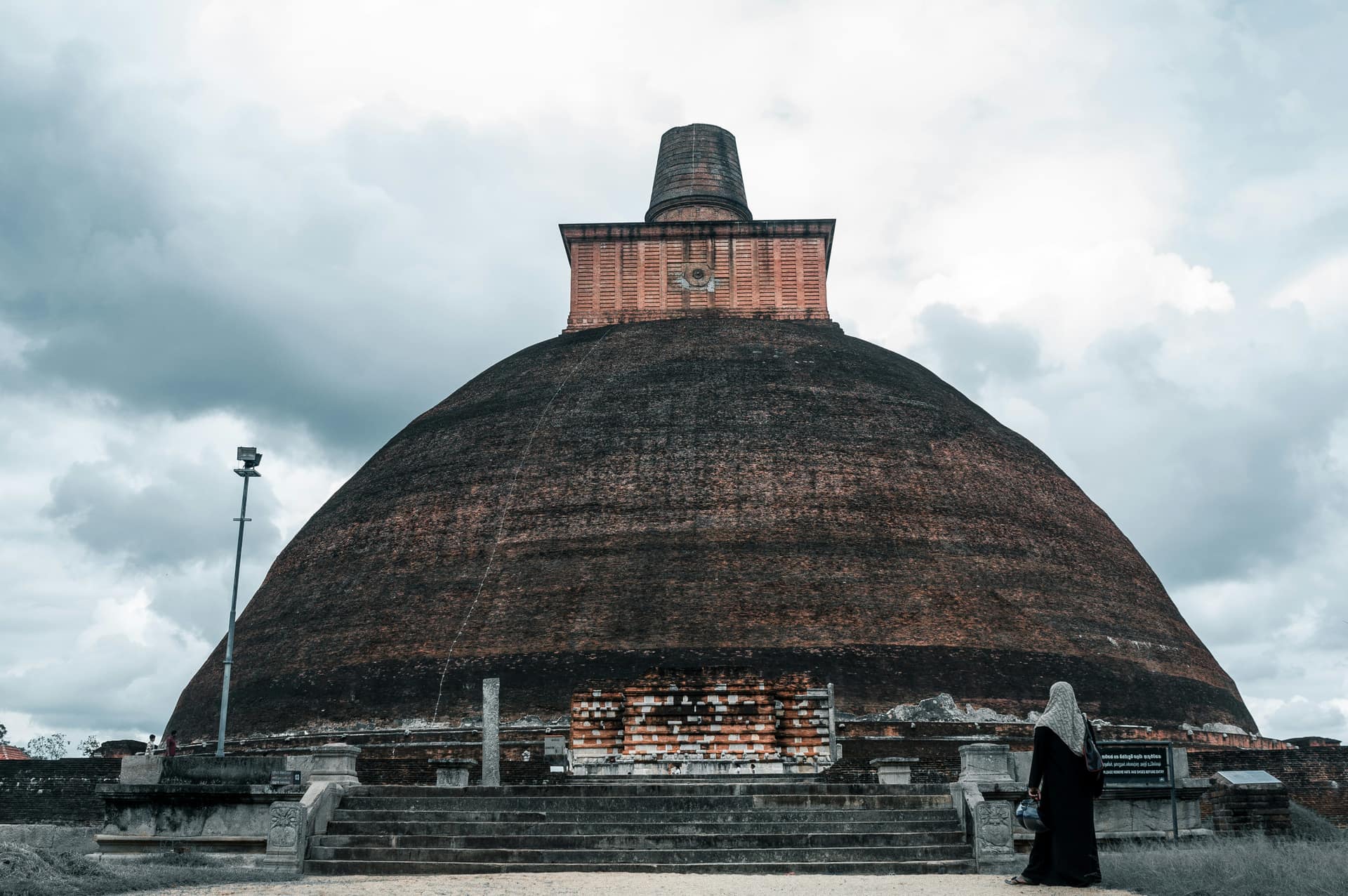
Kandy's Temple of the Sacred Tooth Relic is the site where American visitors report the strictest, most consistently checked dress code, given its status as one of Buddhism's most revered relics. Anuradhapura and Kataragama, both active pilgrimage sites rather than pure ruins, enforce the same standard with a genuine local congregation present.
Archaeological sites with temple elements, such as Dambulla's cave temples, apply the rules just as firmly even though much of the visit feels like a heritage tour. Assume every site with an active shrine, however small, follows the same baseline.
- →Kandy's Temple of the Sacred Tooth Relic: strict dress checks, long queues on poya (full moon) days.
- →Anuradhapura and Kataragama: active pilgrimage sites with a genuine local congregation, not just tourists.
- →Dambulla's cave temples: heritage-site atmosphere, but full temple etiquette still applies inside.
How this compares with American places of worship
Choose to treat every Sri Lankan temple like a strict place of active worship, not like a museum with a religious theme, and you'll rarely go wrong. Choose to treat it the way many Americans treat a cathedral open for tourism, browsing in shorts, chatting at normal volume, and you'll be corrected quickly and sometimes firmly.
The difference isn't unfriendliness. Sri Lankan temple staff and monks are generally patient with genuine visitors who are simply unfamiliar with the expectations, and a quick, respectful adjustment is all that's usually needed.
Planning your temple visits
Building temple visits into a wider Sri Lanka itinerary is straightforward once the dress code is sorted: a scarf, slip-on shoes and modest layers packed from day one cover nearly every site on a typical route through Kandy, Anuradhapura and the Cultural Triangle.
Our guides brief every guest on temple etiquette before the first visit, so the adjustment happens once, calmly, rather than at the gate of a busy site. For the fuller general rules that apply to all visitors, not just Americans, see our complete temple etiquette guide.
Frequently asked questions
What should Americans wear to a temple in Sri Lanka?
Cover both shoulders and knees, avoid shorts, sleeveless tops and short skirts, and bring a lightweight scarf or sarong as backup. Shoes and often socks come off before entering the sacred area, so slip-on footwear makes repeated temple visits far easier.
Do you have to take your shoes off at every temple in Sri Lanka?
Yes, shoes come off before entering the marked sacred area at every active Buddhist or Hindu temple, and socks often come off too at more traditional sites. This applies to all visitors regardless of religion, not just to worshippers.
Can you take photos inside Sri Lankan temples?
Generally yes outside the inner shrine rooms, but never pose with your back to a Buddha statue, which is considered seriously disrespectful. Some inner rooms prohibit photography entirely, so check for posted signs before using a camera or phone.
Why do you have to cover your shoulders at Sri Lankan temples?
Covered shoulders and knees signal modesty and respect at an active place of worship, a standard applied to every visitor regardless of faith. It's a stricter, more consistently enforced dress code than most US religious sites open to tourists.
Is it disrespectful to wear a hat at a Sri Lankan temple?
Yes, hats and sunglasses should come off before entering the sacred area, even if worn only for sun protection. It's treated the same as a shoe or shoulder rule, not an optional courtesy, at nearly every active temple site.
How strict is temple etiquette in Sri Lanka compared to the US?
Noticeably stricter than the average American experience of touring a church or synagogue. Sri Lankan temples are active worship sites first, so dress and behaviour rules are checked and enforced consistently, closer to a strict mosque or monastery than a typical tourist-friendly cathedral.
What happens if you break temple etiquette rules in Sri Lanka?
Usually a polite correction, a request to cover up, remove a hat, or reposition for a photo. Repeated or deliberate disrespect, especially posing with your back to a Buddha image, can lead to being asked to leave a site altogether.