
Quick answer
The best things to do in Kandy in the rain are indoors or under cover: the Temple of the Sacred Tooth Relic with its International Buddhist Museum and Audience Hall, the National Museum, the Ceylon Tea Museum at Hantana, a cooking class, an ayurvedic massage, the covered central market and a Kandyan dance performance. Rain in Kandy most often falls in the afternoon, so do outdoor sights such as the botanic gardens and the lake before midday. October and November are the wettest months, and January to March the driest.
Key takeaways
- Kandy receives roughly 1,800 to 2,000 millimetres of rain a year, spread across about 150 wet days.
- October and November are the wettest months in Kandy, and January to March the driest.
- Rain in Kandy typically falls as afternoon and evening showers of one to two hours, with clearer mornings.
- The Temple of the Sacred Tooth Relic, its museums and the dance halls are all under cover.
- Leeches are active in Udawattakele and on hill trails around Kandy whenever the ground is wet.
How rain behaves in Kandy
Rain in Kandy follows a recognisable pattern. Mornings often start bright. Cloud builds over the hills from late morning, and showers break in the early or mid-afternoon, sometimes with thunder. By evening it has usually eased.
The seasons of rain in Kandy differ in character. April, May, October and November bring heavy convective downpours. June to September, the south-west monsoon, brings wind and lighter, passing showers. December to March is the driest stretch, although a wet day is always possible.
Indoor sights in the centre
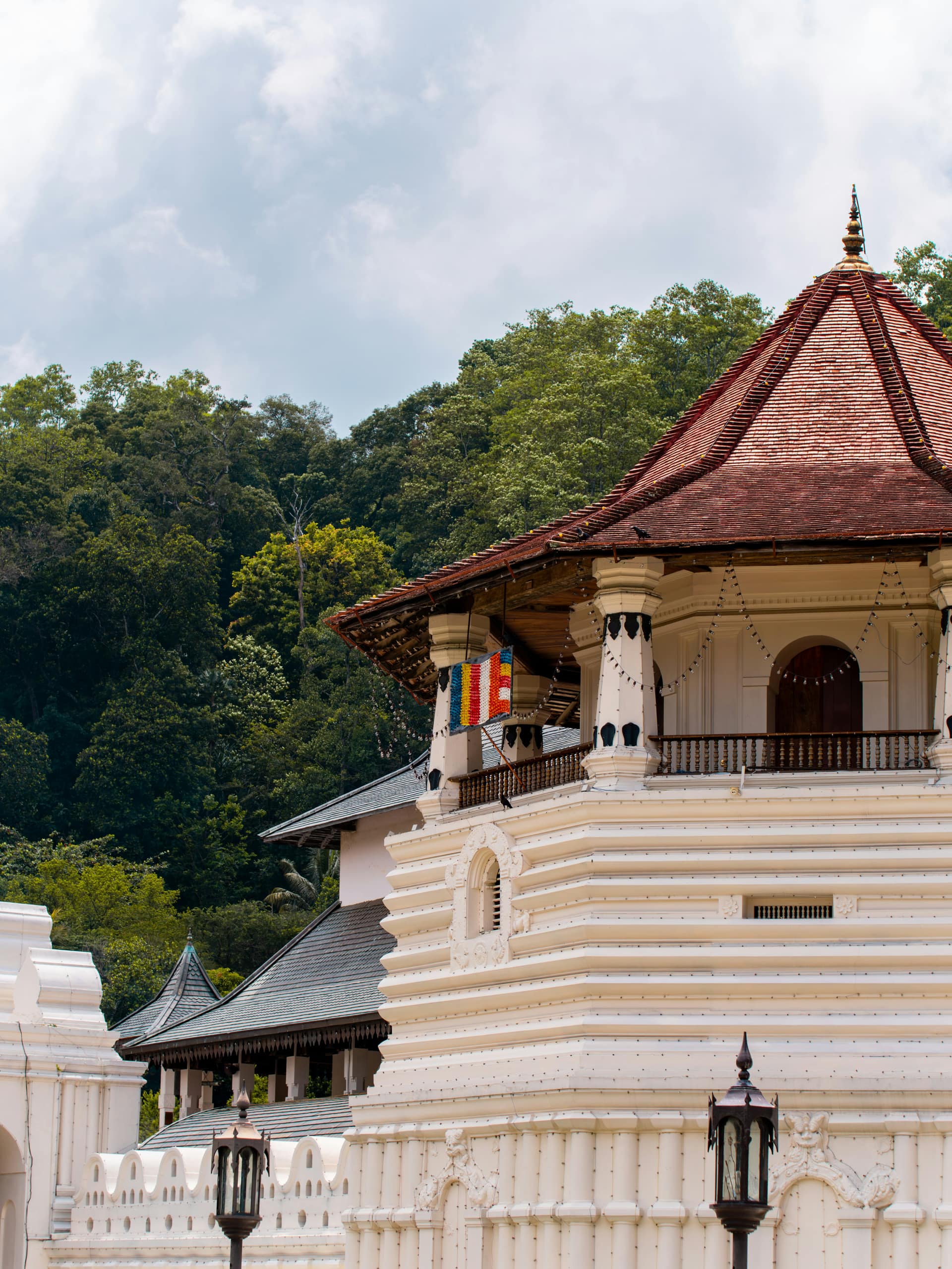
The Temple of the Sacred Tooth Relic is the best wet-weather sight in Kandy. Nearly everything is roofed: the drumming hall, the shrine, the library and the octagon. The International Buddhist Museum behind it and the Raja Tusker hall add an hour under cover.
The National Museum and the Audience Hall extend a rainy visit to Kandy's royal quarter. The museum's single long gallery takes 30 to 45 minutes. The central market, a ten-minute walk away, is also covered and is lively whatever the weather.
- →Temple, drumming hall and shrine: one hour.
- →International Buddhist Museum: 45 minutes.
- →National Museum: 30 to 45 minutes.
- →Central market: 45 minutes.
Activities that do not need sunshine
A cooking class is the ideal rainy-day activity in Kandy. Three to four hours in a family kitchen, grinding spices and stirring curries while rain drums on the roof, ends with the best meal of your stay. Book the day before.
Other activities in Kandy are equally weatherproof. An ayurvedic massage and steam bath fills two hours of a wet afternoon. The Ceylon Tea Museum at Hantana has four floors of exhibits and a tea room, though the view will be lost in cloud. A dance performance at 5 is indoors.
- →Cooking class: three to four hours.
- →Massage or spa treatment: one to two hours.
- →Ceylon Tea Museum: one to one and a half hours.
- →Tea factory visit: one hour, all under cover.
- →Dance performance: one hour.
Outdoor sights in light rain
Some outdoor sights in Kandy survive light rain well. The Royal Botanic Gardens at Peradeniya have huge trees, a covered orchid house and several pavilions, and the lawns are at their greenest in the wet. Take an umbrella and go anyway.
Other outdoor plans in Kandy should be dropped when it rains. Viewpoints such as Arthur's Seat, Bahirawakanda and Ambuluwawa show nothing but cloud. Udawattakele and the Hantana trails become slippery and full of leeches. Lankan Stays & Trails keeps a wet-weather alternative ready for every outdoor day.
- →Still good: botanic gardens, the lake's temple shore, the devales.
- →Not worth it: viewpoints, Ambuluwawa, Hantana, the Knuckles.
- →Take care: stone steps at temples become very slippery.
Re-ordering a wet day
Re-ordering a day is the simplest answer to rain in Kandy. Move everything outdoors to the morning, starting as early as 7.30, and keep museums, classes and treatments for after lunch. Check the sky at breakfast, not the forecast the night before.
A wet day in Kandy can still end at the temple. The evening puja goes ahead in any weather, and the crowd is often thinner. Carry a small bag for wet shoes, since you will leave them at the counter and collect them damp.
- →7.30: botanic gardens or the lake while it is dry.
- →11.00: market and museums.
- →2.00: cooking class or spa.
- →5.00: dance performance.
- →6.30: evening puja.
What to bring
Packing for rain in Kandy is light work. A compact umbrella is more useful than a heavy raincoat in warm, humid air. Sandals that can get wet are practical in town, with closed shoes for anything on a trail.
A few small items make wet days in Kandy easier. Bring a dry bag or zip-lock pouch for your phone and passport, a spare pair of socks for the temple and a light layer, since air-conditioned rooms feel cold when you are damp.
Frequently asked questions
Does it rain a lot in Kandy?
Kandy is in Sri Lanka's wet zone and receives roughly 1,800 to 2,000 millimetres of rain a year. Rain falls on about 150 days, mostly as afternoon showers. Entire days of continuous rain are uncommon outside October and November.
What can you do in Kandy when it rains?
When it rains in Kandy, visit the Temple of the Sacred Tooth Relic and its museums, the National Museum, the Ceylon Tea Museum or a tea factory, take a cooking class, book a massage, browse the covered market and see a dance performance in the evening.
Which month has the most rain in Kandy?
October and November are the rainiest months in Kandy, during the second inter-monsoon period and the start of the north-east monsoon. April and May also bring heavy afternoon thunderstorms. January, February and March are the driest months.
Is the Temple of the Tooth open when it rains?
The Temple of the Sacred Tooth Relic is open in all weather and holds its three daily pujas regardless of rain. Most of the complex is under cover. The courtyards and steps become slippery, so walk carefully in bare feet or socks.
Can I visit the botanic gardens in the rain?
The Royal Botanic Gardens at Peradeniya can be visited in light rain with an umbrella. Large trees give shelter, and the orchid house and pavilions are covered. In a heavy thunderstorm, wait it out, since lightning and falling branches are a risk.
Should I avoid Kandy in the monsoon?
There is no need to avoid Kandy in the monsoon. Rain is usually limited to part of the day, the main sights are indoors or sheltered, and hotel prices are lower. Plan outdoor activities for the morning and keep the afternoon flexible.