
Quick answer
The International Buddhist Museum in Kandy, also called the World Buddhist Museum, is a two-storey museum directly behind the Temple of the Sacred Tooth Relic. Opened in 2011 in a nineteenth-century British court building, it has galleries contributed by more than a dozen Asian countries, each showing how Buddhism developed there. Entry is usually covered by the temple ticket. Allow 45 minutes to an hour, visit after the shrine, and expect cool, quiet rooms with replicas and photographs alongside original objects.
Key takeaways
- The International Buddhist Museum in Kandy opened in 2011 and describes itself as the first museum devoted to Buddhism across the world.
- Galleries in the museum come from more than a dozen countries, including India, Nepal, Thailand, Myanmar, China, Korea and Japan.
- The museum occupies a British-era court building that stands on part of the old royal palace grounds.
- Entry to the International Buddhist Museum is normally included with the foreign visitor ticket for the Temple of the Sacred Tooth Relic.
- Photography inside the International Buddhist Museum is generally not permitted.
What the International Buddhist Museum is
The International Buddhist Museum in Kandy sets out the spread of Buddhism from the Ganges plain to the rest of Asia. It was created by the temple authorities with help from Buddhist governments and communities abroad, each of which furnished a gallery in its own style.
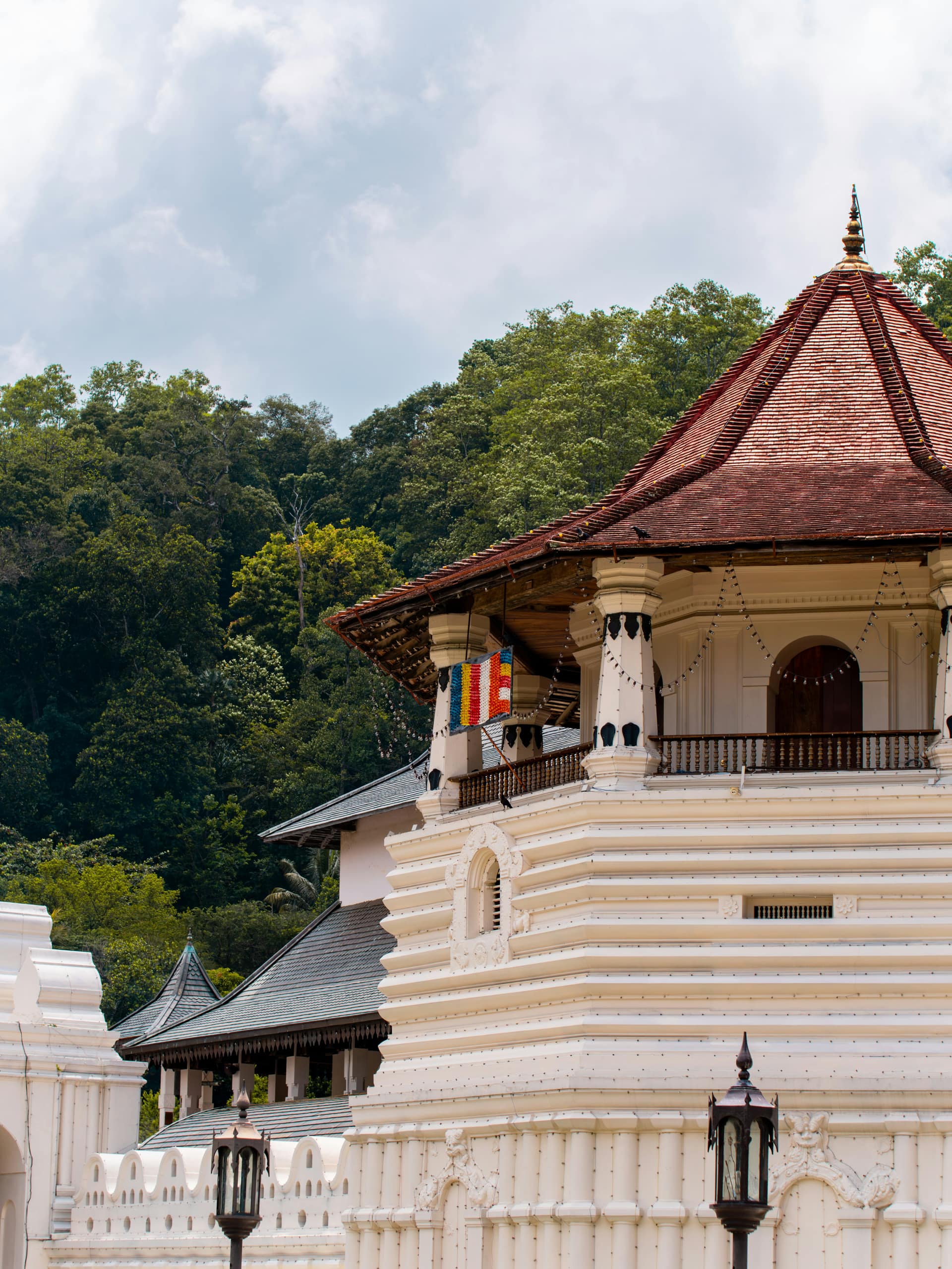
The building of the International Buddhist Museum is part of the story. The Victorian block was put up by the British as law courts on land that had belonged to the palace. Its high ceilings, arched verandas and teak staircases now hold Buddha images from a dozen traditions.
The country galleries
The galleries of the International Buddhist Museum are arranged by country, roughly following the routes by which the teaching travelled. The ground floor begins with India and the life of the Buddha, then moves to Sri Lanka and its neighbours. Upstairs are the galleries of South-East and East Asia.
The quality of the galleries in the International Buddhist Museum varies. Some countries sent fine original sculpture and ritual objects. Others rely on replicas, models and large photographs of famous sites. Read it as an illustrated survey, not a treasure house.
- →India and Nepal: the birth, enlightenment and first sermon sites.
- →Sri Lanka: the arrival of Buddhism in the third century BC and the great dagobas.
- →Myanmar, Thailand, Laos and Cambodia: the Theravada countries and their gilded images.
- →China, Korea and Japan: Mahayana schools, including Zen.
- →Bhutan and the Himalaya: tantric art and painted scrolls.
What is worth slowing down for
The International Buddhist Museum rewards a selective eye. The Gandhara-style images in the Pakistan and Afghanistan sections show the earliest human depictions of the Buddha, with Greek-influenced robes and faces. The scale models of Borobudur and Angkor help if you have not been.
The Sri Lankan gallery of the museum is the most useful for travellers on the island. It explains the differences between Anuradhapura, Polonnaruwa and Kandyan art in a few rooms, which makes later visits to those sites easier to read. The Japanese gallery, spare and carefully lit, is the most elegant.
Tickets, hours and rules
Entry to the International Buddhist Museum is normally included in the foreign visitor ticket for the Temple of the Sacred Tooth Relic, so keep the ticket after you leave the shrine. The museum generally keeps daytime hours and closes before the evening puja. It may shut for religious events.
The rules of the International Buddhist Museum follow those of the temple. Shoes come off at the door, shoulders and knees stay covered, and cameras and phones are put away inside. The stone floors are cool, which is welcome at midday.
- →Where: behind the main shrine, reached through the temple grounds.
- →Time needed: 45 to 60 minutes.
- →Dress: as for the temple; shoes left at the entrance.
- →Good for: a hot or wet hour in the middle of the day.
Who should go and who can skip it
The International Buddhist Museum suits travellers who like context. If you are visiting several Buddhist countries, or want to understand why a Thai Buddha looks unlike a Sri Lankan one, the hour is well spent. Students of religion and art will find it a useful primer.
Visitors with one day in Kandy can leave the International Buddhist Museum out without much loss. The living temple next door, the lake and the botanic gardens deserve the time first. Young children tend to find the galleries dull, and there is little that is interactive.
- →Go if you have two days, an interest in religion, or a rainy afternoon.
- →Skip if you have one day, restless children, or museum fatigue.
- →Shorten to 30 minutes if you only want the Sri Lankan and Japanese rooms.
Combining it with the temple quarter
The International Buddhist Museum fits naturally into a circuit of the temple quarter. Visit the shrine at a puja, then walk through to the museum, the Audience Hall and the Raja Tusker hall. The National Museum and the Garrison Cemetery lie a few minutes further on.
A guided visit makes the International Buddhist Museum more rewarding, since labels are short and of uneven quality. Lankan Stays & Trails uses guides who can explain the Theravada and Mahayana traditions briefly and without jargon, and who know which galleries to pass through quickly.
Frequently asked questions
Is the International Buddhist Museum included in the Temple of the Tooth ticket?
The International Buddhist Museum is normally included in the foreign visitor ticket for the Temple of the Sacred Tooth Relic. Staff at the museum door may ask to see it, so do not throw the ticket away after leaving the shrine. Confirm at the counter, as arrangements can change.
How long does the International Buddhist Museum take?
Most visitors spend 45 minutes to an hour in the International Buddhist Museum. There are two floors and more than a dozen country galleries. If time is short, 30 minutes in the Indian, Sri Lankan and Japanese sections gives a fair impression.
Can you take photos in the World Buddhist Museum in Kandy?
Photography is generally not allowed inside the World Buddhist Museum in Kandy, and bags may be checked at the door. The exterior and the verandas can be photographed freely. The rule is enforced by attendants in each gallery.
Where is the Buddhist museum in Kandy?
The Buddhist museum in Kandy stands immediately behind the Temple of the Sacred Tooth Relic, within the same security perimeter. After visiting the shrine, follow signs to the rear of the complex. It cannot be entered directly from the street without passing the temple checkpoint.
Is the International Buddhist Museum worth visiting?
The International Buddhist Museum is worth visiting if you have more than one day in Kandy or a real interest in Buddhist history and art. It is not essential. Many exhibits are replicas, and the experience is informative more than spectacular.
Is the Buddhist museum in Kandy suitable for children?
Older children with an interest in history may enjoy the models of temples and the variety of Buddha images. Younger children usually find the museum slow, since there is nothing to touch and silence is expected. Half an hour is a sensible limit for families.