
Quick answer
The culture, wildlife and beach route has three safaris. Day 3: an afternoon at Minneriya, Kaudulla or Hurulu, where herds of wild elephants graze around ancient reservoirs. Day 8: dawn at Udawalawe, the most reliable park for elephants at close range, with excellent birds. Day 9: a full day around Yala, the best-known park for leopards, with sloth bears, crocodiles and great variety. Whale watching off Mirissa on day 13 adds a marine safari.
Key takeaways
- Each safari visits a different kind of park: reservoir grassland, open savannah-like plains and dry scrub with coast.
- The Cultural Triangle parks are best for large herds; Udawalawe for close encounters; Yala for leopards and variety.
- Jeep drivers choose between Minneriya, Kaudulla and Hurulu on the day, according to where the elephants are.
- Yala gets a full day on this route, roughly doubling the chance of a leopard compared with one drive.
- Every safari on the route is observation-only, with no feeding, riding or off-track driving.
Why three safaris
Many two-week routes include one safari, usually a single afternoon in Yala. The culture, wildlife and beach route includes three, because each park shows something the others do not. The Cultural Triangle parks show elephants in large social herds, Udawalawe shows them close up in open country, and Yala adds leopards, bears and a much wider range of animals.
The safaris are also spread across the trip. The first breaks up the culture week, the second and third form the wildlife core in the south, and whale watching extends the theme to the sea. That rhythm keeps wildlife present through most of the fortnight without making it repetitive.
Three safaris sounds like a lot of early mornings, but only the Udawalawe and Yala drives start at dawn. The day 3 safari is in the afternoon, after the Sigiriya climb and a midday rest.
- →Day 3: afternoon, Cultural Triangle.
- →Day 8: dawn, Udawalawe.
- →Day 9: dawn and afternoon, Yala or Bundala.
- →Day 13: morning at sea, whales.
Day 3: the Cultural Triangle elephants
Minneriya, Kaudulla and Hurulu Eco Park all surround ancient reservoirs built by the kings of the dry zone. As the water recedes in the dry season, fresh grass grows on the exposed beds and elephants gather to graze, sometimes in herds of dozens. The scene, with the forest behind and the elephants spread across the grass, is one of the great sights of Asia.
The herds move between the three parks through the year, so local jeep drivers choose the park on the day. From roughly July to September Minneriya hosts the Gathering, the largest concentration; in the route's December to April window, Kaudulla or Hurulu are often better. The safari lasts around three hours in the late afternoon.
- →Herds of dozens around ancient reservoirs.
- →Park chosen on the day.
- →Gathering at Minneriya, roughly July to September.
- →Late afternoon, around three hours.
Day 8: Udawalawe at dawn
Udawalawe National Park surrounds a large reservoir, with grassland and scrub that make animals easy to see. It is widely considered the most reliable park in Sri Lanka, and one of the best in Asia, for seeing wild elephants. Family groups and solitary bulls often graze close to the tracks, allowing close, unhurried viewing.
The park is also excellent for birds, especially raptors such as crested serpent eagles, and for water buffalo, spotted deer, crocodiles and jackals. Leopards are present but rarely seen. The dawn drive, roughly three to four hours, is the best time, with cool air and soft light.
The Elephant Transit Home on the park boundary, where orphaned calves are raised for release, makes a fitting addition.
- →Elephants at close range, almost guaranteed.
- →Raptors, buffalo, deer and crocodiles.
- →Dawn drive, three to four hours.
Day 9: a full day around Yala
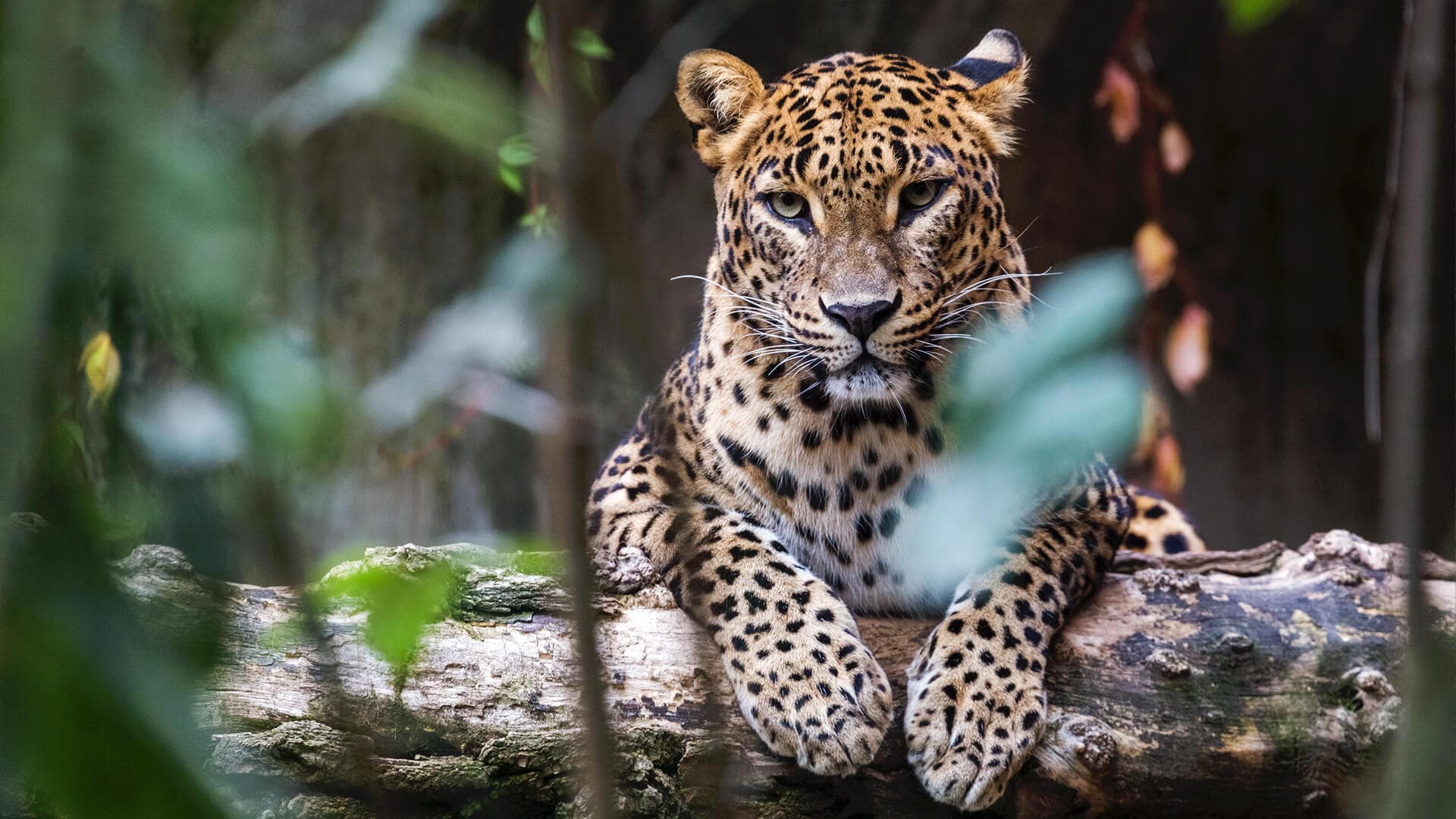
Yala National Park, in the south-east, has a mix of scrub, lagoons, rock outcrops and coastline, and one of the highest densities of leopards in the world. It is also home to sloth bears, elephants, crocodiles, wild boar, spotted deer and a remarkable range of birds. No other park on the route offers as much variety.
Yala is also the busiest park, especially in Block 1. The route gives it a full day, with a dawn drive and either a second drive or Bundala's wetlands in the afternoon. That roughly doubles the chances of a leopard compared with a single drive, and allows a quieter block for one of the sessions.
- →Leopards, sloth bears, elephants and crocodiles.
- →Lagoons, rocks and coast.
- →Block 1 busy; quieter blocks available.
The three compared
For elephants, Udawalawe is the most reliable and gives the closest views, while the Cultural Triangle parks show the biggest herds. For leopards, Yala is far ahead. For birds, all three are good, with Bundala as an excellent bonus near Yala. For a sense of wilderness, the Cultural Triangle parks and Yala's quieter blocks feel wildest.
Crowds vary. The Cultural Triangle parks can be busy at peak times, Udawalawe is usually manageable and Yala's Block 1 is the busiest of all. Lankan Stays & Trails books careful drivers who keep their distance and avoid racing between sightings, which makes a real difference in the busier parks.
Costs are broadly similar per safari, made up of jeep hire, park entry and service charges.
- →Biggest herds: Cultural Triangle.
- →Closest elephants: Udawalawe.
- →Leopards and variety: Yala.
- →Birds: all three, plus Bundala.
Tips for all three
Wear neutral colours, a hat and sunscreen, and bring a light layer for early mornings in an open jeep. Binoculars make a huge difference, and a camera with a zoom lens is useful. Bring water and a small snack, and use the toilet before entering the park.
Keep voices low, never feed animals and ask your driver to switch off the engine when stopped. Patience matters: some of the best sightings come after long, quiet waits.
- →Neutral clothing and a light layer.
- →Binoculars and a zoom lens.
- →Quiet voices, no feeding.
Frequently asked questions
Why does the route include three safaris?
Each park shows something different. The Cultural Triangle parks have large elephant herds around reservoirs, Udawalawe has the closest and most reliable elephant viewing, and Yala has leopards, sloth bears and the greatest variety. Together they give a much fuller picture than any single park.
Which is the best safari on the route?
It depends on what you want. Yala is best for leopards and variety, Udawalawe for close elephant encounters and the Cultural Triangle parks for big herds. Most travellers find the combination more rewarding than any single park.
Are three safaris too many?
Not for most travellers, because each is different and they are spread out. Only two start at dawn. Families with young children may prefer to shorten the Yala day to one drive and spend the afternoon at the pool.
Can I skip one of the safaris?
Yes. Udawalawe is the easiest to drop, because the Cultural Triangle and Yala both have elephants. Dropping it allows a different route south, or an extra night elsewhere. Yala is the one to keep if leopards matter.
Which park is best for leopards?
Yala, by a wide margin, especially Block 1 on a dawn drive. Wilpattu is also good and much quieter, and appears in the route's May to September version. Udawalawe and the Cultural Triangle parks have leopards but they are rarely seen.
How long is each safari?
The Cultural Triangle safari is around three hours in the late afternoon. Udawalawe's dawn drive is three to four hours. The Yala day includes a dawn drive of four to five hours and an optional afternoon drive of around three hours.
Do I need to book safaris in advance?
In peak season, booking Yala and whale watching a few weeks ahead is wise. Udawalawe and the Cultural Triangle safaris are usually easier, and the Cultural Triangle park is chosen on the day. A tour company or hotel can arrange all three.