
Quick answer
Trincomalee belongs on a 2-week Sri Lanka trip from roughly May to September, when it replaces the south coast as the beach stop, and in April, when both coasts fit. It needs three nights in summer, or two in April, at Nilaveli or Uppuveli, roughly two to three hours from Sigiriya. From November to February the north-east monsoon makes it wet and rough, and the standard route to Mirissa is the better choice.
Key takeaways
- Trincomalee's beach season runs roughly from May to September, with April and October as shoulder months.
- Trincomalee is roughly two to three hours from Sigiriya and roughly four to four and a half hours from Kandy.
- Nilaveli, roughly 15 km north of the town, is the quieter beach and the departure point for Pigeon Island.
- Uppuveli, roughly 5 km north of the town, is livelier, with more restaurants within walking distance.
- Koneswaram Temple stands on Swami Rock, a cliff inside the old Fort Frederick.
When Trincomalee belongs on a 2-week trip
Trincomalee belongs on a 2-week Sri Lanka trip whenever the east coast is in season. Sri Lanka's two monsoons work in opposition, so there is always a good coast, and from roughly May to September it is this one.
- →May to September: yes; Trincomalee replaces Mirissa and Galle as the beach stop.
- →April: yes, for two nights, alongside the south coast.
- →March and October: possible, with flexible bookings.
- →November to February: no; expect rain, rough seas and closed hotels.
How many nights, and what Trincomalee replaces
Trincomalee needs three nights in summer to justify the drive: one beach day, one day for Pigeon Island and one for the town. In the east-coast version of the fortnight, those nights come from the south coast, which is in the monsoon anyway.
In April, the both-coasts version takes two nights for Trincomalee by giving up the Nuwara Eliya night and one Kandy night. That exchange is fair in April, when Nuwara Eliya is crowded and expensive.
- →Summer: Sigiriya 3, Trincomalee 3, Kandy 2, Nuwara Eliya 1, Ella 2, Udawalawe 1, Negombo 1.
- →April: Sigiriya 3, Trincomalee 2, Kandy 1, Ella 2, Yala 1, Mirissa 3, Galle Fort 1.
- →Either way, Polonnaruwa and the elephant safari stay within the three Sigiriya nights.
Where Trincomalee slots into the route
Trincomalee slots in directly after Sigiriya. The road east via Habarana takes roughly two to three hours, and the Cultural Triangle days are best done first, while energy is high. The beach then comes as a rest in the middle of the trip.
The onward leg is the long one. Trincomalee to Kandy takes roughly four to four and a half hours, passing back through Habarana and Dambulla, so the Dambulla Cave Temple can be visited on the way. Leave by 8am to reach it before the midday heat.
Nilaveli or Uppuveli
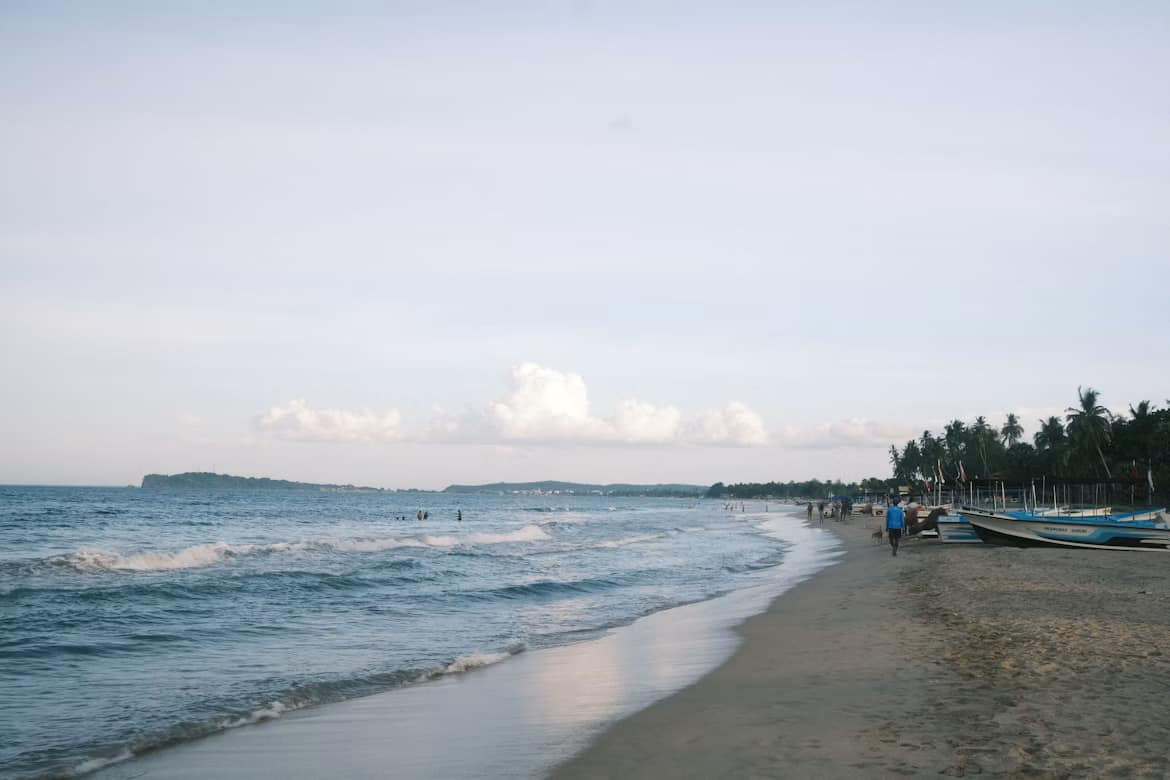
The beaches north of Trincomalee are the reason to come, and the two main ones differ. Nilaveli is long, wide and quiet, with hotels spaced well apart and boats to Pigeon Island leaving from its sand. Uppuveli is closer to town, more compact and more sociable.
Choose Nilaveli for space, snorkelling and a hotel you will not leave much. Choose Uppuveli to walk to a choice of beach restaurants and to reach the town's sights in ten minutes by tuk-tuk.
What to do in three days
Three days in Trincomalee divide naturally between sea, island and town. Mornings are for the water, since the wind tends to rise in the afternoon.
- →Pigeon Island National Park: snorkelling over coral with reef sharks and turtles; go early on a weekday.
- →Koneswaram Temple: a Hindu temple on Swami Rock, with a sheer drop to the sea; best near sunset.
- →Fort Frederick: the old Portuguese and Dutch fort, where spotted deer wander the lawns.
- →Whale and dolphin watching: boats go out between roughly May and September; sightings are less predictable than off Mirissa.
- →Kanniya hot springs: seven small wells with a long local tradition, roughly 20 minutes inland.
- →Marble Beach: a sheltered cove south of the harbour, good for a calm swim.
Who should add Trincomalee, and planning the stop
Trincomalee suits summer travellers, families who want calm water, snorkellers and anyone returning to Sri Lanka. Choose Pasikudah instead for the shallowest bay and larger resorts, or Arugam Bay for surf. Skip the east altogether in the northern winter.
Beach hotels at Nilaveli fill early for July and August. Lankan Stays & Trails can arrange the east-coast route with reputable boat operators for Pigeon Island. The east-coast version of the 14-day itinerary gives the full day-by-day plan.
Frequently asked questions
Is Trincomalee worth visiting on a two-week Sri Lanka trip?
Yes, between roughly May and September, when it has the best beach weather in Sri Lanka, and in April alongside the south coast. From November to February it is wet and rough, and not worth the detour.
How many days do I need in Trincomalee?
Three nights is ideal in summer, giving a beach day, a morning at Pigeon Island and time for Koneswaram Temple and Fort Frederick. Two nights are enough in April, when the stop is shared with a south-coast stay.
How far is Trincomalee from Sigiriya?
Trincomalee is roughly two to three hours from Sigiriya by road, via Habarana. The beaches at Uppuveli and Nilaveli lie a further 10 to 25 minutes north of the town. The road is good by Sri Lankan standards.
Is Nilaveli or Uppuveli better?
Nilaveli is quieter and wider, with boats to Pigeon Island, and suits travellers who want space. Uppuveli is closer to Trincomalee town and has more restaurants and guesthouses within walking distance. Both have calm, clear water in season.
Can I visit Trincomalee in December or January?
It is not recommended. December and January are the peak of the north-east monsoon on the east coast, with heavy rain, rough seas and many hotels closed or quiet. The south and west coasts are the right choice in those months.
How do I get from Trincomalee to Kandy?
By road, in roughly four to four and a half hours, via Habarana and Dambulla. Most travellers stop at the Dambulla Cave Temple on the way. There is no convenient direct train, so a private car is the practical option.