
Quick answer
Of Sri Lanka's ten best-known places, Sigiriya and Galle most clearly live up to their reputations, and Polonnaruwa quietly exceeds its billing. Nuwara Eliya and Kandy are the two most often oversold, the former by the Little England label and the latter by descriptions of a serene hill capital. Ella and Mirissa are accurately described but considerably busier than most photographs suggest.
Key takeaways
- Sigiriya is the rare headline site that matches its reputation, combining ancient engineering, painting and a summit view.
- Polonnaruwa is the most underrated of the ten, compact and cycleable with the Gal Vihara as a clear highlight.
- Nuwara Eliya is the most oversold, largely because the Little England nickname promises more than the town delivers.
- Kandy disappoints travellers expecting a serene hill capital and rewards those expecting a working city with one exceptional temple.
- Ella and Mirissa are accurately described but far busier than most photographs of them suggest.
The places that live up to it
Sigiriya is the clearest case of a headline site that matches its reputation. A fifth-century citadel on a 200-metre granite monolith, surrounded by water gardens that are themselves a significant piece of ancient hydraulic engineering, with fifth-century frescoes partway up and palace ruins at the summit. Very few sites anywhere compress that much into one climb.
Galle Fort also delivers, with a specific condition attached: it delivers in the evening. A visitor arriving at midday finds a hot, busy walled town and leaves unimpressed. A visitor staying inside the walls and walking the ramparts at sunset finds the place the descriptions are about.
The Kandy to Ella train justifies its reputation as one of the world's great rail journeys, though the journey is longer than most people expect at roughly six to seven hours for the full run. The scenic stretch from Nanu Oya onwards, at roughly two and a half to three hours, is where the reputation comes from.
- →Sigiriya: ancient engineering, frescoes and a summit view in one half-day.
- →Galle Fort: delivers in the evening, not at midday.
- →The hill country train: the Nanu Oya to Ella stretch earns the reputation.
- →All three are accurately described, with conditions about timing.
The one that exceeds its billing
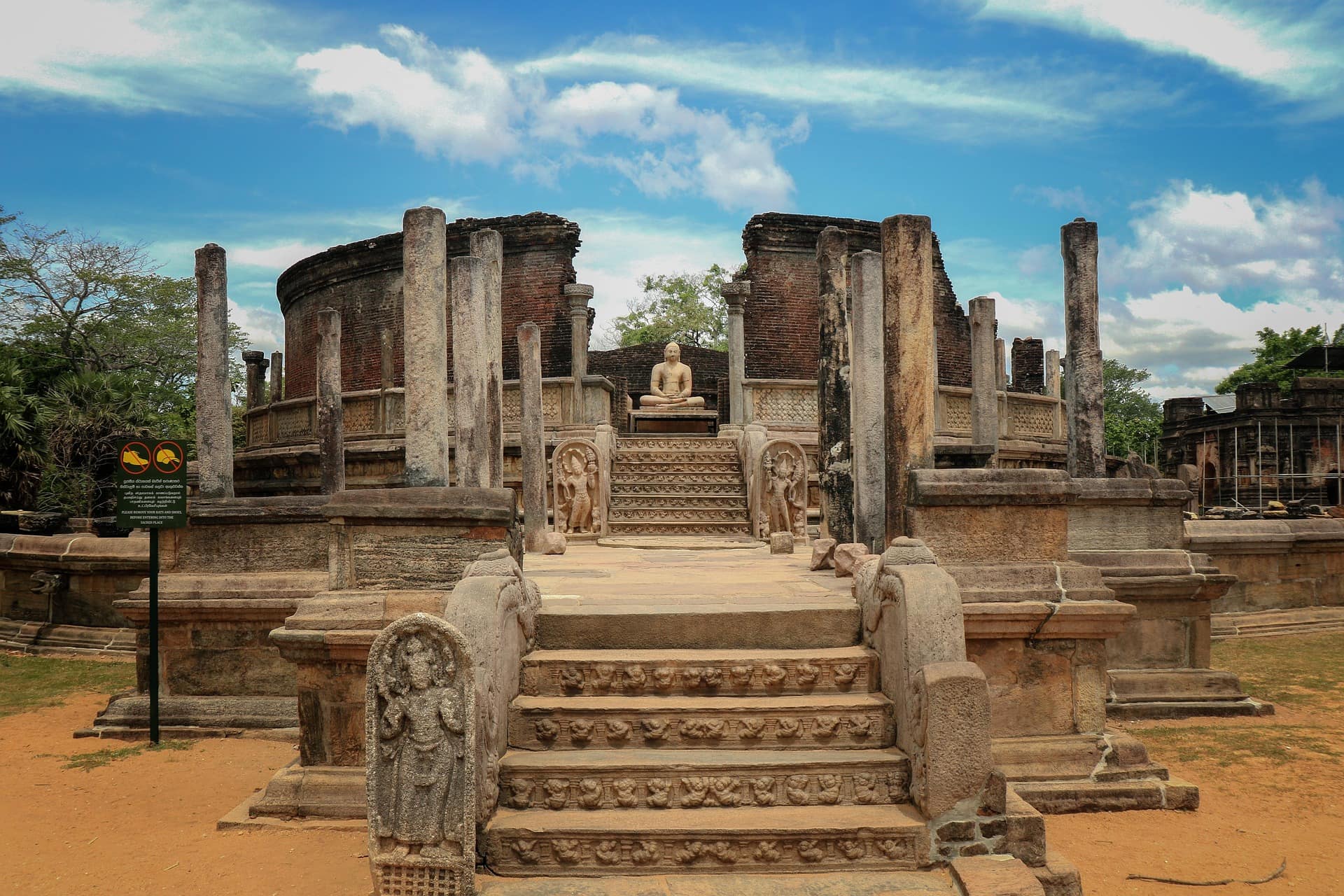
Polonnaruwa is the most underrated of the ten and the one visitors most often mention afterwards as a surprise. It is routinely presented as the second ancient capital, which makes it sound like a lesser version of Anuradhapura, and it is nothing of the sort.
It is the best preserved of the ancient cities, compact enough to cover by bicycle in a morning, with flat shaded routes between monuments. The Gal Vihara, four Buddha figures cut from a single wall of granite including a reclining figure of roughly fourteen metres, is the finest sculpture in Sri Lanka and has no real competition among the other sites.
The bicycles are the other half of it. Covering a ruined city by bike, through woodland with macaques overhead, is a genuinely different experience from walking between car parks, and it is why Polonnaruwa is frequently the favourite Cultural Triangle stop for both children and adults.
- →Presented as the second capital, which undersells it considerably.
- →The best preserved of the ancient cities and cycleable in a morning.
- →The Gal Vihara is the finest sculpture in Sri Lanka.
- →Covering it by bicycle is what makes it memorable.
The two that are oversold
Nuwara Eliya is the most oversold place in Sri Lanka, and the culprit is the Little England nickname. It promises a preserved colonial hill station and delivers a somewhat scruffy provincial town with a racecourse, a boating lake and a scattering of period buildings among ordinary modern ones.
This does not mean skipping it, because what is genuinely worth the visit lies outside the town: the tea estates, the working factories, and Horton Plains. Travellers who understand Nuwara Eliya as a base rather than a destination plan it correctly and are not disappointed.
Kandy is the second. It is frequently described as a serene lakeside hill capital and is a substantial working city with heavy traffic, limited pavement and a busy commercial centre. The Temple of the Sacred Tooth Relic is genuinely exceptional, and everything around it is an ordinary Sri Lankan city.
- →Nuwara Eliya: the Little England label promises far more than the town delivers.
- →Its real value is outside the town, in the estates and at Horton Plains.
- →Kandy: a working city with traffic, not a serene hill capital.
- →In both cases the fix is the expectation, not the itinerary.
Accurate, but busier than the photographs
Ella and Mirissa are both accurately described in what they contain and misleadingly presented in how they feel. The Nine Arch Bridge is exactly as handsome as its photographs; those photographs simply exclude the several hundred people standing out of frame at eleven in the morning.
Mirissa's beach is a genuine crescent between two headlands with good swimming in season, and the central strip behind it is loud into the night in high season, which the photographs also omit. Both are timing and positioning problems rather than misrepresentations.
The practical response for both is the same: arrive at dawn, or position at the quieter ends. Ella shortly after sunrise and Mirissa's eastern end are close to what the photographs suggest, and they are available to anyone willing to set an alarm.
- →The Nine Arch Bridge is as handsome as photographed, minus the crowd out of frame.
- →Mirissa's beach is genuine; its central strip is loud at night in high season.
- →Both are timing problems rather than misrepresentations.
- →Dawn at Ella and the quieter ends at Mirissa match the photographs.
The genuinely divisive ones
Anuradhapura divides visitors more than any other site in Sri Lanka, and the split is predictable. Travellers who come for standing ruins find a sacred landscape of foundations and open ground spread across many kilometres, and are underwhelmed. Travellers who come for living pilgrimage find the most moving site in the country.
Yala divides for a different reason. It has among the highest leopard densities recorded anywhere and among the worst jeep crowding, and which of those a visitor encounters on a given morning largely determines what they say about it afterwards.
In both cases the disagreement is not really about the place. It is about what the visitor came for, which is a useful reminder that hype in travel is usually a mismatch of purpose rather than a false claim.
- →Anuradhapura: underwhelming for ruins, extraordinary for living pilgrimage.
- →Yala: exceptional leopard density and genuinely bad crowding, in the same park.
- →Which one you encounter shapes the whole verdict.
- →Most hype in travel is a mismatch of purpose rather than a false claim.
Planning around the gap
The useful conclusion is that almost none of the ten should be removed on the grounds of being overrated. What changes is how each is scheduled: Galle in the evening, Ella at dawn, Nuwara Eliya as a base rather than a destination, Kandy as one temple rather than a city break.
Lankan Stays and Trails tells clients which places tend to disappoint and why before the trip rather than afterwards, because nearly every complaint we hear about a Sri Lankan site is an expectation problem that could have been solved with one sentence at the planning stage.
Frequently asked questions
Is Sigiriya worth the hype?
Yes, it is the clearest case among Sri Lanka's headline sites of a place matching its reputation. A fifth-century citadel on a 200-metre monolith with ancient water gardens, fifth-century frescoes and summit palace ruins, all within one half-day climb.
What is the most overrated place in Sri Lanka?
Nuwara Eliya, largely because the Little England nickname promises a preserved colonial hill station and the town delivers something considerably more ordinary. Its real value lies outside the town, in the tea estates and at Horton Plains.
What is the most underrated place in Sri Lanka?
Polonnaruwa. It is presented as the second ancient capital, which undersells it, and it is the best preserved of the ancient cities, cycleable in a morning, with the Gal Vihara rock-cut Buddhas as the finest sculpture in the country.
Is Kandy overrated?
It is oversold rather than overrated. Descriptions of a serene lakeside hill capital set up disappointment, since Kandy is a substantial working city with heavy traffic. The Temple of the Sacred Tooth Relic is genuinely exceptional and worth the stop.
Is Ella too crowded to enjoy?
Not at dawn. The Nine Arch Bridge is exactly as handsome as its photographs suggest; those photographs simply exclude the crowd that gathers from mid-morning around each train crossing. Arriving shortly after sunrise gives close to the photographed version.
Why do people disagree so much about Anuradhapura?
Because it rewards a specific interest. Visitors expecting standing ruins find a sacred landscape of foundations spread over many kilometres and are underwhelmed. Visitors coming for living Buddhist pilgrimage, particularly around the Sri Maha Bodhi, often find it the most moving site in Sri Lanka.
Should I skip any of Sri Lanka's famous places?
Rarely on grounds of being overrated. What usually needs changing is the scheduling rather than the list: Galle in the evening, Ella at dawn, Nuwara Eliya treated as a base rather than a destination, and Kandy as one temple rather than a city break.