
Quick answer
Nuwara Eliya is worth it on a first trip to Sri Lanka if tea estates, cool air or Horton Plains are priorities, and skippable otherwise. At roughly 1,900 metres it is the highest town on the standard route, with temperatures that can fall to single figures overnight. The surrounding estate landscape is the draw rather than the town itself. Travellers who want hill country scenery with better walking often prefer Ella, roughly two to three hours further on.
Key takeaways
- Nuwara Eliya sits at roughly 1,900 metres, and overnight temperatures can fall into single figures Celsius.
- The tea estate landscape around the town is the genuine attraction; the town centre itself divides opinion sharply.
- It is the practical base for Horton Plains and the World's End escarpment, which needs a pre-dawn start.
- Ella covers similar hill country ground with better walking and a shorter onward drive to the south coast.
- Nuwara Eliya is the second place most first trips cut when days run short, after one of the ancient capitals.
The verdict on Nuwara Eliya for a first-time visitor
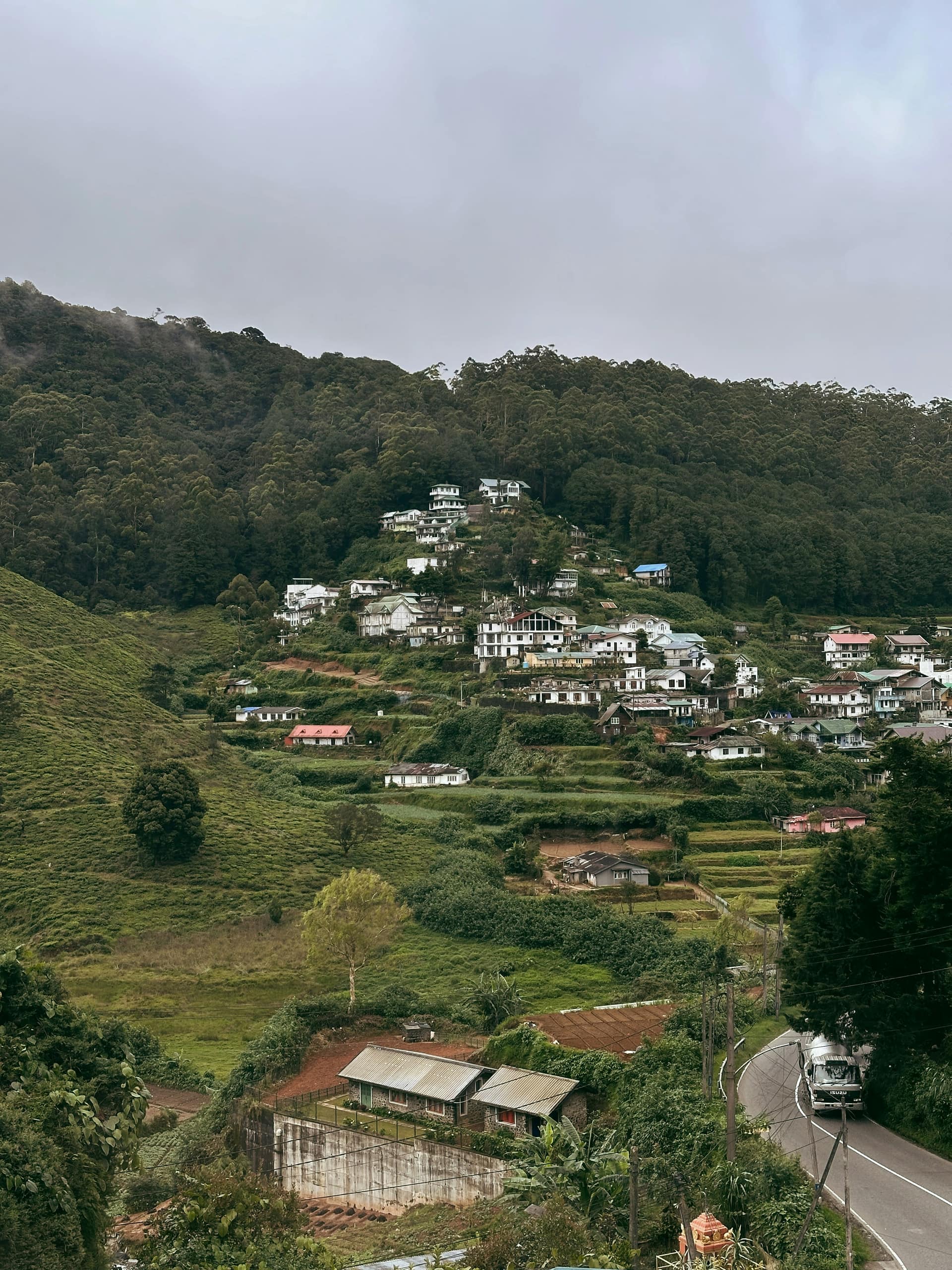
Nuwara Eliya is worth it for travellers who came to Sri Lanka partly for tea, and genuinely optional for everyone else. The landscape of clipped tea bushes running over steep slopes, with pickers working the rows and processing factories in the valleys, is one of the defining images of the country, and Nuwara Eliya sits in the middle of it.
The town is the complication. Nuwara Eliya was developed as a hill station by the British in the nineteenth century, and it retains a scattering of colonial buildings, a racecourse, a golf course and a boating lake. Some travellers find this charming; many find it a slightly scruffy provincial town whose nickname of Little England oversells it considerably.
The honest framing is that Nuwara Eliya is a base rather than a destination. What is worth the visit lies outside it: the estates, the factories, the high moorland of Horton Plains, and the drive or train ride in.
- →The tea estate landscape is the genuine draw, not the town centre.
- →Developed as a British hill station in the nineteenth century, with colonial-era buildings remaining.
- →The Little England nickname oversells the town; treat it as a base rather than a sight.
- →Horton Plains and the estate factories are the reasons to stay nearby.
The cold, which surprises almost everyone
Nuwara Eliya is genuinely cold by the standards of the rest of a Sri Lanka trip, and this catches out a remarkable number of first-time visitors. At roughly 1,900 metres, daytime temperatures are pleasant but overnight lows can fall into single figures Celsius, and the combination of damp air and unheated buildings makes it feel colder still.
Very few hotels in Nuwara Eliya have heating, and the older colonial-era properties in particular can be draughty. Hot water bottles are commonly provided, which tells visitors something about what to expect. A warm layer, long trousers and closed shoes are worth packing for these two nights even on a trip that is otherwise entirely tropical.
The cold matters most at Horton Plains, where the pre-dawn start means standing around in genuinely cold, often wet conditions before sunrise. A fleece or light down layer makes the difference between an enjoyable walk and an endured one.
- →Overnight temperatures can fall into single figures Celsius at roughly 1,900 metres.
- →Most hotels have no heating; hot water bottles are commonly provided.
- →Pack one warm layer, long trousers and closed shoes for this part of the trip.
- →Horton Plains before dawn is the coldest anyone is likely to be in Sri Lanka.
Horton Plains and World's End
Horton Plains National Park is the strongest single argument for basing in Nuwara Eliya. It is a high plateau of grassland and cloud forest at over 2,000 metres, and the circular walking trail of roughly nine to ten kilometres takes in World's End, an escarpment where the land drops away sharply for several hundred metres.
The walk needs an early start, typically leaving Nuwara Eliya well before dawn, because cloud usually fills the valley by mid-morning and the famous view disappears entirely. Travellers who arrive at nine or ten often see nothing but white, which is the most common Horton Plains disappointment.
The trail is not difficult in gradient terms but it is long, exposed and often wet underfoot, and it takes roughly three to four hours at a steady pace. Baker's Falls sits on the same loop. Note that single-use plastics are restricted in the park, so bring a refillable bottle.
- →A circular trail of roughly nine to ten kilometres, taking three to four hours.
- →Leave well before dawn: cloud typically fills the valley by mid-morning and hides the view.
- →Not steep, but long, exposed and frequently wet underfoot.
- →Single-use plastics are restricted in the park; carry a refillable bottle.
Nuwara Eliya or Ella on a first trip
Nuwara Eliya and Ella both sit in the hill country and both offer tea estates, cool air and walking, which is why trips short on days rarely need both. The distinction is one of character rather than scenery.
Nuwara Eliya is higher, colder, more estate-focused and more genuinely remote in feel, with Horton Plains as its headline walk. Ella is lower at roughly 1,000 metres, warmer, considerably more relaxed, with shorter walks such as Little Adam's Peak, the Nine Arch Bridge, and a far shorter onward drive to the south coast.
For most first-time visitors choosing one, Ella is the easier stop and Nuwara Eliya is the more distinctive one. Travellers whose interest is specifically tea should keep Nuwara Eliya; travellers who want hill country as a pleasant interlude between the Cultural Triangle and the beach should keep Ella.
- →Nuwara Eliya: roughly 1,900 metres, colder, estate-focused, Horton Plains on the doorstep.
- →Ella: roughly 1,000 metres, warmer, more relaxed, shorter walks, closer to the coast.
- →Choose Nuwara Eliya if tea estates are a specific reason for the trip.
- →Choose Ella if the hill country is an interlude rather than a destination.
Who should skip Nuwara Eliya
First-time visitors on trips of ten days or fewer that already include Ella can usually skip Nuwara Eliya without losing much. It is the second place we would cut from a ten-place list, after one of the ancient capitals, precisely because Ella covers overlapping ground.
Travellers who feel the cold should think carefully. Two nights in an unheated hotel at 1,900 metres is a genuine adjustment in the middle of a tropical holiday, and it is not what most people picture when they book Sri Lanka.
Anyone whose main interest in the hill country is the train journey should note that the scenic stretch runs from Nanu Oya, the station serving Nuwara Eliya, onwards to Ella. That means the train can be boarded at Nanu Oya without staying in Nuwara Eliya at all, which is a common and sensible compromise.
- →Trips of ten days or fewer that include Ella: Nuwara Eliya is the sensible cut.
- →Travellers sensitive to cold: two unheated nights at altitude is a real consideration.
- →The scenic train can be joined at Nanu Oya without an overnight stay.
Fitting Nuwara Eliya into a first trip
Nuwara Eliya sits naturally between Kandy and Ella, roughly three hours from the former, and is best given two nights if Horton Plains is planned and one if it is not. A single night with a pre-dawn start the following morning is possible but tiring.
A tea estate and factory visit is worth building in deliberately rather than leaving to chance, since the working factories keep their own hours and are generally quieter later in the week. Our Nuwara Eliya tea and World's End article covers the estates and the walk in detail. Lankan Stays and Trails includes Nuwara Eliya on longer first itineraries and skips it on tighter ones, which is the honest approach rather than the one that fills more nights.
Frequently asked questions
Is Nuwara Eliya worth visiting?
It is worth visiting if tea estates, cool air or Horton Plains are priorities for your trip. The estate landscape around the town is the real draw rather than the town centre itself, which many visitors find less charming than its Little England reputation suggests.
How cold does Nuwara Eliya get?
Overnight temperatures can fall into single figures Celsius at roughly 1,900 metres, and damp air makes it feel colder. Very few hotels have heating, and hot water bottles are commonly provided. Pack a warm layer, long trousers and closed shoes for this stretch of the trip.
Should I visit Nuwara Eliya or Ella?
Ella for most first-time visitors, because it is warmer, more relaxed, has shorter walks and sits closer to the south coast. Choose Nuwara Eliya if tea estates are a specific reason for your trip, or if you want to walk Horton Plains and World's End.
How long do you need in Nuwara Eliya?
Two nights if Horton Plains is planned, since the walk requires a start well before dawn. One night is enough for a tea estate and factory visit plus a look around the town. Three nights is rarely justified on a first trip to Sri Lanka.
Is Horton Plains worth the early start?
Yes, provided you actually leave before dawn. Cloud usually fills the valley by mid-morning and hides the World's End view entirely, which is the most common disappointment. The circular trail runs roughly nine to ten kilometres and takes three to four hours.
Can you take the scenic train without staying in Nuwara Eliya?
Yes. The most scenic stretch runs from Nanu Oya, the station serving Nuwara Eliya, onwards to Ella. Travellers can board at Nanu Oya without an overnight stay in the town, which is a common compromise on trips that are short on days.
What is there to do in Nuwara Eliya?
Visit a working tea estate and factory, walk Horton Plains and World's End, and see Gregory Lake and the colonial-era buildings around the town centre. Most of what is worth doing lies in the surrounding estate landscape rather than in the town itself.