
Quick answer
The windiest months in Sri Lanka are roughly June to August, when the southwest monsoon blows strongly and steadily across the island. The strongest winds are on exposed coasts such as Kalpitiya, Mannar and Hambantota, on mountain gaps such as Riverston and the Horton Plains plateau, and on the south and west coasts as onshore wind. A lighter northeast wind blows from about December to February. March, April, October and November are the calmest months.
Key takeaways
- June to August are the windiest months, with the southwest monsoon at full strength.
- The strongest winds are on the northwest and southeast coasts and on exposed mountain gaps.
- A lighter northeast wind blows from about December to February.
- The inter-monsoon months, March to April and October to November, are the calmest.
- Wind decides which beaches are calm: offshore wind flattens the sea, onshore wind roughens it.
When the wind blows
Sri Lanka's wind follows the monsoons. From about late May to September, the southwest monsoon blows steadily from the Indian Ocean, strongest from June to August. It is often 15 to 25 knots on exposed coasts and gaps, and stronger in gusts.
From about December to February, the northeast monsoon blows from the Bay of Bengal, usually lighter, about 10 to 18 knots. The inter-monsoon months of March to April and October to November have light, variable winds, broken only by thunderstorm gusts.
Wind is usually strongest in the afternoon, when the land heats up and adds a sea breeze to the monsoon. Mornings are calmer in every season.
Wind speeds vary with exposure. In sheltered valleys and towns, even the summer monsoon is often only a breeze, while on open coasts and ridges a few kilometres away it can be a gale. Local forecasts for the exact place are more useful than a national summary.
- →Strongest: June to August.
- →Lighter: December to February.
- →Calmest: March to April, October to November.
Where it blows hardest
The windiest places are where the monsoon wind is funnelled or meets flat, open land. The northwest coast around Kalpitiya and Mannar is famously windy in summer, which makes Kalpitiya Sri Lanka's kitesurfing centre. The southeast coast around Hambantota hosts wind farms for the same reason.
In the hills, gaps such as Riverston in the Knuckles range and exposed plateaus such as Horton Plains catch the full force of the summer wind, and walkers can struggle to stand on open ridges. The plains of the Cultural Triangle and the north have a strong, dry summer wind that raises dust.
On the south and west coasts, the summer wind blows onshore, driving the swell. On the east coast, it blows offshore, which is why the east is calm in summer.
- →Kalpitiya and Mannar: kitesurfing wind.
- →Hambantota: wind farms.
- →Riverston and Horton Plains: mountain gales.
What wind does to beaches
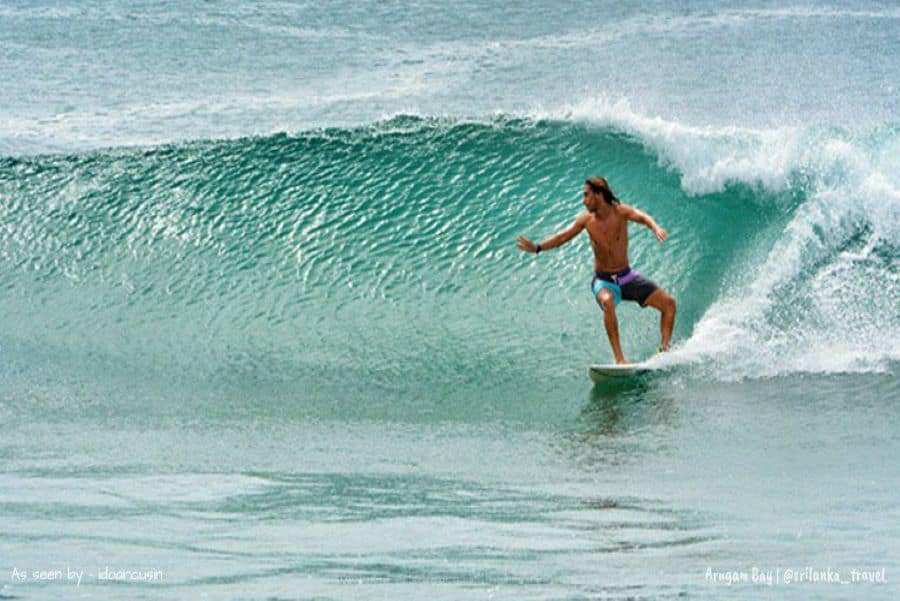
Wind direction is the key to the sea. When it blows onshore, it builds waves and currents and churns up sand, so the water is rough and murky. When it blows offshore, it flattens the sea near the shore and holds up surf waves, which is why Arugam Bay has its best surf in the summer wind.
For beach-goers, the rule is simple: from about June to September, choose the east coast, where the wind is offshore; from about December to April, choose the south and west, where the northeast wind blows off the land.
- →Onshore wind: rough, murky sea.
- →Offshore wind: calm sea, clean surf.
- →Summer: east coast; winter: southwest.
Wind in the hills
In the hills, wind adds chill. Nuwara Eliya and Horton Plains at about 18 °C feel much colder in a 20-knot summer wind with mist. A windproof layer matters more there than heavy warm clothing. Ella and Haputale are more sheltered, though breezy in the afternoon.
Wind can also briefly close viewpoints or slow trains on exposed sections, and it can fell trees onto hill roads during storms.
- →Nuwara Eliya: wind chill in summer.
- →Ella and Haputale: breezy afternoons.
- →Windproof layer essential.
Planning around the wind
Plan beaches on the offshore side for the season, start hill walks early before the afternoon wind, and bring a windproof layer for the hills in summer. Kitesurfers should plan Kalpitiya for June to August, and lighter riders December to March.
Lankan Stays & Trails uses the season's wind direction to choose beaches and plans exposed walks for the calm early mornings.
Frequently asked questions
What are the windiest months in Sri Lanka?
June to August are the windiest months, when the southwest monsoon blows strongly and steadily across the island. A lighter northeast wind blows from about December to February. March to April and October to November, the inter-monsoon months, are the calmest.
Where is the windiest place in Sri Lanka?
The windiest places include the northwest coast around Kalpitiya and Mannar, the southeast coast around Hambantota, and exposed mountain gaps and plateaus such as Riverston in the Knuckles range and Horton Plains. All are strongest from June to August.
Is Sri Lanka windy in July?
Yes. July is one of the windiest months, with the southwest monsoon blowing strongly. The south and west coasts have onshore wind and rough seas, the east coast has offshore wind and calm seas, and Kalpitiya is at its best for kitesurfing.
When is the kitesurfing season in Sri Lanka?
The main season is roughly May to October, with the strongest wind from June to August, centred on Kalpitiya. A lighter season runs roughly December to March. Mannar and some east coast lagoons also have kitesurfing in the summer wind.
Does wind affect beaches in Sri Lanka?
Yes, more than rain does. Onshore wind builds waves and currents and makes the sea rough and murky; offshore wind flattens it. That is why the east coast is calm from June to September and the southwest coast from December to April.
Is the hill country windy?
In summer, yes, especially on exposed areas such as Horton Plains, Nuwara Eliya and Riverston, where the southwest monsoon brings strong wind and mist. Wind chill makes it feel colder than the temperature, so a windproof layer is useful. Ella and Haputale are more sheltered.
How does Lankan Stays & Trails plan around wind?
Beaches are chosen on the side where the wind blows offshore for the season, hill walks are planned for the calmer early mornings, and guests are reminded to bring a windproof layer for the hills in summer. Kitesurfing stays are timed to the wind seasons.
Is Sri Lanka windy in December?
December brings the northeast monsoon, which is usually lighter than the summer wind, about 10 to 18 knots on exposed coasts. It blows onto the east coast, making the sea rough there, and off the land on the south and west coasts, which is why their sea is calm in winter.