
Quick answer
A 2-week Sri Lanka plan for photographers spends three nights at Sigiriya, two in Kandy, one in Nuwara Eliya, two in Ella, two near Yala, one at Mirissa and two inside Galle Fort. It follows the standard route but adds a second Yala night for two dawn drives and a second Galle night for the ramparts at both ends of the day. Every morning starts before sunrise, around 6am, and midday is used for travel and rest.
Key takeaways
- Sunrise and sunset in Sri Lanka fall at roughly 6am and 6pm all year, with only about 40 minutes of low, warm light each time.
- Pidurangala Rock, not Sigiriya itself, gives the classic sunrise view of Sigiriya Rock.
- Photography of the Sigiriya frescoes is not permitted, and flash is banned on temple murals.
- Posing with your back to a Buddha statue is considered disrespectful and can lead to trouble with the authorities.
- Drones need permission from the Civil Aviation Authority of Sri Lanka and are not allowed over national parks or sacred sites without specific approval.
The 2-week plan for photographers at a glance
The 2-week Sri Lanka plan for photographers takes thirteen nights across seven bases. Compared with the standard route, it moves two nights from Mirissa to Yala and Galle Fort, the two places where a second chance at the light pays off most.
- →Sigiriya, three nights: Pidurangala at sunrise, Polonnaruwa, elephants in the afternoon.
- →Kandy, two nights: the lake at dawn, the market, the evening puja.
- →Nuwara Eliya, one night: tea slopes and Horton Plains.
- →Ella, two nights: Nine Arch Bridge and Little Adam's Peak.
- →Tissamaharama, two nights: three drives in Yala.
- →Mirissa, one night: Coconut Tree Hill at dusk.
- →Galle Fort, two nights: ramparts, lighthouse and streets.
The Cultural Triangle and Kandy: where to stand
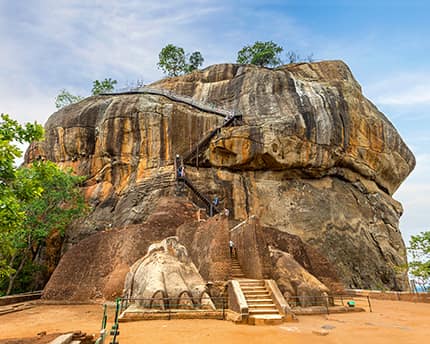
Sigiriya Rock photographs best from outside. Pidurangala, a rougher climb of roughly 30 to 45 minutes with a scramble at the top, faces the rock across the forest and catches the first light. Sigiriya itself is climbed the next morning at opening, for the water gardens before the crowd arrives.
At Polonnaruwa, the Gal Vihara Buddhas sit under a canopy and are evenly lit by mid-morning. Minneriya or Kaudulla in the late afternoon gives elephants in warm, low light with water behind them. In Kandy, the lake is glassy before 7am, and the evening puja at the Temple of the Sacred Tooth Relic is all drums, smoke and lamplight; a fast lens matters more than a flash, which is not allowed.
The hill country: mist, tea and trains
The hill country rewards patience with weather. Mist on the tea slopes around Nuwara Eliya lifts between roughly 7 and 9am, which is also when the pluckers begin work. Ask before photographing people, and expect to be asked for a small tip on estates that see many visitors.
In Ella, the Nine Arch Bridge is best with a train on it, so check the day's timetable at the station; trains often run late. Little Adam's Peak at sunrise looks across to Ella Rock. On the train itself, shoot from a seat by an open window. Leaning out of the doors causes serious injuries every year.
- →Horton Plains: World's End is clearest before roughly 9am.
- →Nine Arch Bridge: morning light falls on the eastern face.
- →Tea factories: interiors are dim; ask whether photography is allowed.
Two nights at Yala for wildlife
Yala National Park is the one stop where photographers should add a night. One afternoon drive on arrival, a dawn drive and a second afternoon drive give three sessions of usable light and a far better chance of a leopard in the open. Sightings are never guaranteed.
A lens reaching 300 to 400 mm is the working length in Yala. Dust is constant in the dry months, so change lenses as little as possible and carry a cloth and a blower. A private jeep allows you to wait at a waterhole instead of following the radio calls.
The south coast and Galle Fort
The south coast offers two contrasting subjects. Coconut Tree Hill at Mirissa is a simple sunset silhouette. The stilt fishermen near Koggala and Ahangama are another matter: most now pose for payment and seldom fish, so treat it as a staged portrait and agree the fee first.
Galle Fort earns its two nights. The ramparts face west for sunset, the lighthouse and Flag Rock catch the dawn, and the streets between them have the texture of four centuries. Early morning is also when the fort belongs to its residents.
Rules, etiquette and gear
Photography rules in Sri Lanka are mostly about respect. Lankan Stays & Trails can brief guests on these before the first temple, because the mistakes are easy to make and taken seriously.
- →Buddha images: never pose with your back to a statue, and never climb on one.
- →Frescoes and murals: no photography of the Sigiriya frescoes; no flash on any painting.
- →People: ask first, especially monks, worshippers and children.
- →Drones: permission from the Civil Aviation Authority is required; do not fly at temples or in parks.
- →Military sites, ports and checkpoints: do not photograph them.
- →Humidity: keep silica gel in the bag, and let cold gear warm up before opening it.
Frequently asked questions
What are the best photography spots in Sri Lanka?
The best-known photography spots are Sigiriya Rock from Pidurangala, the Gal Vihara at Polonnaruwa, the tea slopes around Nuwara Eliya, the Nine Arch Bridge in Ella, Yala National Park for wildlife and the ramparts of Galle Fort. A two-week route passes all of them.
What time is sunrise and sunset in Sri Lanka?
Sunrise is at roughly 6am and sunset at roughly 6pm throughout the year, shifting by only about half an hour between seasons. Twilight is short near the equator, so be in position at least 20 minutes before either.
Can I fly a drone in Sri Lanka?
Only with permission. Drones must be registered and approved by the Civil Aviation Authority of Sri Lanka, and further permits are needed for national parks, archaeological sites and sacred places. Flying without approval risks confiscation and fines. Apply well before travelling.
Can I take photos inside temples in Sri Lanka?
Usually yes, without flash, but rules vary by temple. Never photograph someone posing with their back to a Buddha statue. Photography of the Sigiriya frescoes is not permitted. Ask before photographing monks or worshippers, and follow any signs or instructions from temple staff.
What lens do I need for a Sri Lanka safari?
A zoom reaching 300 to 400 mm suits Yala and Udawalawe. Elephants are often close enough for a shorter lens, but leopards and birds are not. A second body with a wide zoom avoids changing lenses in the dust.
Are the stilt fishermen in Sri Lanka real?
Stilt fishing was a real tradition on the south coast, but most men seen on stilts near Koggala and Ahangama today pose for photographs in return for payment. It is fine to photograph them. Agree the fee beforehand and treat it as a portrait.