
Quick answer
To fit the Kandy Esala Perahera into a 7-day Sri Lanka itinerary, give Kandy two nights timed to the final, largest processions, spend two nights at Sigiriya beforehand, and finish with two nights on the east coast at Trincomalee or Nilaveli, which is dry in July and August while the south coast is in its monsoon. The festival usually falls in July or August but its dates shift each year with the lunar calendar, so confirm them before booking anything.
Key takeaways
- The Kandy Esala Perahera usually takes place in July or August, over roughly ten nights, with dates set by the lunar calendar.
- The final nights, leading up to the Esala full moon, have the largest and most elaborate processions.
- Kandy hotels fill months ahead and prices rise sharply during the festival.
- July and August fall in the south-west monsoon, so the east coast is the better beach choice for a perahera week.
- Reserved seats along the procession route are sold in advance and give a far better view than standing.
What the Kandy Esala Perahera is
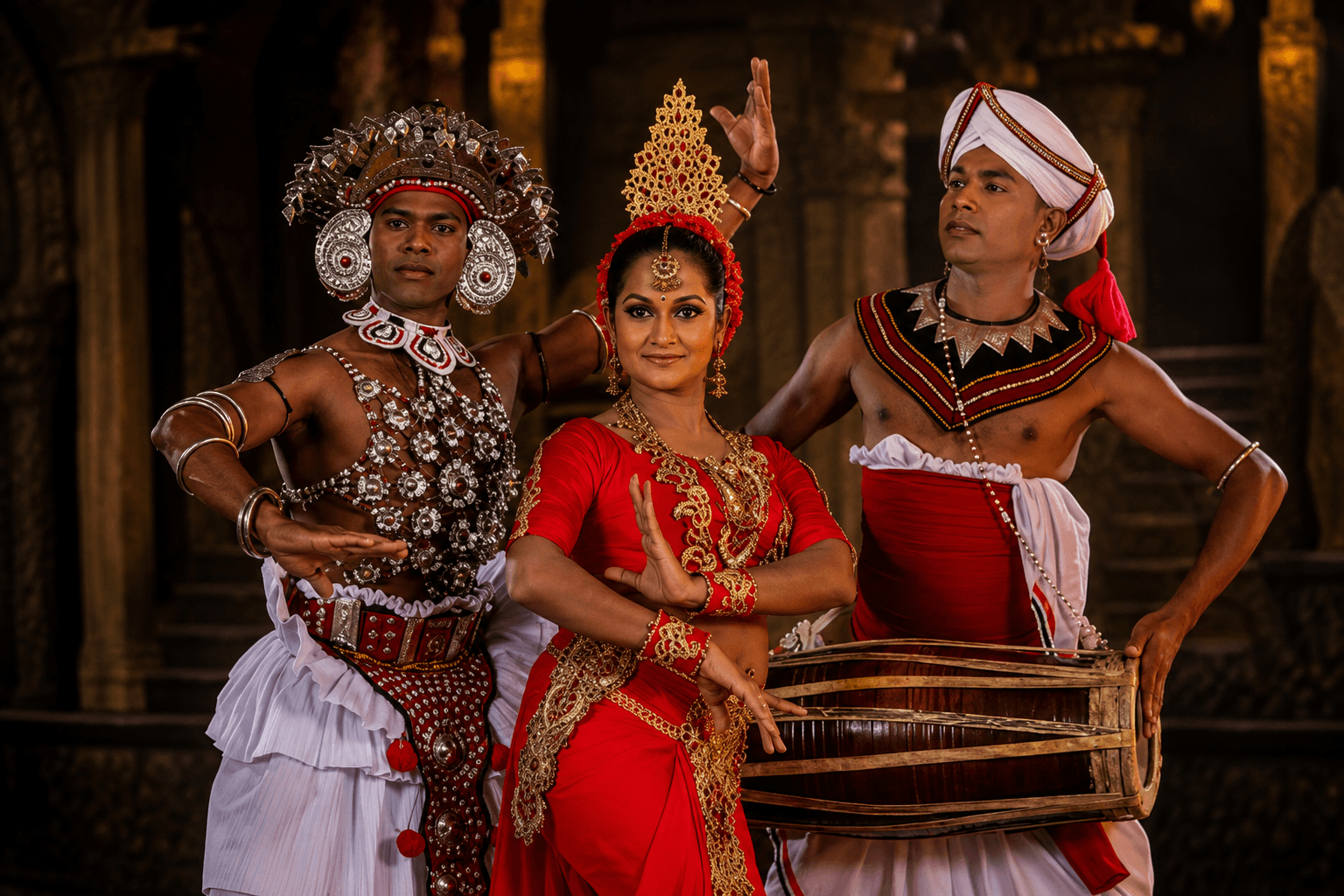
The Kandy Esala Perahera is held each year in the month of Esala, usually July or August, and honours the Sacred Tooth Relic kept at the Temple of the Sacred Tooth Relic in Kandy. Over roughly ten nights, processions of Kandyan dancers, drummers, whip-crackers, fire performers and decorated elephants parade through the streets around the temple and the lake.
The processions grow larger and more elaborate each night, and the final nights, leading up to the Esala full moon, are the grandest. On the last of these, a large tusker carries a replica casket of the relic, and the crowds are at their largest. A daytime procession usually follows the final night.
The dates are set by the lunar calendar and shift each year. They are usually announced some months ahead, and confirming them is the first step in planning a perahera week.
- →Usually July or August; dates shift each year with the lunar calendar.
- →Roughly ten nights of processions, growing in scale.
- →The final nights before the Esala full moon are the grandest.
The perahera week, day by day
A perahera week reorganises the classic 7-day route around two nights in Kandy, timed to the final processions. Because July and August fall in the south-west monsoon, the coast moves from the south to the east, following the logic of the May to September version.
The result is a three-base week: Sigiriya, Kandy and Trincomalee, with two nights in each. The order can be adjusted so that the Kandy nights fall on the right dates.
- →Day 1: Airport to Sigiriya, roughly four to five hours.
- →Day 2: Sigiriya Rock at opening; Dambulla Cave Temple or a Minneriya safari, where the elephant gathering is often strong in these months.
- →Day 3: Sigiriya to Kandy, roughly two and a half to three hours; the evening procession.
- →Day 4: Kandy by day: the Temple of the Sacred Tooth Relic, Peradeniya gardens; a second procession at night.
- →Day 5: Kandy to Trincomalee or Nilaveli, roughly four to five hours.
- →Day 6: East coast: Pigeon Island snorkelling or a whale and dolphin trip.
- →Day 7: Trincomalee to the airport, roughly five to six hours, or via Sigiriya.
Choosing which perahera nights to see
The final two or three nights of the perahera are the most spectacular, and the most crowded. Seeing one of them is the priority; a second, earlier night is a worthwhile addition and usually less crowded.
If the dates allow only one night, choose one of the final nights and plan the rest of the week around it. If you have two Kandy nights, the two final processions together make an extraordinary experience, though crowds and prices are at their peak.
Processions typically begin in the evening and last several hours. They start from the temple area and move along a fixed route through the city centre, so hotels within walking distance make the evenings much easier.
- →Priority: one of the final nights before the full moon.
- →Bonus: an earlier night, less crowded and still impressive.
- →Stay within walking distance of the procession route if possible.
Seats, crowds and bookings
Reserved seats along the procession route are sold in advance, often in buildings, stands or balconies overlooking the street, and they give a far better view than standing in the crowds. Prices vary widely with location and night. Book through a reputable source and confirm exactly where the seats are.
Kandy hotels fill months ahead for the perahera and prices rise sharply, especially for the final nights. Booking the hotel as soon as the dates are confirmed is essential; waiting often means staying outside the city and travelling in each evening through heavy traffic.
Standing is free, but it means arriving hours early to secure a place, long waits in the crowd, and limited visibility. For a first perahera, a reserved seat is well worth the cost.
Why the coast moves east
July and August are in the south-west monsoon, which brings rain and rough seas to the south and west coasts, including Mirissa and Galle. The east coast around Trincomalee and Nilaveli, by contrast, is typically dry and calm, and whale and dolphin trips run from Trincomalee.
Trincomalee is roughly four to five hours from Kandy, which makes a straightforward transfer after the final perahera night. Pasikudah, further south on the east coast, is an alternative with a shallow, sheltered bay well suited to families.
Etiquette and ethics at the perahera
The perahera is a sacred religious event, not a show. Dress modestly, cover shoulders and knees, and stand or sit respectfully when the casket passes. Flash photography of the elephants and performers is discouraged.
The use of elephants in the perahera is a long tradition and also the subject of genuine welfare debate, with concerns raised about some animals' treatment. Visitors can attend respectfully while being aware of this, and should avoid any associated attraction offering elephant rides or close contact.
- →Dress modestly and respect the religious nature of the event.
- →Avoid flash photography of elephants and performers.
- →Be aware of welfare concerns, and avoid elephant rides elsewhere.
Planning a perahera week
The order of planning is fixed: confirm the festival dates, book the Kandy hotel for the chosen nights, secure procession seats, and then build the rest of the week around them. Flights come after the Kandy hotel, not before.
Lankan Stays & Trails runs a dedicated Kandy Esala Perahera and Cultural Treasures tour over eight days, with procession seating arranged, and adapts seven-day routes around the festival dates for guests who prefer a shorter trip.
Frequently asked questions
When is the Kandy Esala Perahera?
Usually in July or August, over roughly ten nights ending on the Esala full moon. The exact dates are set by the lunar calendar and shift each year, so confirm them before booking. They are usually announced some months ahead.
Which night of the Kandy perahera is best?
The final nights before the Esala full moon have the largest, most elaborate processions and the biggest crowds. An earlier night is less crowded and still impressive. Seeing one of the final nights is the priority for a first visit.
How many nights should I spend in Kandy for the perahera?
Two nights is ideal on a 7-day trip, timed to the final processions. That allows one or two procession nights and a day for the Temple of the Sacred Tooth Relic and the Peradeniya gardens. Book early, since Kandy hotels fill months ahead.
Do I need tickets for the Kandy perahera?
Standing along the route is free, but reserved seats in stands or balconies are sold in advance and give a much better view. Prices vary with location and night. For a first perahera, a reserved seat is well worth the cost.
Which beach should I visit during the perahera season?
The east coast, around Trincomalee, Nilaveli or Pasikudah. July and August fall in the south-west monsoon, when the south and west coasts are rougher and wetter, while the east coast is typically dry and calm.
Is the Kandy perahera crowded?
Very. The final nights draw very large crowds, and standing places along the route fill hours in advance. Reserved seats, a hotel within walking distance and patience make the evening much more enjoyable.